
Most “sales” you scroll past in India are not sales. They are a calendar.
Brands do not wake up one morning and decide to be generous. Every markdown is planned months in advance, tied to inventory cycles, festive demand, fiscal year deadlines, and the GMV pressure marketplaces put on themselves. Once you understand the calendar, you stop overpaying.
This guide maps out that calendar. It tells you which months actually move the needle, which “sales” are mostly noise, what categories go deepest in each window, and how to time your wishlist so you never pay the inflated MRP again.
A short note before we start. Discount depths shift slightly year to year. Brands occasionally pull surprise sales. Marketplace strategy changes. The structure, however, holds. The structure is the whole point.
How Fashion Sales Actually Work in India
Before the calendar, understand what you are actually looking at when a brand says “70% off.”
The MRP problem
Indian fashion runs on MRP. The number printed on the tag is the maximum legally allowed retail price, not the price the brand expects to sell at. For most fashion categories, MRPs are inflated 2x to 3x above the price brands actually need to hit their margin.
This means a “60% off” sticker often brings a product down to its real intended price, not below it. The discount is real on paper. The bargain is shallower than it looks.
Once you accept this, the question changes. Stop asking “how much off?” Start asking “what is the actual rupee price, and is this the lowest it has been in 90 days?”
Three types of sale, three different reasons
Not every sale means the same thing. Three categories cover almost everything you will see in India:
End of Season Sales (EOSS). These are clearance events. Brands need to push out the previous season’s stock before the next one lands. Discounts are real and deep, usually 40 to 70 percent, sometimes more on residual sizes. Twice a year: January and July.
Festive sales. Big Billion Days, Great Indian Festival, Diwali sales. These are demand-driven. Brands are not desperate to clear stock. They are competing for share of wallet during peak shopping intent. Discounts are headline-friendly but usually shallower per item than EOSS. Volume matters more than depth.
Flash and event sales. Republic Day, Independence Day, Valentine’s Day, brand birthdays, payday sales. Mostly traffic events. Some genuine deals exist, but discounts tend to hover in the 20 to 40 percent range.
If you can identify which type of sale you are looking at, you can predict whether it is worth buying now or waiting.
The three pressures behind every markdown
Brands discount when one of three things is happening:
- Inventory is sitting too long. Fashion has a 90 to 120 day window before warehousing costs and seasonality kill margins. Old stock has to move.
- Cash flow is tight. Indian fashion brands run on working capital. End of quarter and end of fiscal year (31 March) create real pressure to liquidate.
- Demand windows are open. Festivals, wedding season, school reopening, weather shifts. Brands chase intent.
Every genuine sale in this calendar maps to at least one of those three pressures. Once you see it, you can predict the depth.
January: The Real End Of Season Sale Window
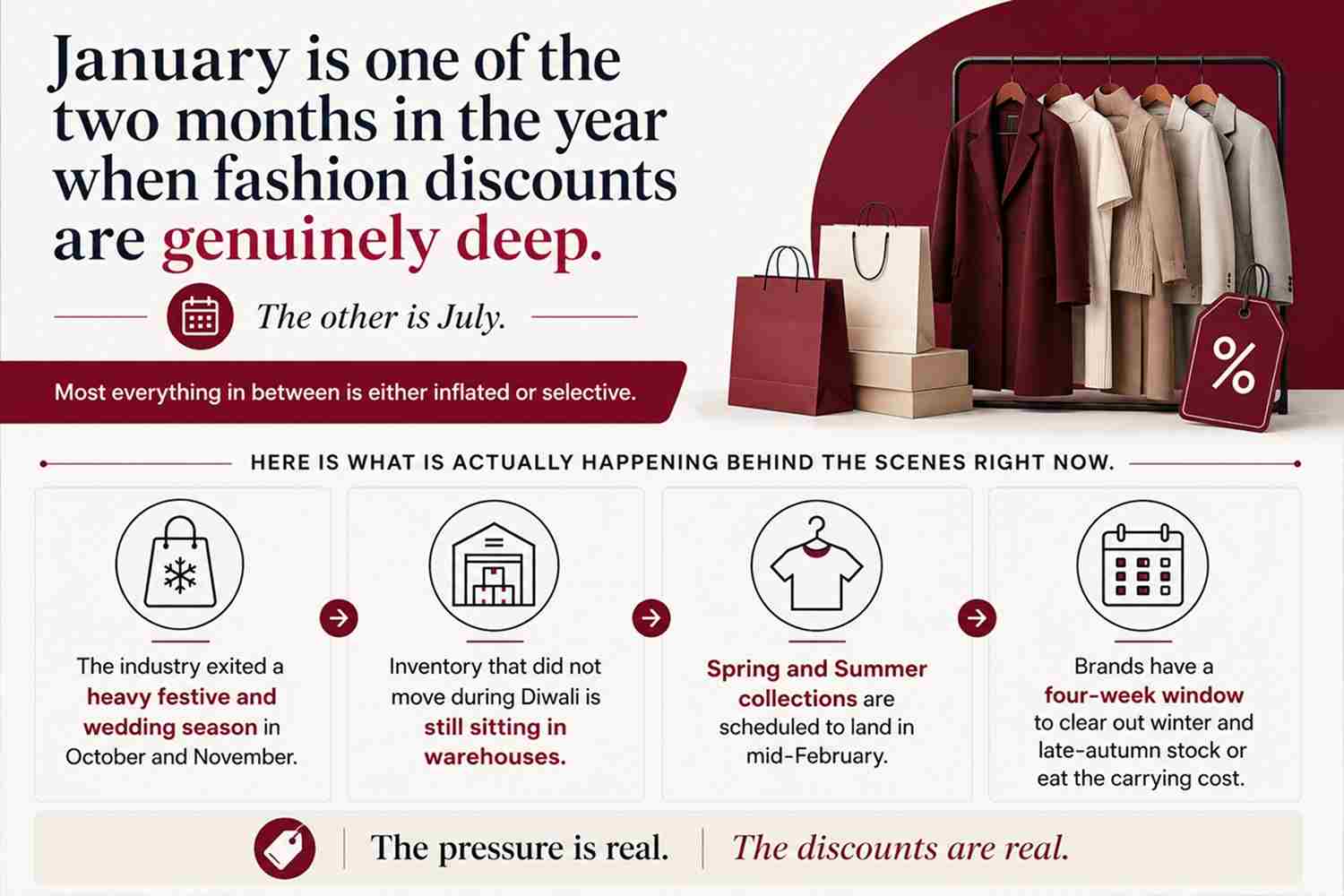
January is one of the two months in the year when fashion discounts are genuinely deep. The other is July. Most everything in between is either inflated or selective.
Here is what is actually happening behind the scenes right now.
The industry exited a heavy festive and wedding season in October and November. Inventory that did not move during Diwali is still sitting in warehouses. Spring and Summer collections are scheduled to land in mid-February. Brands have a four-week window to clear out winter and late-autumn stock or eat the carrying cost.
The pressure is real. The discounts are real.
Key sale events to track
Most major retailers run EOSS from the first week of January through the last week. Across recent years, the active windows have included:
- Flipkart Big Bachat Days in the first week of January
- Pay Day Sale around the 5th to 9th
- Ajio Fashionation Sale running through most of the month
- Flipkart Monumental Sale in the third week
- Amazon Great Republic Day Sale and Republic Day events across Myntra and Ajio peaking around 26 January
Brand-led EOSS at H&M, Westside, Pantaloons, Lifestyle, Shoppers Stop, Marks and Spencer, Zara, and most mass and premium labels runs alongside.
The pattern almost no one talks about
Discounts in January do not stay flat. They deepen as the month progresses.
H&M has historically opened January EOSS at around 50 percent off and pushed up to 70 percent by the third week as sell-through targets get harder to hit. Aldo, Lifestyle, and most department stores follow similar curves.
The smart play is not to rush in on day one. It is to buy in the middle to late stretch of EOSS, when discount depth peaks but inventory of common sizes has not fully drained.
The exception: if you wear a non-standard size (very small or very large), buy early. Those move first.
What to actually buy in January
| Category | Why January is the right month |
| Winter wear (jackets, sweaters, thermals, boots) | Brands need this gone before Spring drops |
| Formal Western wear | End-of-quarter targets, low organic demand |
| Premium and designer labels | Twice-yearly EOSS only; this is one of two windows |
| Accessories (bags, watches, sunglasses) | Stack EOSS plus bank offers for compounding cuts |
| Closed footwear (boots, formal, sneakers) | Aligns with formal and winter wear cycles |
What to skip in January
| Category | Why to wait |
| Spring and summer wear | Just dropping at full price, will discount in March and April |
| Ethnic wear | Wedding season demand keeps prices firm |
| Activewear | Resolution-period demand spike, brands hold prices |
| New launches | Always full price, no exceptions |
The insider tactics
Stack the offers. A January EOSS discount plus a bank instant discount plus a platform coupon plus cashback can compound to an effective 65 to 75 percent off the MRP. Most shoppers stop at the headline EOSS number and leave 15 to 20 percent on the table.
Watch the second wave. Around 18 to 22 January, retailers re-discount unsold stock with sharper cuts to clear before Republic Day rebalancing. This is the deepest cut of the cycle for most categories.
Republic Day is not really a fashion sale. It is an electronics and appliances sale wearing a fashion jacket. The genuine fashion deals during 24 to 26 January are continuations of EOSS, not Republic Day specials. Do not let the branding distract you from the actual discount depth.
The sizing trap. Brands sometimes load EOSS pages with sizes they could not move otherwise. Check whether your size is on discount before celebrating the headline number.
The “EOSS extended” tell. When you see “EOSS extended” rolling into early February, that is not generosity. That is unsold inventory. Discounts in extension weeks are often deeper than during the original EOSS window, but selection is poor.
February: The Quiet Month with Loud Marketing
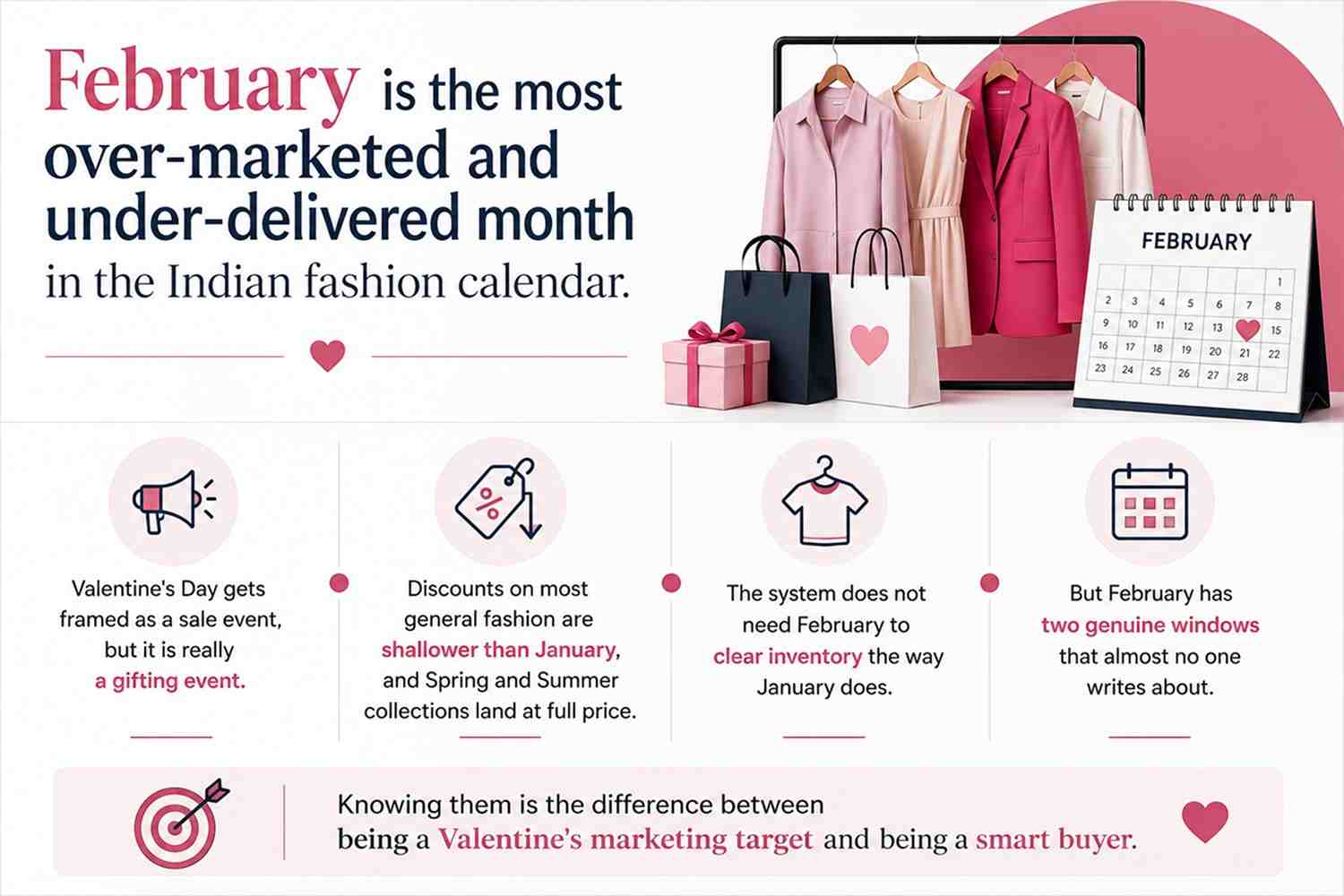
February is the most over-marketed and under-delivered month in the Indian fashion calendar.
Valentine’s Day gets framed as a sale event, but it is really a gifting event. Discounts on most general fashion are shallower than January, and Spring and Summer collections land at full price. The system does not need February to clear inventory the way January does.
But February has two genuine windows that almost no one writes about. Knowing them is the difference between being a Valentine’s marketing target and being a smart buyer.
What February actually contains
Week 1 to 14: Valentine’s marketing. Amazon Valentine’s Style Fest, Myntra Valentine’s Day Sale, Ajio’s Valentine’s window, and brand-led offers from The Man Company, Caprese, and similar. Headline discounts of “up to 80 percent” are common but heavily concentrated on gifting SKUs: jewellery, perfume, lingerie, beauty, and curated “for him” or “for her” edits. General fashion discounts in this stretch are 30 to 50 percent, almost always shallower than January EOSS.
Week 3 onwards: The real value zone. Once Valentine’s marketing exits, brands face a quiet retail period. Myntra runs its Birthday Blast Sale starting late February into mid-March, with discount depth often matching the mid-year clearance window. Ajio runs its Mega Clearance Sale in the last week. Nykaa runs its Winter Glow Sale in mid-February.
End of February: Pre-fiscal-year clearance. The Indian fiscal year ends 31 March. Listed retailers and D2C brands begin the offload in the last week of February. This is where genuine clearance pricing starts, especially on direct-to-consumer brand sites that need to hit Q4 numbers without making noise about it.
The Valentine’s Day reality
If you are buying a gift, Valentine’s deals are genuinely useful. Perfume sets, jewellery, watches, lingerie, and curated gifting boxes see real cuts because the demand window is narrow and brands need to clear seasonal SKUs before the moment passes.
If you are buying for yourself, Valentine’s is mostly noise. The same Levi’s jeans at 40 percent off during Valentine’s were at 50 percent off during January EOSS. The same Nike runners cost less in late-February clearance than they do during the Valentine’s hype.
One real exception: gifting categories that do not appear in EOSS cycles, like fragrance and fine jewellery, can hit their lowest prices of the year during Valentine’s. If you have a brand like Skinn, CaratLane, Giva, or Mia on your wishlist, this is your window.
What to actually buy in February
| Category | Why February is the right month |
| Fragrance and grooming gift sets | Lowest price of the year on most curated combos |
| Lingerie and innerwear (premium) | Valentine’s-specific markdowns from Zivame, Clovia, Amante |
| Fine and demi-fine jewellery | Brands like CaratLane, Giva, Mia run their sharpest cuts |
| Activewear (mid-month onwards) | Resolution-period demand cools, prices soften |
| Winter wear residuals | Last realistic chance before stock disappears entirely |
| Spring and summer wardrobe (last week only) | Early Birthday Blast and pre-fiscal-year clearance pricing |
What to skip in February
| Category | Why to wait |
| New Spring and Summer collections | Just landed, full price, will discount in March to May |
| Ethnic and wedding wear | Pre-wedding-season demand keeps prices firm |
| Footwear at Valentine’s headline pricing | Late-February clearance is deeper |
| Anything mid-month wrapped in Valentine’s branding | Wait two weeks for Birthday Blast or clearance |
The insider tactics
Skip the first half unless you are gifting. Most of the real value in February sits in the second half. Valentine’s sales are wrapping paper around shallow discounts on the mainline catalogue.
Track Myntra Birthday Blast specifically. It is one of the two best Myntra sales of the year, alongside the End of Reason Sale. Discount depth on selected brands matches the major mid-year and year-end events. Most shoppers miss it because the timing overlaps with the Valentine’s hangover and Holi prep.
Hit D2C brand sites in the last week. Indian D2C labels closing fiscal year quietly run unannounced markdowns to hit revenue targets without spooking investors with public discounting. Subscribe to newsletters from your top three or four D2C brands in early February so you catch the late-month emails.
Off-season buy your winter wear. A heavy jacket priced at 60 percent off in February is a steal. The same jacket in November will be at full price. If you have storage space, this is the highest-ROI shopping month for winter goods you will not need for nine months.
Decode the Valentine’s “up to 80 percent off” headlines. That ceiling almost always applies to a tiny slice of clearance SKUs: last-season lingerie cuts, discontinued perfume bottles, end-of-line bags. The mainline catalogue rarely crosses 50 percent. Always check whether your size and variant are inside the discount, not just the banner.
Bank offers compound harder in February. With softer base discounts, the marginal value of a 10 percent bank instant discount and a stacked coupon is higher in percentage terms than during EOSS. February is a coupon stacker’s month, not a headline-discount month.
March: The Underrated Power Month
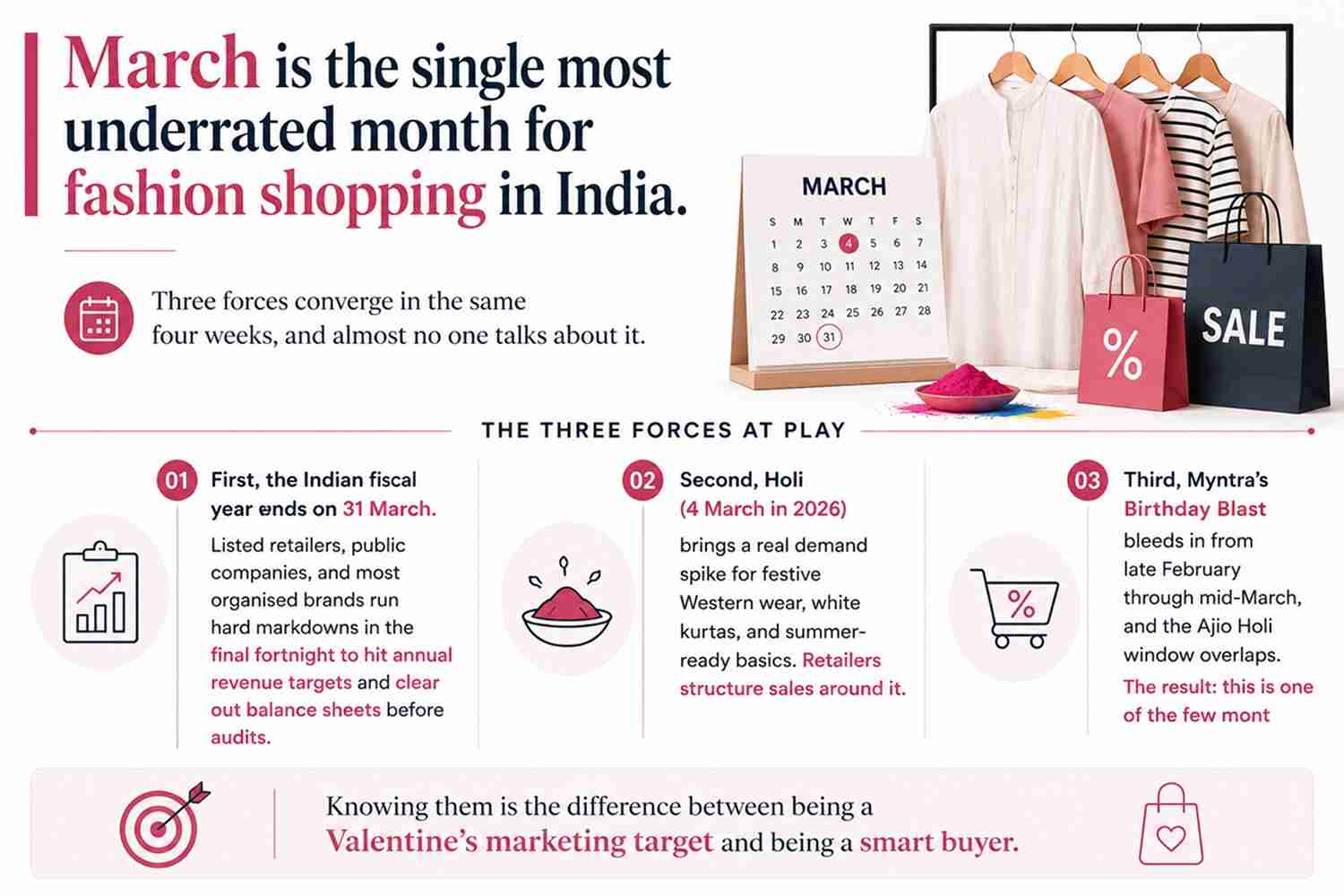
March is the single most underrated month for fashion shopping in India. Three forces converge in the same four weeks, and almost no one talks about it.
First, the Indian fiscal year ends on 31 March. Listed retailers, public companies, and most organised brands run hard markdowns in the final fortnight to hit annual revenue targets and clear out balance sheets before audits.
Second, Holi (4 March in 2026) brings a real demand spike for festive Western wear, white kurtas, and summer-ready basics. Retailers structure sales around it.
Third, Myntra’s Birthday Blast bleeds in from late February through mid-March, and the Ajio Holi window overlaps. The result: this is one of the few months where mass-market platforms and brand sites both run aggressive discounting at the same time.
Key sale events to track
- Myntra Birthday Blast Sale, typically running until around 15 March, with 50 to 90 percent off across H&M, Levi’s, Nike, Snitch, Adidas, Puma, and similar
- Myntra Holi Party Sale, a short window in the first week
- Amazon Holi Fest, a 2 to 3 day window typically just before Holi
- Flipkart Holi Sale, similar timing
- Ajiomania Holi Edit, running from late February into early March
- International Women’s Day sales across Myntra, Nykaa, Ajio, and Giva, around 5 to 9 March
- Ajio All Star Anniversary Sale in mid-March
- Myntra Summer Style Bash launching the new summer drops in the third or fourth week
- Late-month D2C and brand-site fiscal-year-end clearance, often unannounced
The pattern that defines March
First half (1 to 15 March): This is the festive-overlap window. Birthday Blast, Holi sales, and Women’s Day events stack on top of each other. Discount depth on platforms is at its highest of the quarter, especially on international brands that did not move in January EOSS.
Second half (16 to 31 March): This is fiscal-year clearance territory. The platform sales quiet down. The real value shifts to brand-owned sites and offline stores running silent end-of-year markdowns. Some of the deepest D2C discounts of the entire year happen in the last 10 days of March, almost never advertised as “sales.”
What to actually buy in March
| Category | Why March is the right month |
| Summer Western wear (cotton, linen, breathable) | Fresh stock from new SS drops priced down to move volume |
| White and pastel kurtas (Holi-related demand) | Heavy markdowns concentrated in the first 7 days |
| Sneakers and casual footwear | Birthday Blast and Holi sales hit footwear hard |
| Activewear and athleisure | Pre-summer ramp, brands push volume |
| Watches, bags, and accessories from international brands | Birthday Blast typically goes deeper here than EOSS |
| Premium D2C basics (last 10 days only) | Fiscal-year clearance, often unannounced |
| Sunglasses and eyewear | Summer prep, full category discounting |
What to skip in March
| Category | Why to wait |
| Winter wear at “Birthday Blast” pricing | Already moved, what is left is residual; February had better depth |
| Heavy ethnic wear | Pre-wedding-season demand still firm; wait for July or post-Diwali |
| Brand-new Summer launches at full price | Most will see 30 to 50 percent off by April or May |
The insider tactics
The two-window play. Buy your high-velocity items (footwear, basics, summer Western wear) in the first half during platform sales. Hold premium and brand-site purchases for the last week, when fiscal-year-end markdowns quietly hit D2C sites.
Watch listed retailers carefully. Companies like Aditya Birla Fashion, Trent (Westside, Zudio), and Reliance Retail are obligated to report Q4 numbers. The last 10 days of March typically see the deepest in-store EOSS extensions and quiet website markdowns from these groups.
Holi-themed sales are not just for Holi outfits. Use the Holi sale window to buy non-festive items. Discounts apply across the full catalogue, but most shoppers only browse the Holi-themed edits. The non-themed sections often have better stock and better prices.
Don’t fall for “summer collection 50 percent off” banners on launch day. New summer collections almost never genuinely discount in their first week. The 50 percent off banner is usually applied to last year’s residuals labelled as “summer.” Check the product pages and tags, not the banner.
Women’s Day Sale is mid-tier but useful for one specific category. Ethnic wear and beauty cross-sell during Women’s Day sales tend to outperform the surrounding weeks. If you need a kurta set for an upcoming wedding, this is a better window than Holi or post-Holi.
April: The Slow Burn Month
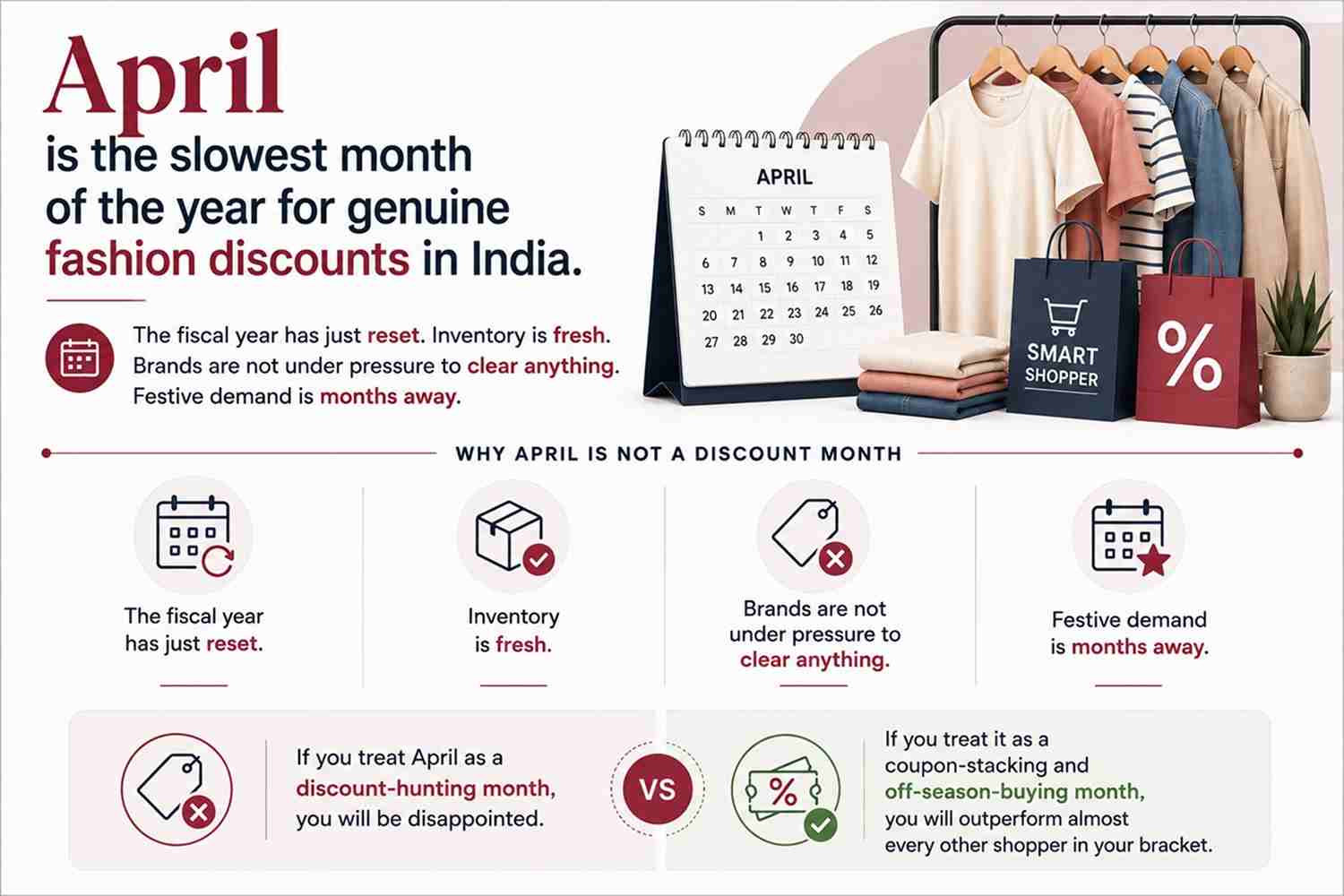
April is the slowest month of the year for genuine fashion discounts in India. The fiscal year has just reset. Inventory is fresh. Brands are not under pressure to clear anything. Festive demand is months away.
If you treat April as a discount-hunting month, you will be disappointed. If you treat it as a coupon-stacking and off-season-buying month, you will outperform almost every other shopper in your bracket.
Key sale events to track
- Flipkart Big Bachat Days running into the first week of April
- Amazon Great Summer Sale, launching in late April with up to 80 percent off promised across categories
- Myntra Hot Like Summer Sale, an early summer push
- Myntra Rising Stars Sale, focused on homegrown brands like Highlander, Snitch, Bonkers Corner, FableStreet, Rare Rabbit, Giva, with discounts up to 70 percent
- Myntra Glow Up Sale on beauty categories
- Akshaya Tritiya jewellery sales in late April or early May depending on the lunar calendar
- Eid-al-Fitr-linked sales (Eid timing depends on moon sighting; in 2026, expected around 21 March, so trail effects continue into early April)
What is happening in the system
New stock is fully on shelves. Spring/Summer collections are at full price for the first 30 to 45 days post-launch. Premium and designer labels are not discounting at all.
The summer push is on, which means brands are competing for attention with limited markdown budgets. They use coupons, free shipping thresholds, and bank offers as primary levers, not deep base discounts.
The exceptions are very specific:
- Homegrown D2C labels sometimes run silent month-long discounts to test new pricing, especially in the second and third weeks. Brands like Snitch, Uniqlo, The Souled Store, Berrylush, and similar players do this regularly.
- Marketplace summer-themed events like Hot Like Summer or the Rising Stars Sale offer real depth on specific homegrown labels, just not on the large international names.
- Activewear and athleisure see early-summer markdowns as gym memberships peak and brands chase the resolution-tail demand.
What to actually buy in April
| Category | Why April is the right month |
| Homegrown D2C streetwear (Snitch, Highlander, Souled Store) | Rising Stars and similar sales target these directly |
| Activewear and gym wear | Brands hit resolution and summer-prep demand |
| Linen, cotton, and breathable summer staples | New collection volume push, mid-tier discounts |
| Beauty (skincare, sunscreen, body care) | Pre-summer demand, retailer-led bundling |
| Last-season ethnic wear | Wedding season is ending in many states; clearance starts |
| Innerwear and basics | Coupon stacking goes furthest in low-discount months |
What to skip in April
| Category | Why to wait |
| New Spring/Summer launches at full price | Will discount 30 to 50 percent in May or June EORS |
| Premium international brands | No real discount cycle in April; wait for July |
| Footwear from major international labels | June EORS or July EOSS will go deeper |
| Anything labelled “Akshaya Tritiya special” outside jewellery | Usually shallow non-jewellery discounts riding on the festival branding |
The insider tactics
This is your coupon-stacking peak. With base discounts soft, every additional 10 percent off via a bank card or 5 percent cashback through a discount aggregator matters more in percentage terms. April is when the savvy stacker makes the same purchase 15 to 20 percent cheaper than the casual shopper.
Akshaya Tritiya is a jewellery moment, not a fashion moment. Real value exists in gold, silver, and demi-fine pieces that brands and offline jewellers genuinely discount. Fashion offers riding on Akshaya Tritiya branding tend to be marketing only.
Watch homegrown D2C newsletters. April is when smaller brands quietly clear residual Spring stock to fund new drops. These markdowns are usually email-only and last 24 to 72 hours.
Off-season ethnic wear deals start now. Wedding-season-specific lehengas, sherwanis, and heavy ethnic outfits begin their long markdown cycle in April. If you have a wedding to attend in late 2026, buying conservative ethnic wear now can save 40 to 60 percent versus waiting for festive-season prices.
Resist the “summer launch” pricing. Almost every summer-themed listing at full price in April will be 30 to 50 percent cheaper by mid-June. The only reason to buy at full price is if you need the item now or it is a limited drop unlikely to be discounted.
May: The Pre-EORS Coiled Spring
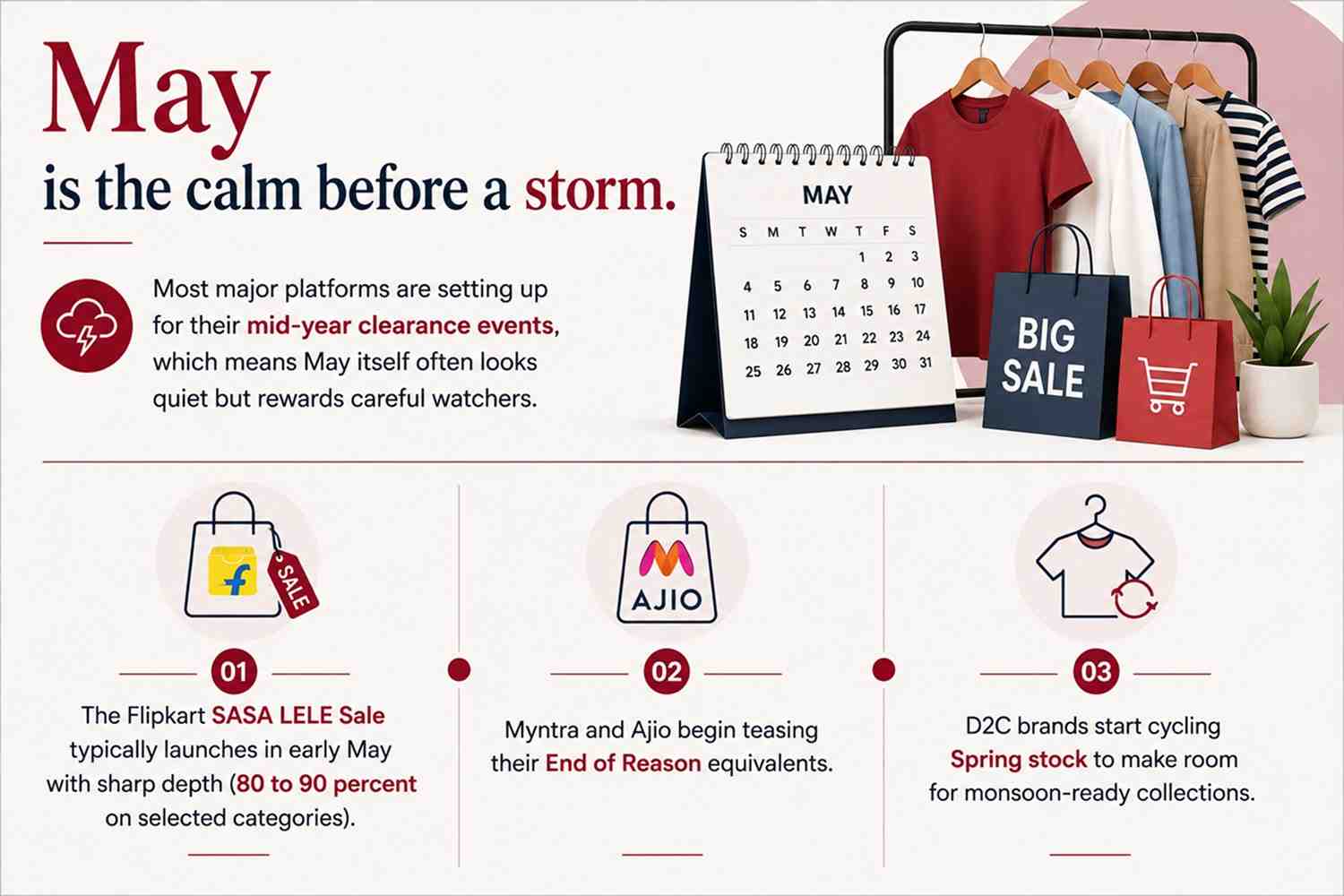
May is the calm before a storm. Most major platforms are setting up for their mid-year clearance events, which means May itself often looks quiet but rewards careful watchers.
The Flipkart SASA LELE Sale typically launches in early May with sharp depth (80 to 90 percent on selected categories). Myntra and Ajio begin teasing their End of Reason equivalents. D2C brands start cycling Spring stock to make room for monsoon-ready collections.
Key sale events to track
- Flipkart SASA LELE Sale, typically launching around 9 May with steep discounts on selected categories
- Amazon Great Summer Sale extending from April into May
- Myntra Hot Like Summer or Summer Refresh Sale running through the month with up to 70 percent off
- Mother’s Day sales (early May), gifting-focused
- Pre-EORS teasers and Insider early access announcements building toward the late-May launch
- Eid-al-Adha-linked sales (in 2026, Eid-al-Adha falls around late May)
- Ajio month-long festival or summer events
What is happening in the system
Spring stock that did not sell in March or April is approaching its 90-day window. Brands are deciding what to clear at EORS and what to mark down quietly now.
Marketplaces are pre-promoting their June clearance events to build wishlists. This is the month when their algorithms are heaviest on cart abandonment emails, “price drop” notifications, and “your size is back in stock” pings.
The smart shopper does two things in May: builds wishlists for EORS, and buys only the items that are genuinely cheaper now than they will be in two weeks (which is rare, but exists).
What to actually buy in May
| Category | Why May is the right month |
| Summer staples mid-month (cotton tees, linen pants, breathable shirts) | Fresh stock at first markdowns from new collection cycle |
| Sandals, slip-ons, and open footwear | Peak summer demand met with ramp-up promotions |
| Sportswear and swimwear | Pre-vacation demand, brands push volume |
| Mother’s Day gifting (jewellery, perfumes, bags) | Genuine gifting-category cuts in early May |
| Eid-related ethnic wear (where applicable) | Festival demand spike followed by clearance |
| Travel and luggage | Summer holiday surge, brands compete for share |
What to skip in May
| Category | Why to wait |
| Heavy ethnic wear or wedding wear | Off-season; better prices available; July EOSS or post-Diwali will be deeper |
| New summer drops at full price | Most will discount in EORS within 2 to 4 weeks |
| Winter wear residuals | Already past; late-July or August clearance is the next genuine window |
| Premium watches and accessories at “Mother’s Day” pricing | Marginal cuts, EORS will be sharper |
The insider tactics
Use May as a wishlist-building month. Add everything you are tempted by. Wait. Let the EORS in late May or early June reveal which items genuinely drop in price. Most do. Some do not, and you learn which brands and SKUs are truly demand-driven (and worth paying full price for next time).
Watch the SASA LELE pricing carefully. Flipkart’s deepest cuts during this sale are on selected SKUs with low organic demand. The rest of the catalogue often runs at standard discounts. Cross-check the product on price-tracking tools like Flipshope or Pricehistoryapp before celebrating an 80 percent off banner.
Mother’s Day is genuinely useful for one specific basket. Premium beauty, fine jewellery, and curated gifting have real markdowns. Apparel and bags run shallow Mother’s Day discounts that EORS will undercut.
The “30-day rule” matters most in May. Marketplaces have been documented using countdown timers, exaggerated percent-off claims, and bait-discount practices, particularly during festive sales. Use a price-history tool to confirm that an “80 percent off” SASA LELE deal is actually below the 30-day average price for that SKU. If not, it is a relabelled regular price.
The pre-EORS bank offer race. ICICI, HDFC, Kotak, Axis, RBL, and SBI typically lock down sale-window partnerships with marketplaces in May. If you have flexibility on payment cards, watch which bank locks in with which platform a week before EORS launches. The base 10 percent bank discount is usually the highest-impact stack on EORS purchases.
June: The Mid-Year Clearance Peak
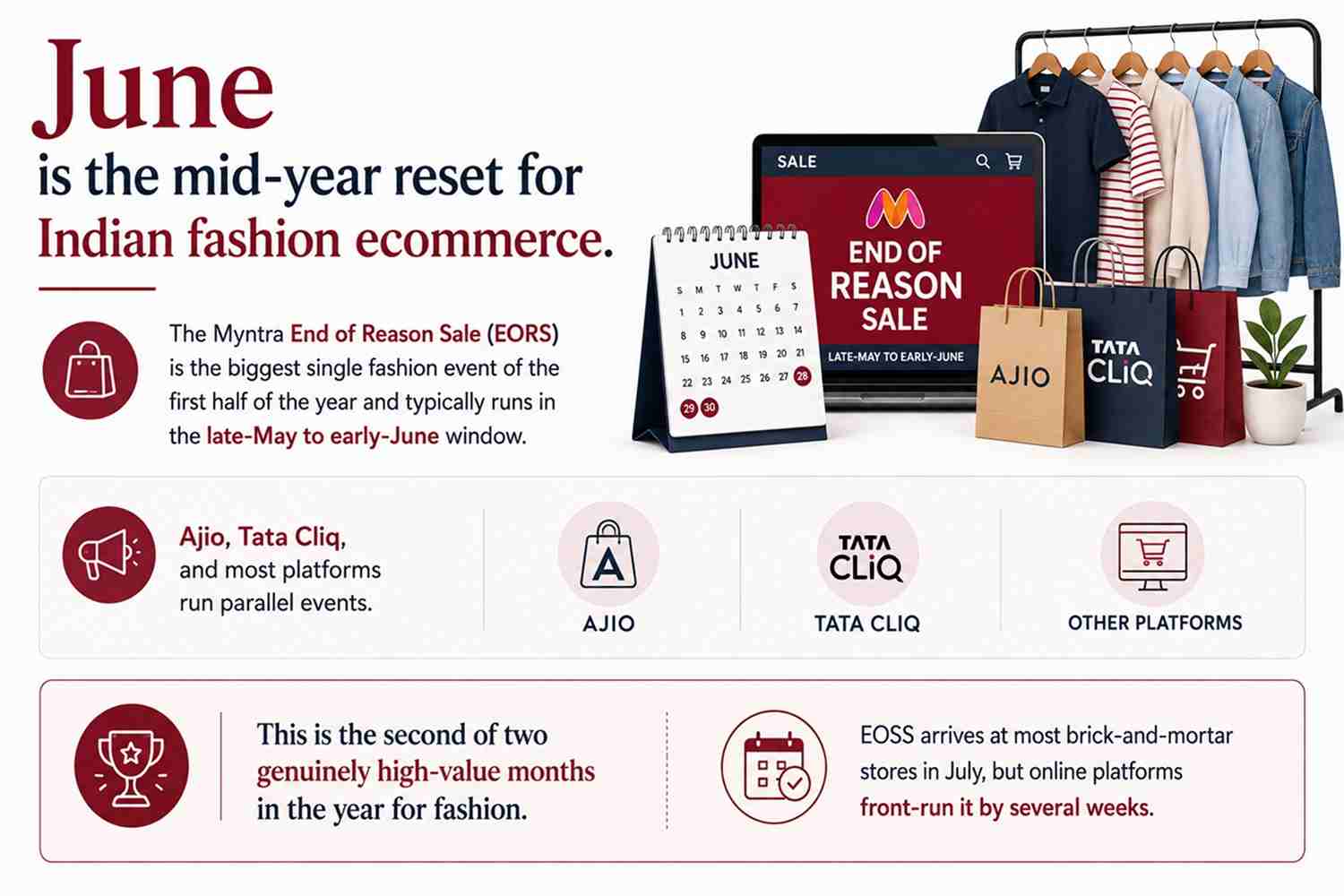
June is the mid-year reset for Indian fashion ecommerce. The Myntra End of Reason Sale (EORS) is the biggest single fashion event of the first half of the year and typically runs in the late-May to early-June window. Ajio, Tata Cliq, and most platforms run parallel events.
This is the second of two genuinely high-value months in the year for fashion. EOSS arrives at most brick-and-mortar stores in July, but online platforms front-run it by several weeks.
Key sale events to track
- Myntra End of Reason Sale (EORS), typically running for 7 to 10 days in late May or early June, with discounts of 50 to 80 percent across thousands of brands
- Ajio mid-year clearance, running parallel
- Father’s Day sales mid-June, gifting-focused
- Amazon Prime Day (sometimes June, sometimes July depending on year), with strong fashion participation
- Tata Cliq Mega Fashion Days
- Pre-monsoon brand-led clearance events
What is happening in the system
Brands and marketplaces are clearing Spring/Summer stock to make room for monsoon-ready and pre-festive collections. The pressure is real because the festive season inventory build-up starts in July, and warehouses cannot hold both sets of stock.
EORS typically delivers comparable depth to January EOSS, sometimes deeper on specific international brands. The first 24 hours have the most aggressive pricing on hero SKUs, but stock clears fast.
What to actually buy in June
| Category | Why June is the right month |
| International brand fashion (H&M, Mango, Levi’s, Nike, Puma, Adidas) | EORS hits these hardest with 50 to 80 percent off |
| Premium and designer labels | One of the only mid-year windows for these |
| Footwear across categories | Discount depth at its annual peak alongside January |
| Watches, bags, and premium accessories | EORS includes a full premium-accessory clearance |
| Summer staples at clearance pricing | Brands purging Spring/Summer residuals at maximum depth |
| Activewear from premium brands (Nike, Adidas, Puma, Reebok) | Sharper than April’s homegrown-focused discounts |
What to skip in June
| Category | Why to wait |
| Monsoon-specific items (waterproof footwear, raincoats) | Just arriving at full price; will discount in July or August |
| Festive ethnic wear | Peak demand build-up begins in July; prices firm now |
| Heavy winter wear | Off-cycle; January and February discounts will go deeper |
The insider tactics
The 24-hour rule. During EORS, the first 24 hours are the most aggressive pricing window. Set an alarm for the midnight launch. Hero SKUs, premium brands, and limited-stock items vanish within hours. If you have something on your wishlist from a popular brand in a common size, day-one purchasing is the winning strategy.
Insider access is worth paying for. Myntra Insiders get 24 to 48 hour early access to EORS. If you are a frequent shopper, the membership economics work out within a single sale. The first-mover advantage on premium brands is real.
Stack EORS with bank offers carefully. Myntra typically partners with one or two banks (often ICICI and Kotak) for an instant 10 percent discount during EORS. Stacking that with category coupons and a cashback aggregator can compound to 30 to 40 percent below the EORS base price.
Father’s Day is mostly noise. Outside of grooming, watches, and a small slice of premium gifting, Father’s Day discounts are shallow and overlap with EORS anyway. Buy what you need during EORS, not Father’s Day specifically.
Watch the monsoon-ready category timing. Brands launching new monsoon footwear and water-resistant items in early June price them at full retail. By the third week of June, as monsoon starts in southern and western India, these same items see 20 to 30 percent off. If you can wait two weeks, you can save meaningfully.
Use EORS as a benchmark. Note the EORS price for items you wanted but did not buy. That price is roughly the floor for those items until December. If the same items show up in August or September festive sales at the same EORS price, that is normal. If they go below, it is a genuine deal. If above, it is a manufactured discount.
July: The Real EOSS, Round Two
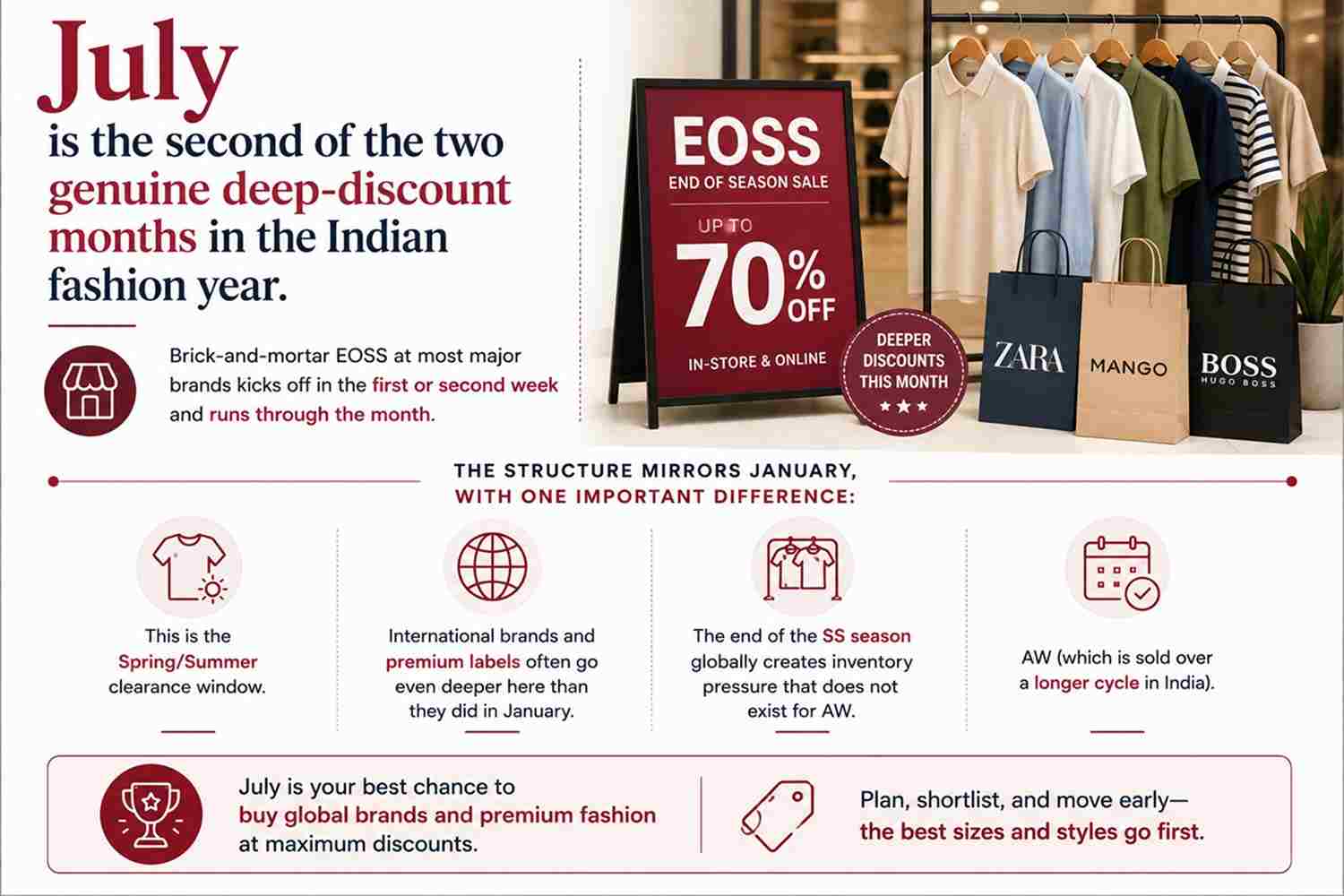
July is the second of the two genuine deep-discount months in the Indian fashion year. Brick-and-mortar EOSS at most major brands kicks off in the first or second week and runs through the month.
The structure mirrors January, with one important difference: this is the Spring/Summer clearance window, which means international brands and premium labels often go even deeper here than they did in January. The end of the SS season globally creates inventory pressure that does not exist for AW (which is sold over a longer cycle in India).
Key sale events to track
- Brand-led EOSS at Westside, Pantaloons, Lifestyle, Shoppers Stop, Marks and Spencer, H&M, Zara, Mango, and most premium and mass labels, running through July
- Amazon Prime Day, often in mid-July, with strong fashion participation alongside electronics
- Flipkart Big Saving Days and similar mid-monsoon sale events
- Ajio Big Bold Sale and similar mid-year events
- Myntra Right to Fashion Sale, typically launching on 31 July and bridging into Independence Day
- Brand-specific monsoon and clearance sales
What is happening in the system
Two pressures stack. First, the Spring/Summer global cycle is ending, and brands need to clear residual inventory before AW collections start landing in late July and August. Second, the festive season build-up begins in late July, and warehouses cannot hold parallel inventory.
This combination produces some of the deepest discounts of the year on international and premium labels, often deeper than January. Mass-market and homegrown brands are roughly comparable to January depth.
What to actually buy in July
| Category | Why July is the right month |
| International brand fashion at peak depth | Globally aligned SS clearance creates the deepest cuts of the year |
| Premium and designer labels | Twice-yearly EOSS, this is the second window |
| Summer staples (sale of last opportunity) | Last chance before the season fully exits |
| Footwear across categories | Mirrors January, often deeper on international SKUs |
| Sunglasses and summer accessories | End-of-season liquidation, sharp cuts |
| Western formal wear | Office return cycles, mid-tier discounts |
| Monsoon-ready footwear (mid to late July) | Demand-met, brands push volume |
What to skip in July
| Category | Why to wait |
| Festive ethnic wear | Pre-Onam/Rakhi demand is firming; September is better for heavy ethnic |
| Brand-new Autumn/Winter launches | Just arriving at full price; January and February will discount |
| Premium watches and jewellery | Twice-yearly cycles; festive season has competitive pricing |
The insider tactics
Compare July prices against your January EORS notes. If you tracked specific items in January and they show up in July at lower prices, buy without hesitation. International brand SS clearance in July is often the year’s lowest point for those SKUs.
Watch for “sale on sale” timing in mid-to-late July. Many brands extend EOSS or run a second markdown wave around 18 to 25 July. Discounts in this window are often the deepest, but selection is the worst. If your size is common, mid-July is your sweet spot. If your size is rare, buy early.
Right to Fashion is a soft event. Despite the patriotic branding, Myntra’s Right to Fashion sale is more about bridging July EOSS to Independence Day demand than about delivering EOSS-level depth. Real values are continuations of EOSS pricing rather than new event-specific cuts.
Don’t be misled by “monsoon sale” branding. A monsoon sale is just a marketing wrapper for July EOSS in most cases. The discount depth is set by the EOSS calendar, not by the rain.
This is the year’s window for premium accessories. Bags, watches, eyewear, and luxury wallets from brands like Coach, Michael Kors, Fossil, and similar see their deepest annual discounts in July through Myntra Luxe and similar premium channels. If you are buying premium gifting for a December wedding, July is your buying window.
The off-season ethnic play. Mid-July to early August, before festive demand peaks, ethnic-wear brands often run quiet clearance on prior-season collections. Brands like Biba, W, Aurelia, and Global Desi do this with limited marketing. This is your cheapest window for daily-wear kurtas, ethnic sets, and prior-season designer pieces that will not get touched once festive demand begins.
August: The Festive Ramp Begins
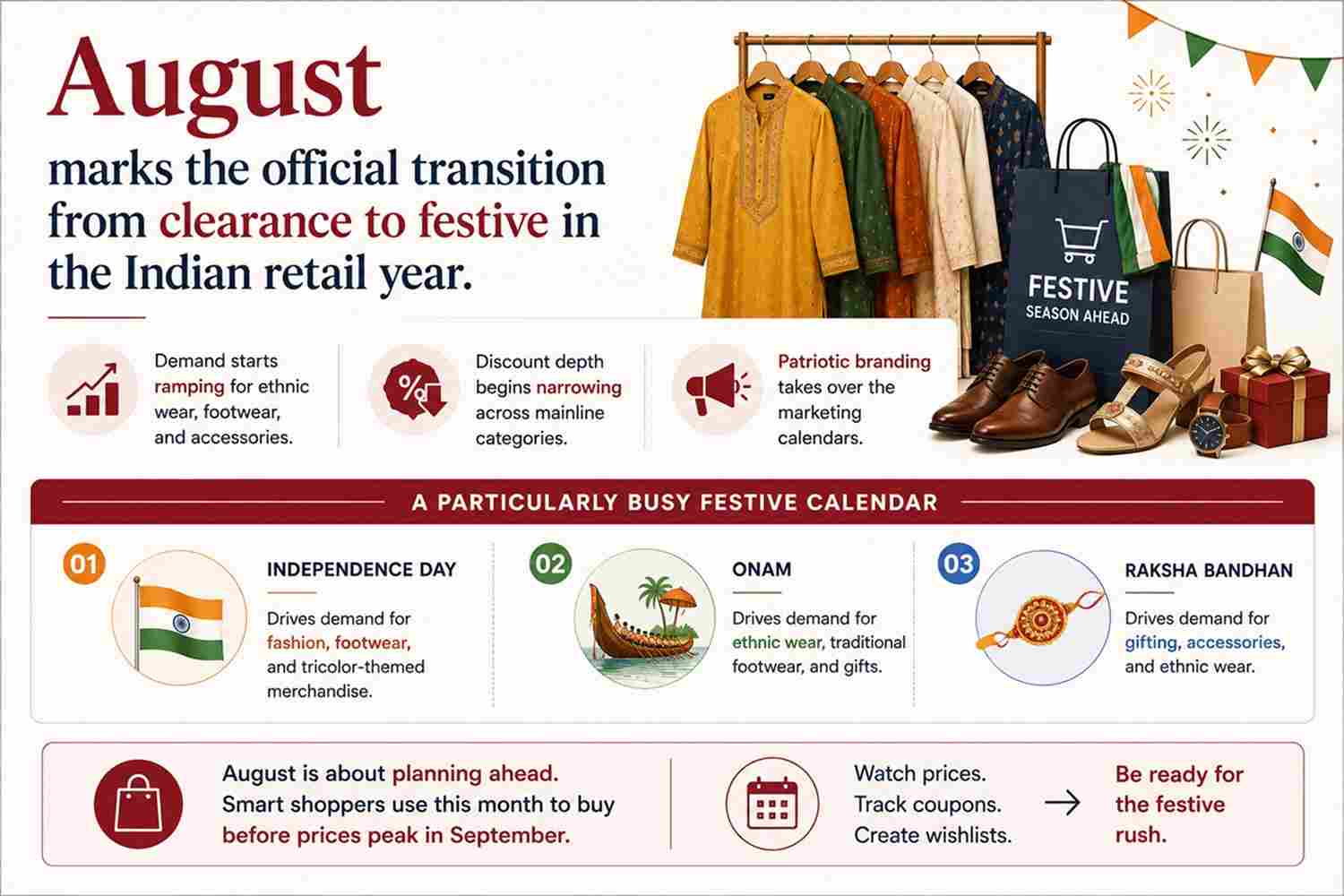
August marks the official transition from clearance to festive in the Indian retail year. Demand starts ramping for ethnic wear, footwear, and accessories. Discount depth begins narrowing across mainline categories. Patriotic branding takes over the marketing calendars.
In 2026, August has a particularly busy festive calendar: Independence Day on 15 August (Saturday), Onam on 26 August, and Raksha Bandhan on 28 August (Friday). Each one drives a specific category demand spike.
Key sale events to track
- Amazon Great Freedom Sale and Amazon Rakhi Sale, running through the first half of August
- Flipkart Independence Day Sale and Big Saving Days
- Myntra Right to Fashion Sale extending from late July through 15 August, with up to 80 percent off
- Ajio Freedom Sale, Onam-specific sales for the Kerala market
- Tata Cliq Independence Day events
- Rakhi gift-focused sales across all major platforms
- Onam-specific fashion drops, especially for ethnic and saree categories
What is happening in the system
The festive build-up has two halves. The first half (1 to 15 August) is dominated by Independence Day and Rakhi gifting. Discounts on patriotic-themed apparel, ethnic fusion, and gift sets are real.
The second half (16 to 31 August) shifts into Onam and Janmashtami territory in southern and western India, with ethnic wear demand rising sharply. Discount depth narrows in these categories as brands hold pricing.
Critically, this is when retailers begin building festive inventory. Stocks of ethnic wear, lehengas, sarees, kurta sets, and festive footwear arrive throughout August at full price. The “festive collection” launches typically happen mid-to-late August.
What to actually buy in August
| Category | Why August is the right month |
| Western basics and casual wear | Independence Day sales hit these hard before festive demand fully takes over |
| Patriotic-themed apparel | Genuine markdowns concentrated in the first 10 days |
| Sneakers and casual footwear | Right to Fashion and Independence Day sales target these heavily |
| Backpacks, lunch boxes, kids’ apparel | Back-to-school demand met with promotions |
| Mid-tier watches and accessories | Rakhi gifting drives genuine discounts on this category |
| Activewear from premium brands | Continuation of mid-year clearance overlap |
What to skip in August
| Category | Why to wait |
| Heavy ethnic wear (lehengas, sarees, sherwanis) | Demand is rising into festive season; prices firm or rising |
| Brand-new festive collections at full price | These do not discount until late October if they discount at all |
| Premium gifting at “Rakhi” prices | Diwali sales typically go deeper in this category |
| Wedding-specific outfits | Wedding season inventory is being built; prices are firming |
The insider tactics
The 10-day window. The first 10 days of August are the last clean discount window before festive prices firm up. After 15 August, ethnic and festive categories begin holding or rising. Buy non-festive needs in this 10-day window.
Independence Day is heavier on electronics. Like Republic Day, Independence Day sales lean hardest on phones, laptops, and appliances. Fashion participation is real but secondary. Set expectations accordingly: 30 to 50 percent off on most fashion, with selected categories going deeper.
Rakhi is a gifting category, not a fashion category. The deepest cuts during Rakhi sales are on watches, perfumes, jewellery, and curated gift sets, not on mainline apparel. If you are not gifting, the Rakhi sale window adds little value over the Independence Day window.
Onam is genuinely valuable for specific shoppers. If you wear traditional Kerala saree styles (kasavu sarees, set-mundu, mundum neriyathum), the Onam sale window typically delivers the deepest annual cuts. Brands like Kalyan Sarees, Seematti, and Suta run authentic Onam sales.
Watch the late-August ethnic launch behaviour. New festive collections launch from 20 August onwards across most platforms. Resist buying these at launch. The same items will discount 30 to 60 percent in the Big Billion Days, Great Indian Festival, or Diwali windows. The only exception is if your size is rare, in which case launch-day buying secures inventory.
Back-to-school is its own micro-cycle. Kids’ apparel, school shoes, and youth-focused fashion run their deepest cuts of the year in late July through mid-August. If you are buying for children, this is the window. After 15 August, prices firm and supply tightens through the festive build-up.
September: The Festive Mega-Sale Launchpad
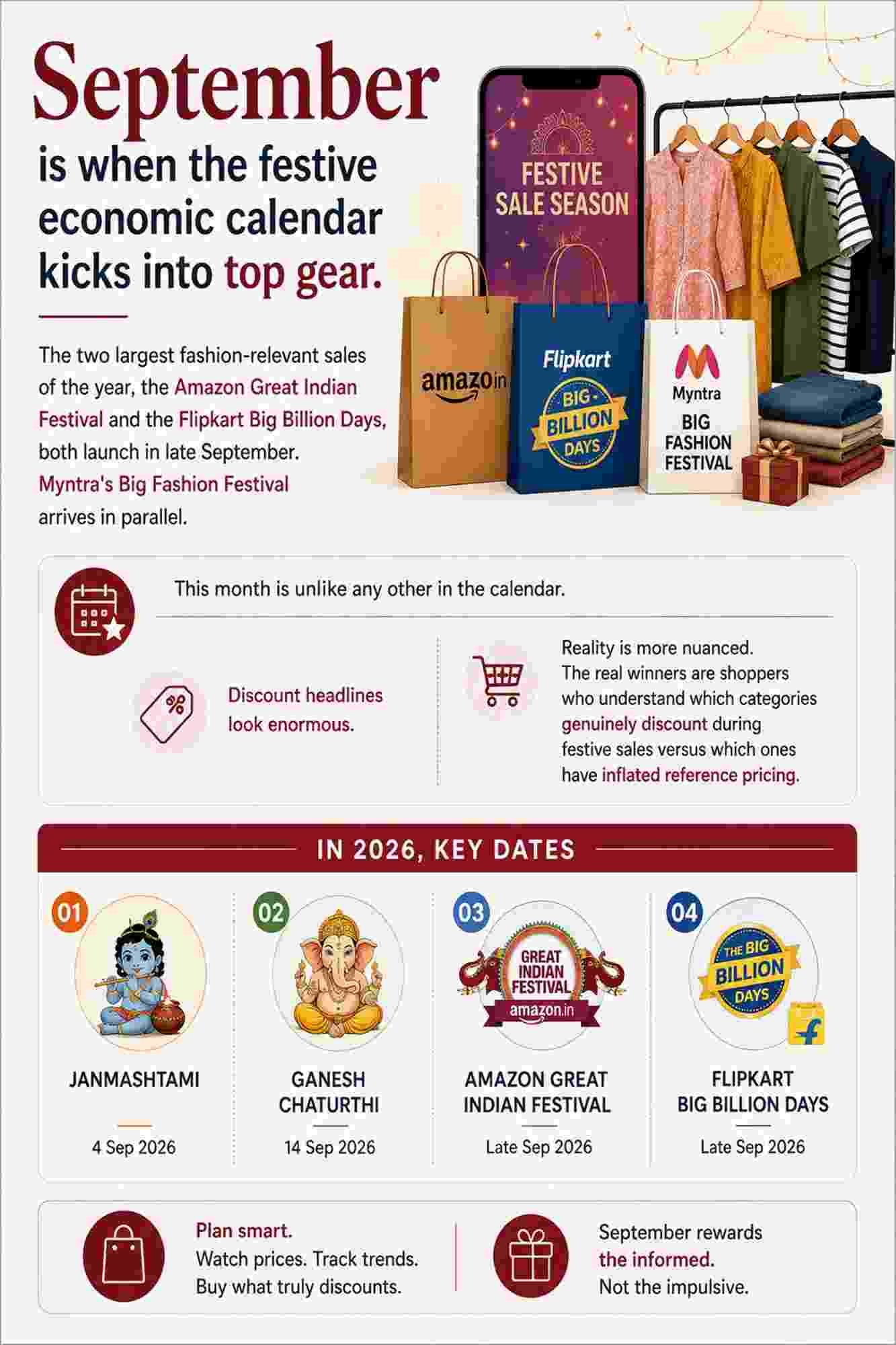
September is when the festive economic calendar kicks into top gear. The two largest fashion-relevant sales of the year, the Amazon Great Indian Festival and the Flipkart Big Billion Days, both launch in late September. Myntra’s Big Fashion Festival arrives in parallel.
This month is unlike any other in the calendar. Discount headlines look enormous. Reality is more nuanced. The real winners are shoppers who understand which categories genuinely discount during festive sales versus which ones have inflated reference pricing.
In 2026, key dates: Janmashtami on 4 September, Ganesh Chaturthi on 14 September, Amazon Great Indian Festival starting on 23 September, and Flipkart Big Billion Days expected around 26 September.
Key sale events to track
- Amazon Great Indian Festival, expected to start 23 September with Prime member early access from 22 September
- Flipkart Big Billion Days, expected to launch around 26 September with Plus member early access
- Myntra Big Fashion Festival (BFF), launching late September, marketed as one of Myntra’s biggest annual sales
- Ajio Festive Sale and Ajio Navratri Sale launching late September
- Tata Cliq Diwali Specials beginning end of month
- Nykaa festive beauty sales
- Brand-led festive collection launches (mostly full price, but with bundling and bank offers)
What is happening in the system
Marketplaces have been preparing this month for six months. Inventory is at peak levels. Marketing budgets are concentrated here. Bank partnerships are exclusive and locked in by August.
Discount depth is high on selected hero SKUs (mobiles, headphones, large appliances) and genuinely competitive on fashion in specific categories. However, not all “discounts” are real. India’s Central Consumer Protection Authority has flagged 13 dark patterns including drip pricing, basket sneaking, false urgency timers, and bait-and-switch discounting, with festive sales as documented examples.
The smart shopper does not buy the headline. They buy specific items they have tracked for 30 days and confirmed are genuinely below recent prices.
What to actually buy in September
| Category | Why September is the right month |
| Mainline Western wear from international brands | BBD and GIF compete hard on H&M, Zara, Mango, Levi’s, Nike |
| Mid-tier ethnic wear (daily-wear kurtas, fusion sets) | Pre-festive demand met with genuine discounts |
| Footwear across categories | Festive sales typically deliver 40 to 70 percent on these |
| Bags and accessories | Strong discount competition between platforms |
| Beauty and skincare | Nykaa Festive and BBD/GIF beauty sections all push hard |
| Smart-watches and fitness accessories (premium gift category) | Festive gifting drives sharp cuts |
What to skip in September
| Category | Why to wait |
| Heavy festive ethnic wear (lehengas, sherwanis, designer sarees) | Often inflated MRPs make festive discounts less real than they appear |
| Brand-new festive collection launches | Will discount further during Diwali tail and Black Friday windows |
| Premium watches and luxury brands | December and January EOSS go deeper in these categories |
| Anything with a 60-minute “Tick-Tock” countdown timer | Documented as a false-urgency dark pattern; the deal usually returns |
The insider tactics
Build your wishlist in August. Buy in September. The 30-day price comparison only works if you have a baseline. If you wishlisted items during the late-July or August window, you can confirm during BBD/GIF whether the festive price is genuinely lower or just rebranded.
The bank-card discipline. Most BBD and GIF discounts require specific bank cards (typically SBI for Amazon, ICICI or Axis for Flipkart, varying for Myntra). If your most-discounted card does not match the platform’s chosen partner, the effective discount drops by 10 percent. Plan accordingly.
Watch for drip pricing at checkout. Documented dark patterns include hidden fees that appear only at checkout, pre-ticked add-ons (warranties, protection plans), and bundled charges that erode the apparent discount. Always check the final checkout price against the displayed offer price.
Day-one is for hero items only. The opening hours of BBD and GIF have the deepest pricing on a small set of hero SKUs (typically the items used in marketing). Mainline catalogue pricing is usually similar throughout the sale window.
Use the price-history tools. Browser extensions like Flipshope and price-history apps that maintain six-month price tracking on Amazon, Flipkart, Myntra, and Ajio have become essential. These tools show you whether the “all-time low” claim on a product page is true or a relabelled regular price.
Big Fashion Festival is the cleanest of the three. Myntra’s BFF tends to have less aggressive dark-pattern usage than the headline mega-sales, and the discount depth on premium fashion brands is often comparable. If you primarily care about apparel and accessories, Myntra BFF is often the better value than BBD or GIF.
Pre-Pitru Paksha lull. The 14-day Pitru Paksha period (typically falling in mid-to-late September) is considered inauspicious for new purchases in many Hindu traditions. Marketplaces often time their biggest sales just after this window ends to capture pent-up demand. Watch for sharper discounts when sales restart post-Pitru Paksha.
October: The Festive Peak
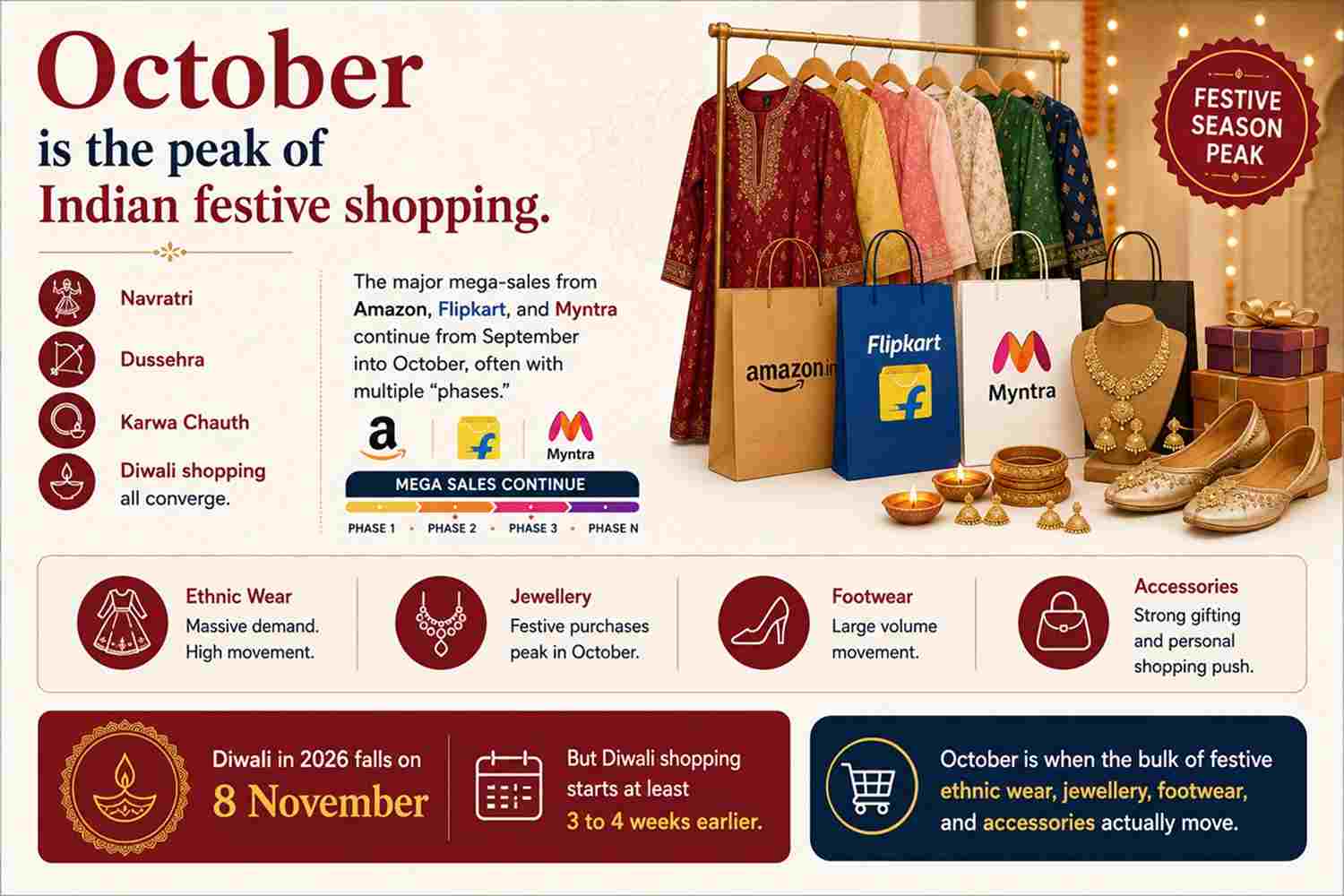
October is the peak of Indian festive shopping. Navratri, Dussehra, Karwa Chauth, and Diwali shopping all converge. The major mega-sales from Amazon, Flipkart, and Myntra continue from September into October, often with multiple “phases.”
Diwali in 2026 falls on 8 November, but Diwali shopping starts at least 3 to 4 weeks earlier. October is when the bulk of festive ethnic wear, jewellery, footwear, and accessories actually move.
Key sale events to track
- Amazon Great Indian Festival continuing through October in multiple phases
- Flipkart Big Billion Days extending into mid-October
- Myntra Diwali Sale, expected to launch in the first or second week of October with 50 to 80 percent off across festive brands
- Myntra What The Trend Sale, typically late October (around 25 to 30 October), with 40 to 80 percent off
- Ajio Navratri and Dussehra sales
- Karwa Chauth specific jewellery and ethnic-wear sales (Karwa Chauth typically falls in late October or early November)
- Nykaa Pink Friday early teasers
What is happening in the system
The festive demand window is at maximum intensity. Brands are not under inventory pressure. They are competing for share of festive wallet. Discount depth narrows on hero categories like ethnic and footwear (where demand is highest) and stays deep on Western, athleisure, and accessories (where festive demand is lower).
This is also the most concentrated dark-pattern window in the calendar, with documented examples of false urgency, manufactured scarcity, and inflated reference prices in the run-up to Diwali. Pricing discipline matters more here than any other month.
What to actually buy in October
| Category | Why October is the right month |
| Mainline Western wear and athleisure | Festive attention is on ethnic; Western prices are competitive |
| Footwear (formal, casual, sneakers) | Genuine discounts ride the festive volume cycle |
| Jewellery (silver and demi-fine) during Dhanteras run-up | Real promotional pricing tied to demand window |
| Bags, wallets, and travel accessories | Gifting demand drives sharp cuts |
| Beauty and personal care | Nykaa and platform sales hit these hard |
| Mid-tier ethnic wear (daily-wear kurtas, kurta sets) | Volume-driven pricing in the early-October window |
| Home, decor, and gifting | Diwali-driven cuts on lifestyle adjacencies |
What to skip in October
| Category | Why to wait |
| Heavy designer ethnic wear (lehengas, sherwanis, premium sarees) | High demand means high reference prices; Black Friday or December often goes deeper |
| Premium gold jewellery at “Diwali special” pricing | Better real value at January EOSS or February gifting windows |
| Anything sold with a midnight countdown timer | Manufactured urgency; the price almost always returns |
| Brand-new festive launches in late October | Will see Black Friday and post-Diwali tail discounts |
The insider tactics
Buy your gifting before Dhanteras. Dhanteras (in 2026, on 6 November) is the peak day for jewellery, kitchen, and home gifting purchases. Prices are often higher in the 48 hours leading up to it than in mid-to-late October. Buy 7 to 10 days before Dhanteras for the cleanest pricing.
Karwa Chauth is a real gifting moment. The 24 to 48 hours before Karwa Chauth see real discounts on ethnic wear and jewellery for the gifting cycle. Watch for these alongside the broader Diwali ramp.
The festive ethnic trap. Lehengas, sherwanis, and heavy festive ethnic wear are the most likely category in October to feature inflated MRPs and dark-pattern discounts. The “70 percent off” lehenga from a no-name brand priced at ₹15,000 down from ₹50,000 is rarely worth it. Either buy from a trusted brand at modest discount, or wait for genuine clearance in November and December.
The mid-October dip. Around 10 to 15 October, between BBD/GIF phase one and Diwali sale launch, there is often a 4 to 6 day window of softer marketing and quietly better pricing. Brands and platforms re-price to balance inventory. This is a hidden value window that few shoppers notice.
Diwali sales begin earlier than Diwali. The Myntra Diwali Sale and platform Diwali sales launch in the first or second week of October, several weeks before Diwali itself. Discount depth peaks in this early-launch window. By the week immediately before Diwali, prices firm up as demand spikes and inventory thins.
Use code-stacking maximally. October is the highest-stack month of the year. Platform discount + bank instant + cashback aggregator + first-time-user code (for new accounts on a brand site) + festive coupon. The savvy stacker can compound 15 to 20 percent on top of the headline discount.
The “Mega Beauty Sale” within the fashion mega-sale. Both BBD/GIF and Myntra BFF run sub-events on beauty during October. These often go deeper on beauty than dedicated beauty platform sales. If you need premium beauty (MAC, Estée Lauder, La Mer, Charlotte Tilbury), the platform mega-sale beauty sub-event in October is often your cheapest annual window.
November: The Two-Speed Month
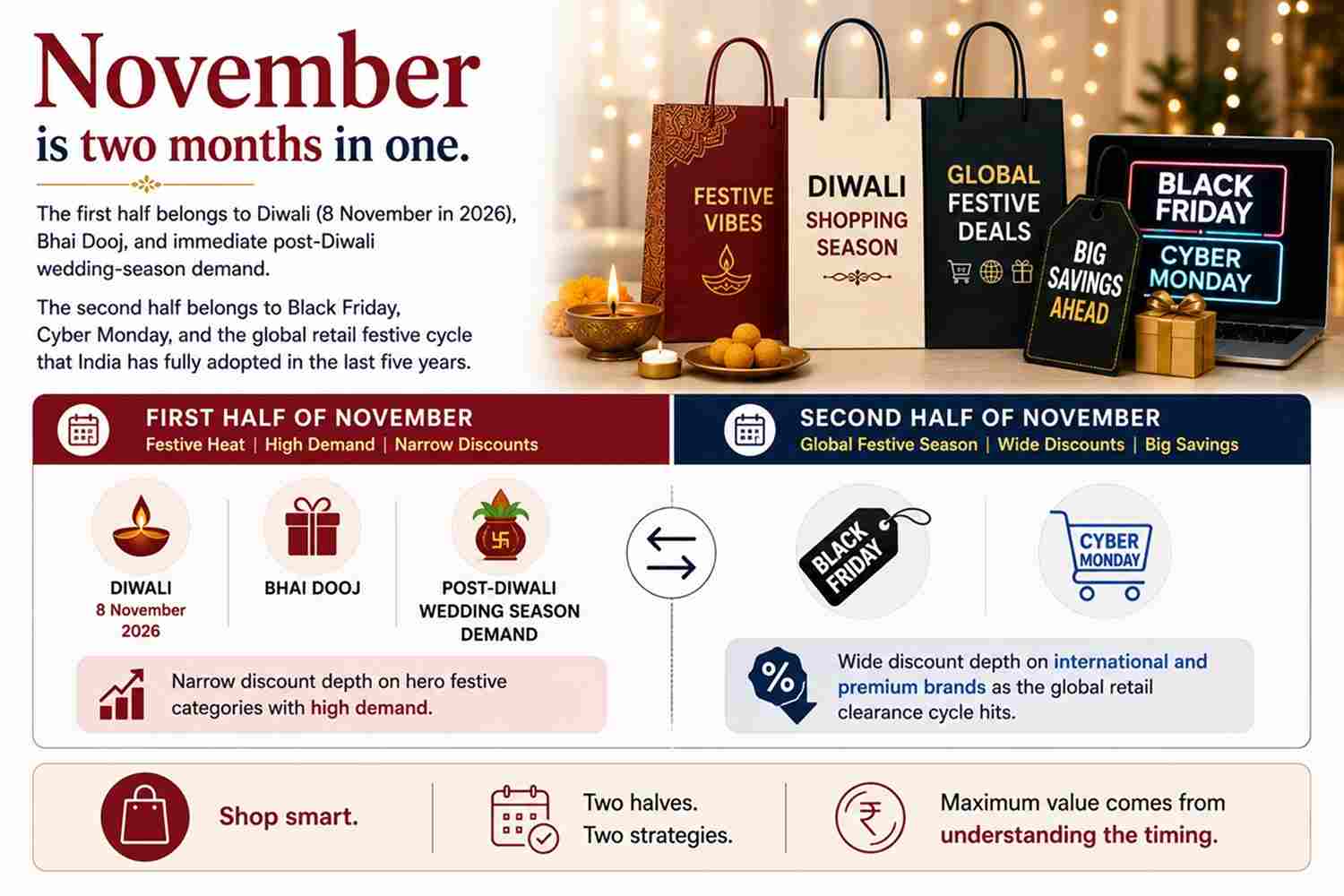
November is two months in one. The first half belongs to Diwali (8 November in 2026), Bhai Dooj, and immediate post-Diwali wedding-season demand. The second half belongs to Black Friday, Cyber Monday, and the global retail festive cycle that India has fully adopted in the last five years.
These two halves operate on opposite logic. The first half has narrow discount depth on hero festive categories with high demand. The second half has wide discount depth on international and premium brands as the global retail clearance cycle hits.
Key sale events to track
- Diwali sales across all platforms peaking 1 to 7 November
- Myntra Grand Wedding Gala Sale, typically running 4 to 9 November with 50 to 80 percent off on wedding-relevant categories
- Pre-Diwali brand-led sales at Westside, Pantaloons, FabIndia, Biba, W, Aurelia
- Bhai Dooj gifting sales (around 11 November)
- Black Friday on 27 November 2026, with most major platforms running events from 22 to 30 November
- Myntra Black Friday Sale (typically 26 to 30 November), focusing heavily on international brands
- Ajio Black Friday Sale (typically 22 to 30 November)
- Nykaa Pink Friday Sale (Black Friday equivalent)
- Cyber Monday (30 November to 1 December) with parallel events extending into early December
What is happening in the system
The first 10 days of November are the festive tail. Inventory is selling. Brands are not under pressure to discount further. Wedding-season demand begins immediately after Diwali.
From around 15 November, the system shifts. Festive inventory has cleared. Pre-winter and AW collections are landing. Indian retailers begin participating in global Black Friday cycles, and international brands run deep clearance on residual SS stock that has not moved through Indian EOSS cycles.
The result: the second half of November is, for many international and premium brands, the deepest discount window of the year on selected SKUs, sometimes deeper than EOSS or BBD.
What to actually buy in November
| Category | Why November is the right month |
| Wedding-season ethnic wear (1 to 9 November window) | Myntra Grand Wedding Gala and similar deliver real depth |
| International brand fashion (Black Friday window) | Global clearance hits these hardest of the year |
| Premium and designer Western wear (Black Friday) | Deepest annual cuts on selected SKUs |
| Footwear from international brands | Black Friday consistently delivers genuine premium-footwear discounts |
| Beauty and skincare premium brands (Pink Friday) | Often the year’s lowest pricing on La Mer, MAC, Estée Lauder, etc. |
| Watches, bags, and accessories from international brands | Black Friday is the year’s peak for these |
| Winter wear ramp (mid-month) | First genuine markdowns of the AW season |
What to skip in November
| Category | Why to wait |
| Heavy festive ethnic wear (post-Diwali) | Demand has cleared; designer ethnic moves to clearance in December |
| Indian D2C brand staples at “Black Friday” prices | Indian D2C tends to run shallower BF discounts; January EOSS is deeper |
| Brand-new winter wear launches at full price | January and February EOSS will discount these heavily |
The insider tactics
The Myntra Black Friday focus is international brands. This is the cleanest signal of the month. If you have international fashion (H&M, GAP, Levi’s, Nike, Converse, Puma) on your wishlist, Black Friday on Myntra is typically the year’s best window. Discounts of 50 to 80 percent are real here, often deeper than EORS or EOSS.
Cyber Monday is for accessories and specific D2C. Cyber Monday in India tilts harder toward digital-native categories: smart-watches, electronics-fashion crossovers, premium beauty, and certain D2C labels. Discount depth on apparel is generally not as sharp as Black Friday.
The wedding-gala paradox. Myntra’s Grand Wedding Gala sales window in early November can deliver deep discounts on wedding-relevant categories, but pricing depth varies wildly between premium designer ethnic (where MRPs are inflated) and mid-tier wedding wear (where the discounts are real). Trust mid-tier brand discounts over premium designer “70 percent off” markdowns.
The post-Diwali dip is a buying opportunity. Around 11 to 15 November, between the festive tail and Black Friday ramp, there is a 4 to 5 day pricing trough on platforms. Inventory that did not clear during Diwali gets quietly re-priced to make room for Black Friday and AW launches. This is one of the year’s hidden value windows.
Stack Black Friday with year-end thinking. Black Friday is your last clean window before December prices. December has selective clearance on AW but limited platform mega-events until late month. If you need international brands, premium accessories, or premium beauty, Black Friday is your best annual window.
Nykaa’s Pink Friday often delivers the year’s deepest cuts on luxury beauty, including international prestige brands not discounted elsewhere. If you have prestige beauty on your list, this is the window.
Ignore the “Indian Black Friday” framing for native brands. Indian D2C and homegrown brands using Black Friday branding are usually running standard November sales rebadged. Their genuine clearance windows are January EOSS, March fiscal-year-end, and June EORS.
December: The Long Tail and the Year-End Push
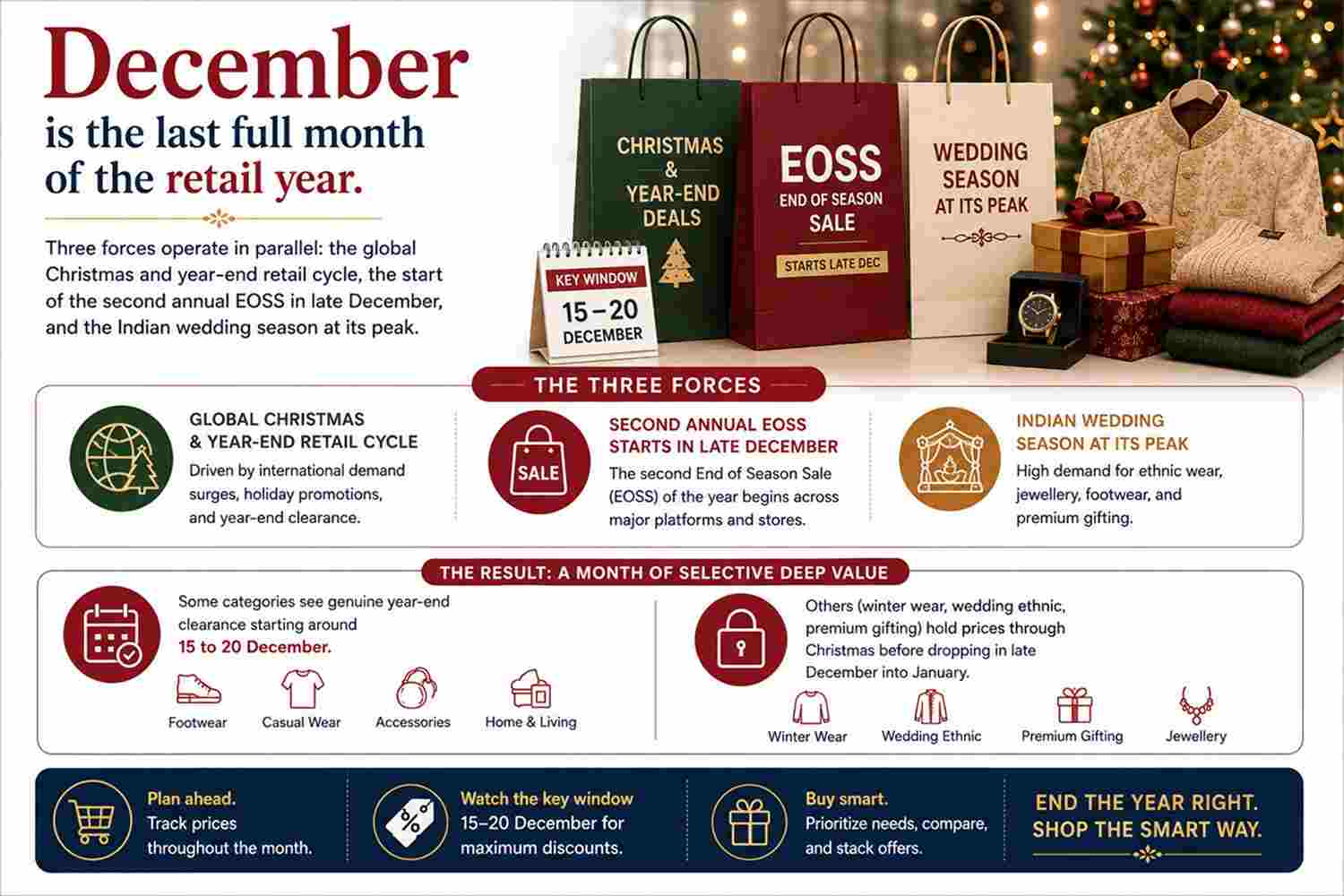
December is the last full month of the retail year. Three forces operate in parallel: the global Christmas and year-end retail cycle, the start of the second annual EOSS in late December, and the Indian wedding season at its peak.
The result is a month of selective deep value. Some categories see genuine year-end clearance starting around 15 to 20 December. Others (winter wear, wedding ethnic, premium gifting) hold prices through Christmas before dropping in late December into January.
Key sale events to track
- Myntra End of Reason Sale (winter cycle), typically launching in early to mid-December with 50 to 80 percent off across thousands of brands
- Ajio Cyber Monday Sale extending into early December (typically 1 to 7 December) with 60 to 70 percent off
- Amazon Christmas Sale (around 20 to 25 December), focused on gifting
- Flipkart Buy Buy Sale and December events
- Flipkart Shaadi Specials Sale, typically the first week of December with 60 to 80 percent off on wedding categories
- Brand-led EOSS launching at most major retailers in the last week of December (Westside, Pantaloons, Lifestyle, M&S, H&M, Zara, etc.)
- Myntra Year-End Sale and New Year Sale running through Christmas week
- Year-end clearance across D2C brands closing calendar-year books
What is happening in the system
The system is preparing for the January EOSS that will officially clear all AW inventory before Spring/Summer landings in February. December is the warm-up. Some brands run aggressive markdowns early; others hold until 26 December and the official EOSS launch.
Wedding-season demand continues at peak through December (especially in north India), keeping ethnic and formal wear prices firm. Christmas drives gift-category demand for premium beauty, watches, perfumes, and luxury accessories, which see real but selective discounts.
What to actually buy in December
| Category | Why December is the right month |
| Western fashion mid-month at year-end clearance | Post-Cyber Monday, pre-Christmas dip is real |
| Winter wear (mid to late month) | EOSS launches in last week, with deep genuine clearance |
| Premium beauty and luxury gifting | Christmas-driven cuts genuinely competitive with Black Friday |
| Watches, bags, and accessories from premium brands | Year-end clearance plus EOSS overlap |
| Wedding-season formal wear (Western) | Wedding-driven demand is on ethnic; Western formals see real discounts |
| Travel and luggage | Year-end vacation surge, brands push volume |
| Perfumes and fragrance gift sets | Christmas is the second-best annual window after Valentine’s |
What to skip in December
| Category | Why to wait |
| Heavy ethnic and wedding wear | Wedding-season demand keeps prices firm; January EOSS goes deeper |
| AW launches at full price (early December) | Late-December and January will discount these by 30 to 60 percent |
| Christmas-themed apparel | Highly seasonal; January clearance will go deeper if you can wait a year |
| Brand-new winter outerwear at full price | January EOSS and February clearance will go deeper |
The insider tactics
The 26 December trigger. Most brick-and-mortar EOSS officially launches the day after Christmas. Online retailers begin parallel discount cycles. The window from 26 December to 31 December is when winter wear and AW collections see their first genuine markdowns of the season.
Christmas is the second-best fragrance window. After Valentine’s, Christmas delivers the year’s deepest cuts on premium fragrance gift sets and curated grooming combos. If you missed February, this is your second chance.
The Cyber Monday tail in early December. Ajio and similar platforms extend Cyber Monday pricing into the first week of December. This is a genuine value window that many shoppers miss because they assume the post-Black Friday pricing has reset. It has not, in many cases, until 7 to 10 December.
The pre-EOSS quiet. From around 15 to 25 December, some platforms enter a quiet phase before the EOSS cycle launches. Discount depth softens, marketing quiets. This is a buying-opportunity dead zone unless you specifically need Christmas gifting.
Wait on heavy ethnic. Wedding-season demand keeps ethnic wear prices firm through December. The same lehenga or sherwani that costs ₹15,000 in mid-December will likely be ₹8,000 to ₹10,000 by mid-January. If your wedding is after February, waiting 3 to 4 weeks pays off.
Year-end EOSS is the gateway to January. The discounts launching on 26 December are the same ones that will run through January. There is rarely a meaningful pricing change between late December and early January. If you find what you need at year-end, buy. Do not wait two days for “January EOSS” thinking it will be sharper. It will not.
The new-year bank-offer reset. Banks renew their merchant partnerships in late December and early January. The sale-window bank discounts you saw in November may not apply in late December. Always re-check which card gives the best instant discount at checkout.
Category-Specific Discount Patterns
The calendar tells you when. The category map tells you what.
Each fashion category has its own demand cycle, its own clearance pressure, and its own optimal buying window. Some align with the major mega-sales. Others align with the off-cycle moments most shoppers ignore.
Western casual wear (jeans, t-shirts, shirts, dresses): January EOSS and June EORS deliver the deepest genuine cuts. International brands (Levi’s, H&M, GAP, Zara) often see 50 to 80 percent off in these windows. Festive sales (BBD, GIF, Diwali) are competitive but not always deeper. Avoid buying these at Valentine’s, Independence Day, or Republic Day pricing without checking 30-day price history.
Ethnic wear (kurtas, kurta sets, sarees, lehengas): This category is the most dependent on demand cycles, not clearance cycles. Daily-wear ethnic (kurtis, kurta sets) discounts deepest in mid-July through early August (off-season) and post-Diwali into early January. Heavy festive ethnic (lehengas, sherwanis, designer sarees) is rarely a true bargain during festive sales due to inflated MRPs. The cleanest value window is mid-January to February for heavy ethnic, especially from established brands.
Footwear (formal, casual, sneakers, sandals): Two windows dominate. January EOSS and June EORS for international brands (Nike, Adidas, Puma, Converse, Skechers). Within the year, Black Friday sometimes goes deeper for premium international footwear. Indian footwear brands (Bata, Liberty, Red Tape, Metro) follow a different cycle, with deepest cuts during BBD/GIF and post-Diwali clearance. Save on footwear purchases with Grabon
Innerwear and basics: This category rarely sees deep base discounts. The optimal strategy is coupon-stacking year-round, with a focus on April to May (slow months, soft pricing, maximum stack value) and during Valentine’s specifically for premium brands like Zivame, Clovia, Amante, and Triumph.
Premium watches, bags, and accessories: Twice-yearly EOSS (January and July) plus Black Friday are the only three genuine windows for saving on premium accessory brands. Festive sales tend to feature inflated MRPs in this category. If a Coach bag or Michael Kors watch is on your list, July or Black Friday is your window.
Activewear and athleisure: Resolution-period (January) sees brands hold pricing. Real discounts hit in April to May (post-resolution demand cool-off), June EORS, and late July through August (back-to-gym cycles for the Indian fitness calendar). Premium athleisure (Nike, Adidas, Puma, Reebok, Asics) follows the same EOSS pattern as Western fashion.
Beauty, skincare, and fragrance: Nykaa’s Pink Friday (Black Friday equivalent) delivers the year’s deepest annual price cuts on premium beauty. Valentine’s Day and Christmas are the two best windows for fragrance and gifting bundles. BBD/GIF beauty sub-events in October are genuinely competitive with Pink Friday.
Kids’ apparel: Back-to-school window (mid-July to mid-August) has the year’s deepest price cuts on uniforms, backpacks, school shoes, and youth fashion. Festive ethnic for kids follows the broader ethnic cycle. Brand-led kids’ fashion (Mothercare, Carter’s, FirstCry) runs major clearance during BBD/GIF and June EORS. Save on Kid’s wear with Grabon.
Designer and premium fashion: Limited windows. Twice-yearly EOSS (January and July) and selected items during Black Friday are essentially the only times these labels meaningfully discount. Festive sales rarely deliver real value on designer fashion due to demand pricing.
| Category | Best month | Second-best window | Window to avoid |
| Western casual wear | June (EORS) | January (EOSS) | Republic Day, Valentine’s |
| International brand fashion | July (EOSS) | November (Black Friday) | September pre-festive |
| Daily-wear ethnic | July (off-season) | January (post-festive) | September, October |
| Heavy festive ethnic | January (post-festive clearance) | February (fiscal-year-end) | September, October |
| Footwear (international) | January (EOSS) | July (EOSS) | Republic Day, Valentine’s |
| Footwear (Indian brands) | October (BBD/GIF) | January (EOSS) | March, April |
| Premium accessories | July (EOSS) | November (Black Friday) | August, September |
| Activewear | June (EORS) | August (post back-to-gym) | January, February |
| Premium beauty | November (Pink Friday) | February (Valentine’s) | March, April |
| Fragrance gift sets | February (Valentine’s) | December (Christmas) | June, July |
| Kids’ apparel | August (back-to-school) | October (BBD/GIF) | March, April |
| Designer and luxury | January (EOSS) | November (Black Friday) | All festive sales |
Online vs Offline: Where Each Category Is Genuinely Cheapest
Most shoppers default to online for everything because they see headline discount percentages. This costs them money on at least three categories.
Where online wins genuinely: International fast fashion (H&M, Zara, Mango), premium and designer labels through Myntra Luxe and Tata Cliq Luxury, beauty and skincare (Nykaa’s curation and pricing is structurally cheaper than offline), and any category where coupon-stacking and cashback aggregators add 15 to 25 percent on top of headline discounts.
Where offline wins genuinely: Heavy ethnic wear from established Indian brands (FabIndia, Biba, W, Manyavar, Kalyan Sarees), premium tailored Western wear (Raymond, Allen Solly, Louis Philippe), and any item where fit and feel matter more than price (suiting, leather goods, undergarments). Offline EOSS at brand-owned stores often goes 5 to 10 percent deeper than online for the same SKU because online platforms charge sellers a marketplace fee that compresses the seller’s discounting room.
Where it depends on the SKU: Footwear, mid-tier ethnic, casual Western, and accessories vary brand by brand. Always check both before buying.
The mechanics behind this are worth understanding. Online platforms run on marketplace economics: sellers pay 15 to 30 percent commissions to Myntra, Ajio, or Flipkart, plus shipping fees, plus return-handling costs. The same product at the same MRP nets the seller meaningfully less when sold online than offline. To run an aggressive online discount, the seller has to absorb commission and discount simultaneously, which often caps the depth.
Offline brand-owned stores have no marketplace commission. They have rent, but no SKU-level economics fighting against the discount. This is why during a brand’s own EOSS at a flagship store, you often see deeper cuts than the same brand’s listing on a marketplace.
The best practice for high-value purchases (anything above ₹3,000): check both. Compare the brand-owned site or store price against Myntra, Ajio, and Tata Cliq. The price gap is often 10 to 20 percent. For anything under ₹1,500, the convenience and stack-ability of online almost always wins.
Three additional online-specific levers most shoppers under-use:
Platforms like GrabCash take a slightly different approach. Instead of just being a middle layer for your own purchases, GrabCash lets you earn by sharing deals with others. You create a trackable link, share it on WhatsApp, Telegram, or social media, and earn a commission whenever someone shops through it. There’s no investment needed, and earnings are transparent and tracked in real time, though final payouts still depend on merchant approval cycles (typically 15 to 60 days).
Bank co-branded gift cards: Buying Myntra, Ajio, or Amazon gift cards through bank partnerships or sites like GyFTR adds another 2 to 5 percent layer. Stacks with everything else.
Wishlist-based pricing notifications: Both Myntra and Flipkart send price-drop alerts when a wishlisted item drops in price. These alerts often beat the public sale announcement by 12 to 24 hours. Wishlist aggressively, then react to alerts.
How to Tell a Real Discount from a Fake One
This is the single most valuable section of this guide. Indian retail has a documented history of inflated MRPs and dark-pattern discounting, particularly during festive sales. India’s Central Consumer Protection Authority has formally identified 13 categories of dark patterns including drip pricing, basket sneaking, false urgency, and bait-and-switch discounting. Festive mega-sales have been documented as repeat examples.
A fake discount looks identical to a real one until you check it. Here is how to check, in a few seconds.
The three-step price test
Step 1: Check the 30-day price history. Tools like Flipshope (browser extension), Pricehistoryapp, Keepa and similar trackers maintain six-month price history for products on Amazon, Flipkart, Myntra, and Ajio. Before buying anything during a sale, install one of these and look at the chart. If today’s “60 percent off” price is the same as the average of the last 30 days, the discount is fake.
Step 2: Check the final-checkout price. Drip pricing is the practice of revealing additional charges only at checkout. Watch for: pre-ticked warranty add-ons, “platform fees,” “convenience charges,” shipping fees that appear after you select your size, mandatory protection plans. The displayed offer price is irrelevant if the checkout price is 15 percent higher.
Step 3: Check the final-discount math. A brand running “Buy 2 Get 1 Free” sounds like 33 percent off. The math is correct. But the same brand often runs a flat 30 percent off the next week, where you can buy any quantity. Calculate effective per-unit pricing, not the headline.
The trust hierarchy
If you have to pick one category-source combination for the cleanest discount transparency, the order tends to be:
- Brand-owned D2C site EOSS (most transparent, no marketplace fees compressing the discount)
- Premium aggregators with verified pricing (Myntra Luxe, Tata Cliq Luxury, Nykaa Luxe for beauty)
- Mainline marketplaces during EOSS or EORS (more transparent during these windows than during festive sales)
- Mainline marketplaces during festive sales (most opportunity for dark patterns; check carefully)
- No-name brands with high MRPs and “70 percent off” (highest risk; mostly avoid)
The single highest-leverage habit a smart Indian shopper can build is using a price-history browser extension. It takes 30 seconds to install and shows you the truth in one chart. Almost no one uses these tools, which means using them gives you a structural information advantage over every other shopper.
The Smart Shopper Playbook
If you take nothing else from this guide, take these seven rules.
- Buy in two windows: January and July. EOSS in January and July deliver the deepest, most reliable, most transparent discounts of the year on the broadest range of categories. Plan your major purchases around these two windows. Everything else is noise unless it lines up against a specific category cycle.
- Build wishlists 30 to 60 days before any sale. A discount only matters if you have a baseline. Wishlist what you want during the slow months (April, May, October-mid). When the sale arrives, you can verify whether the price actually dropped or got rebadged.
- Use a price-history tool every time. Install Flipshope or a similar browser extension. Take 30 seconds to verify before buying anything above ₹1,500. This single habit will save you more money over a year than every other tactic combined.
- Stack strategically, in this order: discount, bank, coupon, cashback. The base sale discount is the foundation. The bank instant discount is typically the highest-impact stack (10 percent on average). A platform-specific coupon adds another 5 to 15 percent. A cashback aggregator click-through adds 3 to 8 percent. Done correctly, this stacks 15 to 25 percent on top of the headline discount.
- Off-season buy your seasonal items. Winter wear in February. Heavy ethnic in mid-January or July. Wedding wear in March or April for next year. The discount premium for shopping off-season is consistently 30 to 50 percent.
- Treat festive sales with discipline, not enthusiasm. Diwali, Big Billion Days, and Great Indian Festival have the highest dark-pattern density of the year. The headline discounts are real on selected SKUs and inflated on others. Check, do not assume.
- Subscribe to D2C newsletters. Independent Indian D2C brands run their best discounts unannounced and via email, especially in March (fiscal year end) and the last week of every quarter. Free newsletters from your favourite three to five brands are the cheapest information advantage you can buy.
Frequently Asked Questions
Which month has the biggest fashion sale in India?
Discount depth and reliability peak in January and July (EOSS) and late May to early June (EORS). Festive mega-sales in September to November have the biggest marketing but variable real-discount depth depending on category and SKU.
Are EOSS discounts genuine?
Yes. EOSS in January and July is the most transparent and reliable discount window in the Indian fashion calendar. Brands have real inventory pressure to clear seasonal stock, and the discounts are not manufactured for marketing.
Is online cheaper than offline for fashion in India?
Depends on the category. Online is genuinely cheaper for international fast fashion, premium beauty, and any item where coupon-stacking adds value. Offline is often cheaper for heavy ethnic wear, premium tailored Western wear, and brand-owned EOSS at flagship stores. For anything above ₹3,000, check both.
When is the cheapest time to buy ethnic wear?
Daily-wear ethnic (kurtas, kurta sets, daily sarees) is cheapest in mid-July through early August (off-season) and again in mid-January after the festive cycle ends. Heavy festive and wedding ethnic (lehengas, sherwanis, designer sarees) is cheapest in mid-January to February.
How much can you actually save by timing your purchases?
A disciplined shopper using EOSS, off-season buying, coupon stacking, and price-history tools typically pays 35 to 55 percent less for the same fashion basket over a year compared to a casual shopper buying as items catch their attention.
Are festive sale discounts deeper online or in-store?
Online platforms run the bigger marketing and the wider selection. Brand-owned offline stores often go deeper on selected SKUs because they avoid marketplace commissions. For a specific brand’s full collection at sharp prices, the brand’s own store or D2C site frequently beats Myntra, Ajio, and Flipkart by 5 to 15 percent.
Do brands repeat the same discounts every year?
Discount depths are remarkably consistent year over year for the same brand, same category, same window. Specific dates shift (festivals are lunar, mega-sales adjust by a few days), but the overall structure of the calendar is highly predictable. The patterns described here have been consistent for at least the last five years.
What is the biggest mistake Indian shoppers make during sales?
Buying based on the headline percentage rather than the actual rupee price. A “70 percent off” no-name kurta at ₹1,500 is almost always more expensive than a “30 percent off” Biba kurta at ₹1,200. The discount math is irrelevant. The price math is everything.