
Netflix is the largest paid video streaming service globally, with over 325 million subscribers (as reported officially in January 2026). And if we consider multiple viewers per account, Netflix estimates that its global audience is approaching 1 billion viewers.
The company holds a dominant market share in the video-on-demand (VoD) segment and earned $45.2 billion in revenue from adding new users, ad income, and pricing in 2025.
Top Picks
- Netflix has the highest number of subscribers among global streaming platforms, with over 325 million subscribers.
- The US has the highest number of Netflix subscribers at 87.8 million.
- At 41%, millennials represent the largest group of monthly Netflix viewers.
- Netflix recorded 95 billion watch hours globally in the first half of 2025 alone.
- Netflix is projecting an annual revenue of $50.7 to $51.7 billion for 2026. Q1 2026 revenue came in at $12.25B (+16% YoY), ahead of guidance.
- Reed Hastings, Netflix co-founder, will not stand for re-election to the Board at the June 2026 Annual Meeting.
A Brief Overview of Netflix
| Category | Details |
| Company Name | Netflix, Inc |
| Launch Date | August 29, 1997 |
| Founded By | Reed Hastings and Marc Randolph |
| CEO | Ted Sarandos, Greg Peters |
| Headquarters | Los Gatos, California |
| Valuation | $442 billion |
| Industry | Video on Demand |
| Business type | Publicly traded |
Netflix User Stats
Netflix’s user base has grown exponentially as the company has evolved from a DVD rental to a global streaming platform. As one of the first companies to introduce the subscription-based model for video entertainment, Netflix successfully capitalized on the initial digital streaming wave. This momentum has only solidified as the streaming landscape expanded. Let’s take a look at where the usage numbers stand today.
How many people use Netflix in 2025?
Netflix launched its streaming service in January 2007 and began with 6.3 million paid subscribers. By the end of 2025, the number had grown to 325 million.
2024 happens to be the year Netflix added the highest number of new subscribers in its history. In Q4 of 2024 alone, Netflix had nearly 18.9M new subscriptions, the highest number ever in its quarterly addition history.
Here’s a look at Netflix’s user growth by year.
| Year | Paid Subscribers | YoY Subscriber Growth Rate |
| 2025 | 325 million | 7.8% |
| 2024 | 301.63 million | 15.9% |
| 2023 | 260.28 million | 12.8% |
| 2022 | 230.75 million | 4.0% |
| 2021 | 221.84 million | 8.9% |
| 2020 | 203.66 million | 21.9% |
| 2019 | 167.09 million | 20.0% |
| 2018 | 139.26 million | 25.9% |
| 2017 | 110.64 million | 24.2% |
| 2016 | 89.09 million | 25.8% |
| 2015 | 70.84 million | 30.0% |
| 2014 | 54.48 million | 23.81% |
Note: Netflix stopped reporting quarterly subscriber numbers starting Q1 2025. The 325M figure is the last disclosed subscriber count (end of 2025). Netflix now reports revenue and engagement as primary growth metrics.
The following graph shows Netflix’s subscriber growth over the years. The graph shows a steady incline over the years, with a distinct plateau in 2021 and 2022.
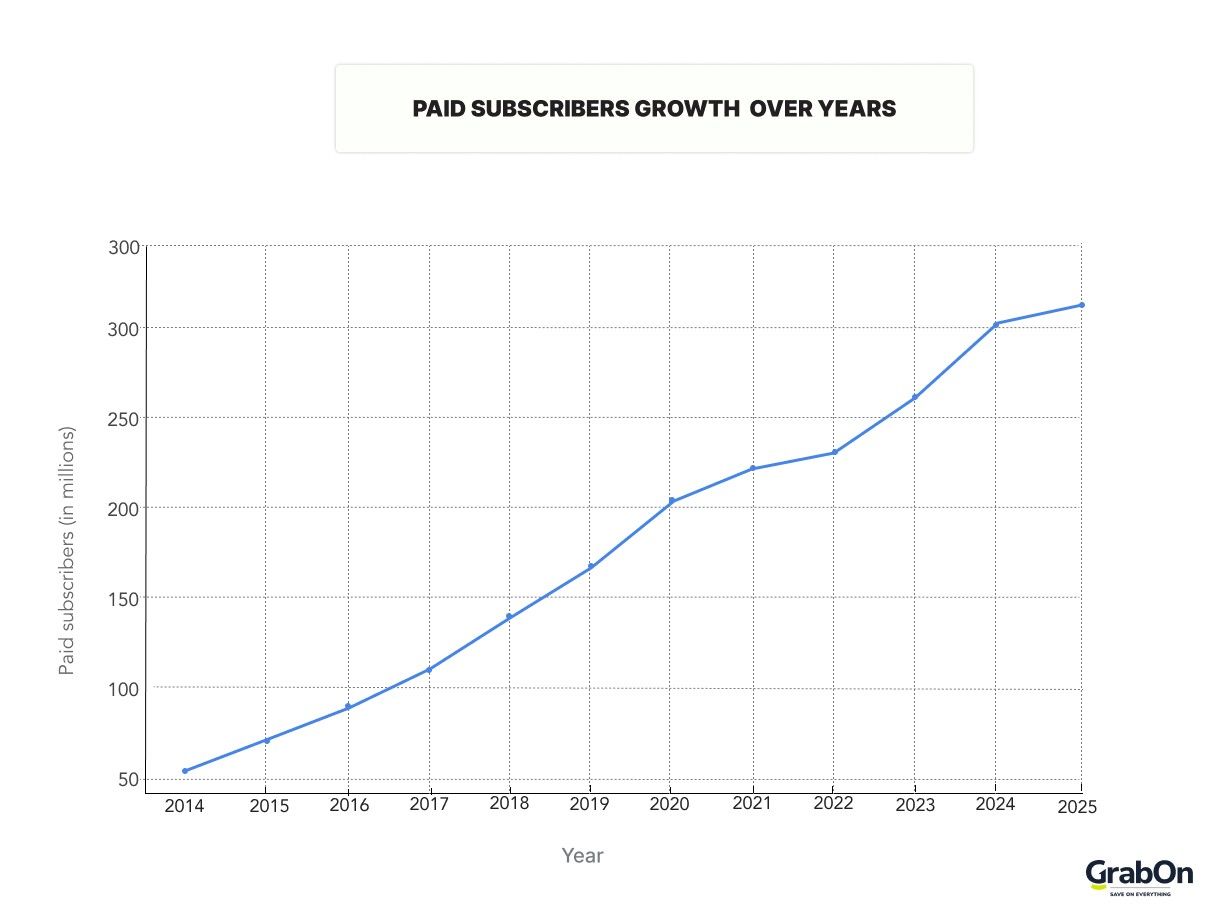
Source: Netflix Investor Relations
Over the past 10 years, Netflix’s memberships have grown at an average of 21.20% The sharp stagnation in growth rate that we see in 2021 and 2022 is a cumulative result of economic slowdown due to COVID, rising competition in the video streaming niche, increased prices, password sharing, and geopolitical events.
Netflix pulled out of Russia in 2022 in response to the Ukraine invasion. According to BBC News, the move resulted in a loss of over 700,000 subscribers at a go. They also increased the prices of their subscription plans in 2022, which resulted in a drop of 600,000 subscribers in North America alone.
However, Netflix made up for the two-year slump in 2023, with the subscriber addition rate going up by almost 3 times compared to the previous year. This was mostly from the password-sharing crackdown and the introduction of its ad-supported tier.
How many subscribers did Netflix gain from the password-sharing crackdown?
Netflix gained over 907,000 new membership additions in the US within the first five months of 2023, at the height of the password-sharing crackdown. The effects were still being felt by 2024, as in the first five months of 2024, Netflix’s gross additions crossed 1.8 million. That’s a nearly 98% year-on-year growth. (Antenna)
According to BBC News, by the first quarter of 2024, Netflix had added 9.3 million new subscribers. A significant part of this is believed to have come from the password-sharing crackdown. Netflix started implementing its anti-password sharing policies in March 2022 and gradually implemented them across the world by 2023.
How many subscribers use Netflix’s ad-supported plan?
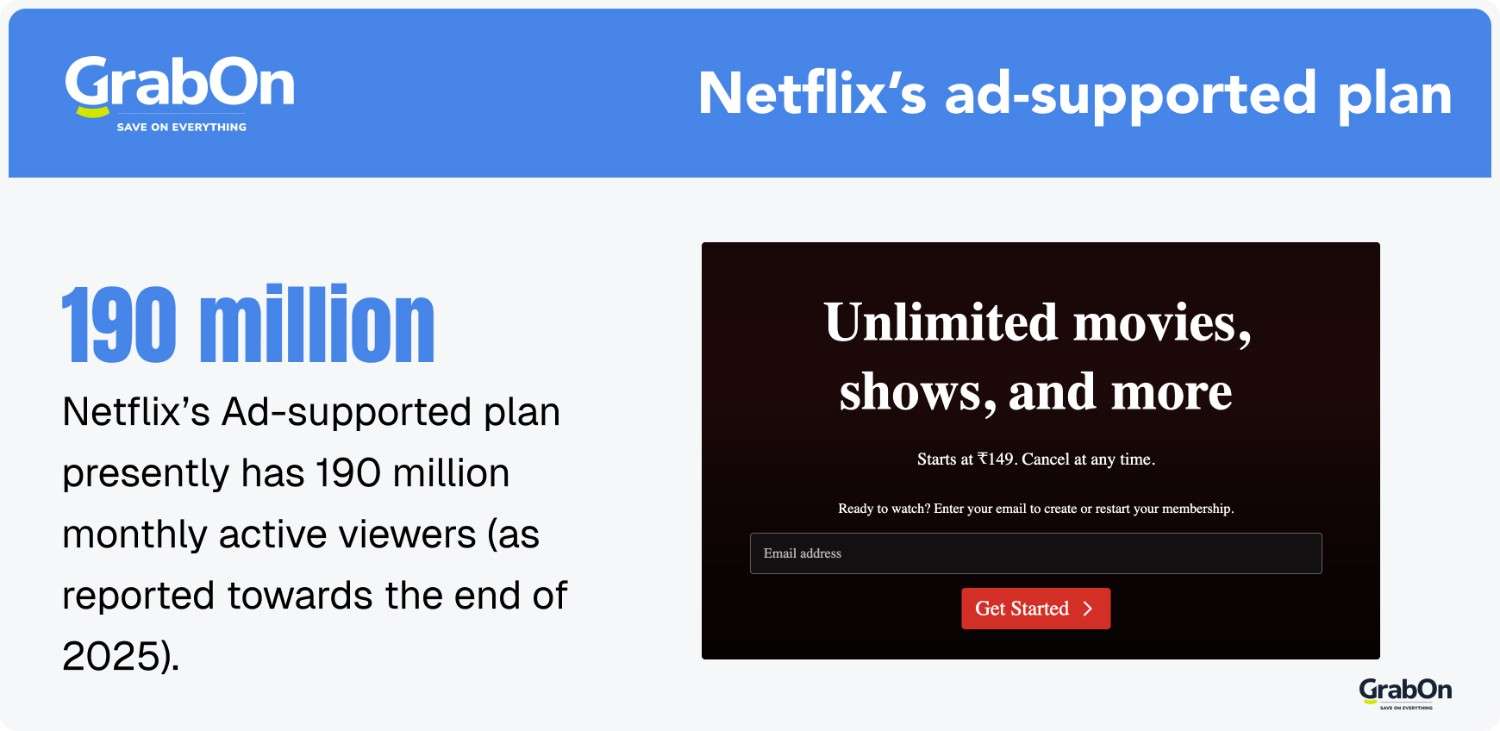
Netflix’s ad-supported plan had 190 million monthly active viewers as of end of 2025. As of May 2026, this figure has grown to over 250 million global monthly active viewers (Variety/Netflix, 2026). In the U.S., 45% of Netflix households now watch on the ad-supported tier (Netflix, 2026).
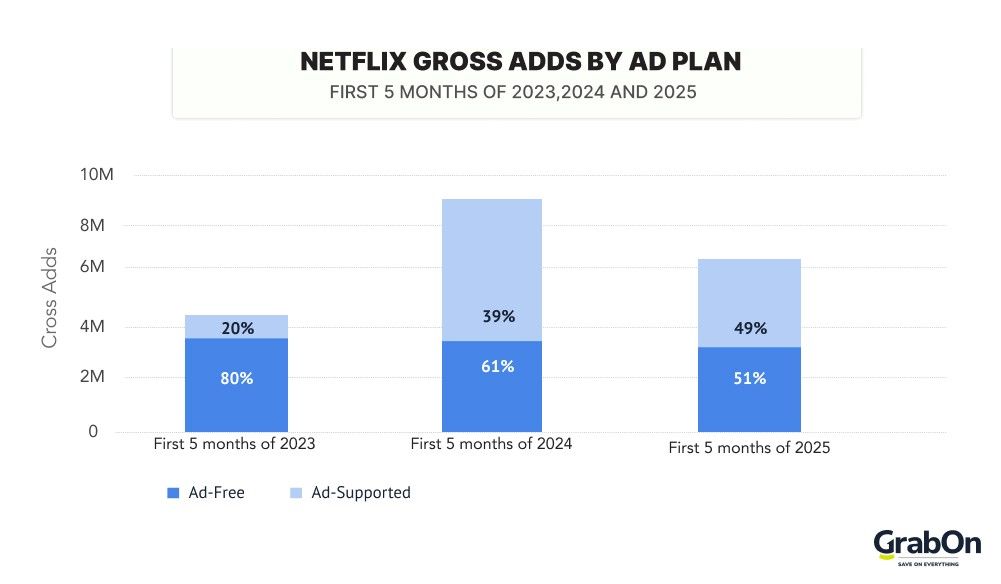
The ad plan accounted for 20% of new US additions in 2023’s first five months. By 2024’s first five months, it was 39%. In 2025, it reached 49% of new sign-ups. Per Q1 2026 shareholder letter, the ads plan represented over 60% of all Q1 2026 sign-ups in countries where ads are available.
At the end of 2024, Netflix confirmed that 40% of new sign-ups come from the ad-supported tier in the countries where it is available.
Netflix offers 3 membership tiers in most regions. The ad-supported plan is only available in 10 countries so far. These include:
- United States
- Canada
- Mexico
- Brazil
- Australia
- France
- Germany
- Italy
- Japan
- United Kingdom
- Spain
- South Korea
Netflix Users by Region
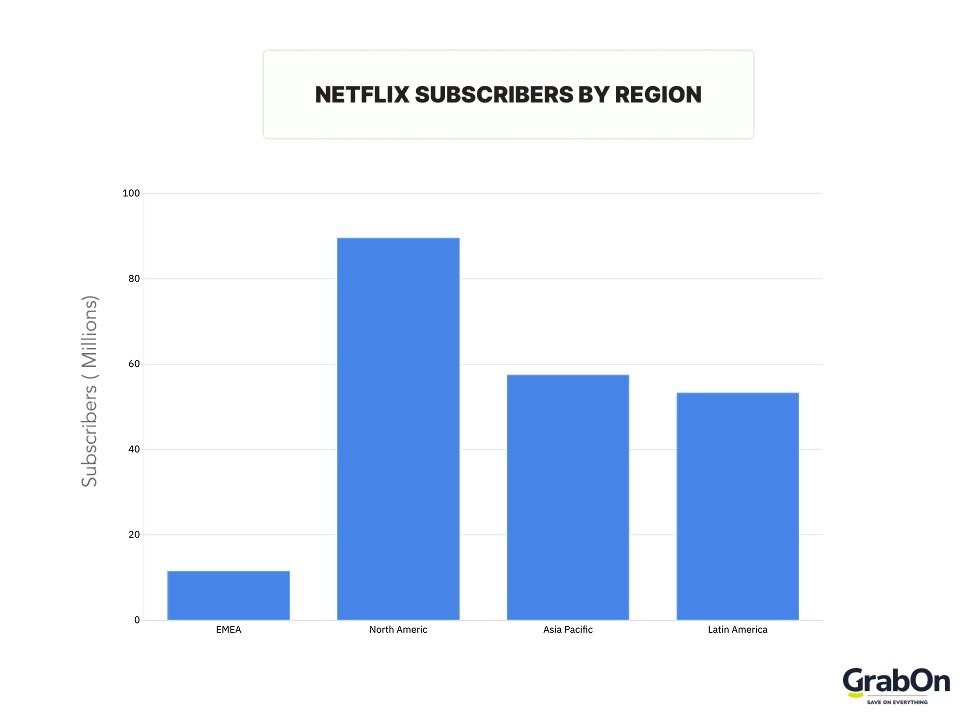
The highest number of Netflix subscriptions comes from the EMEA region, with 101.13 million subscribers, in 2024.
For the longest time, North America has been the leading market for Netflix in terms of subscriber count. However, in 2022, the subscriber count in the EMEA surpassed that by 11.5 million more subscribers.
- In 2024, North America (the U.S and Canada) came in second with 89.63 million subscribers.
- The Asia Pacific is also a fast-emerging market, clocking in third with 57.54 million subscribers.
- Latin America accounts for 53.33 million memberships.
Source: Statista, Netflix Investor Relations
Which country has the highest number of Netflix users?
The U.S. has the highest number of Netflix viewers worldwide at 87.8 million.
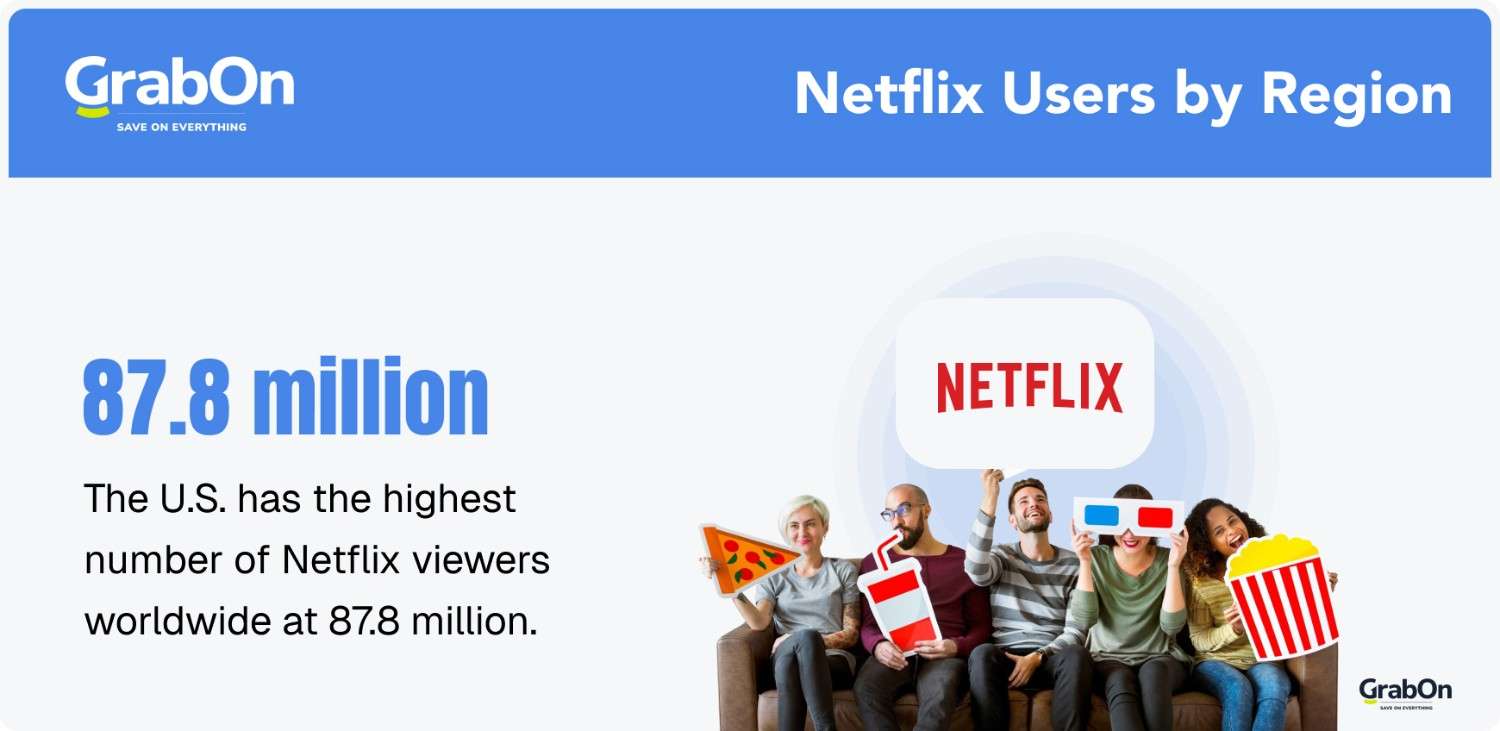
Despite the UCAN region coming in second in terms of total subscribers, the US alone contributes to approximately 27% of Netflix’s total subscriber count.
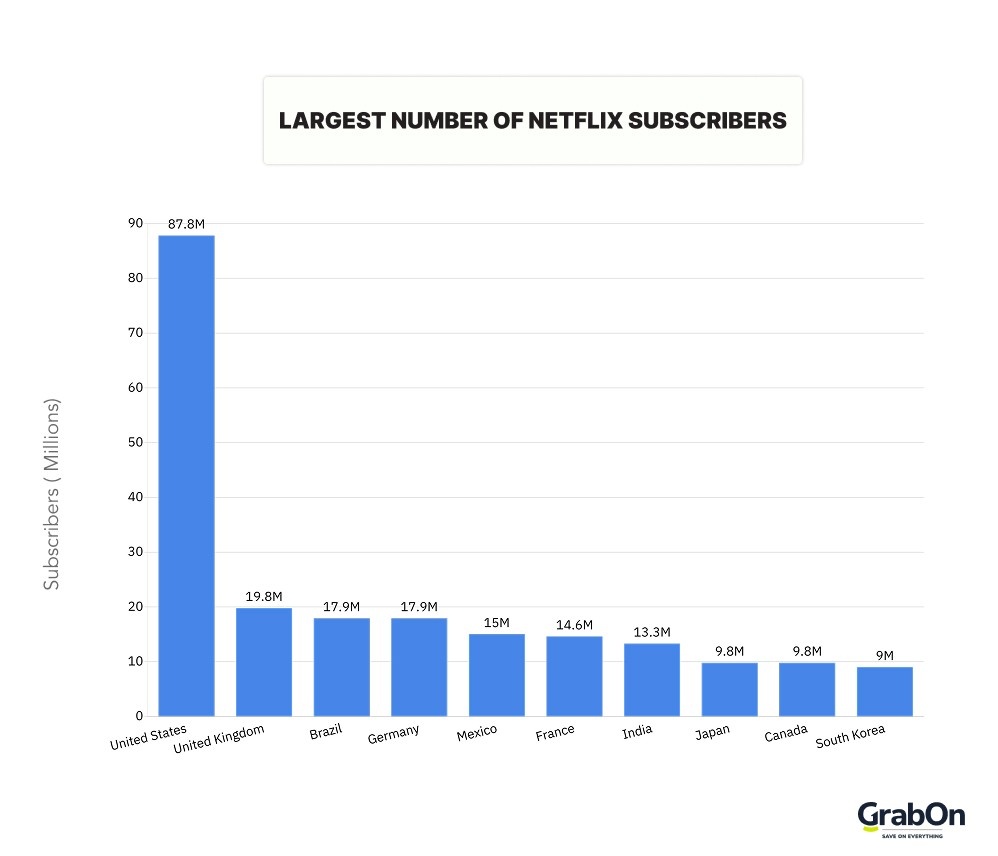
The UK has 19.8 million subscribers, coming in second. Brazil and Germany have the third-highest number of subscribers at 17.9 million.
Here are the top 10 countries with the largest number of Netflix subscribers:
| Country | Subscribers |
| United States | 87.8 million |
| United Kingdom | 19.8 million |
| Brazil | 17.9 million |
| Germany | 17.9 million |
| Mexico | 15.0 million |
| France | 14.6 million |
| India | 13.3 million |
| Japan | 9.8 million |
| Canada | 9.8 million |
| South Korea | 9 million |
As shown in the following graph, the US leads in the number of country-specific Netflix subscriptions by a very wide margin. It has nearly 68 million more subscribers than the UK, which comes in second place.
Meanwhile, countries like India and Brazil, despite ranking globally, still have significant scope for penetration, especially given their populations.
Source: Flix Patrol
Netflix User Demographics
Netflix’s content is consumed by viewers across all age groups. Due to its diverse content, the platform has something to offer for all age groups. This demographic-wide appeal actually helps in keeping users engaged consistently. Here’s a closer look at Netflix’s 2025 user demographics.
Netflix Users by Age
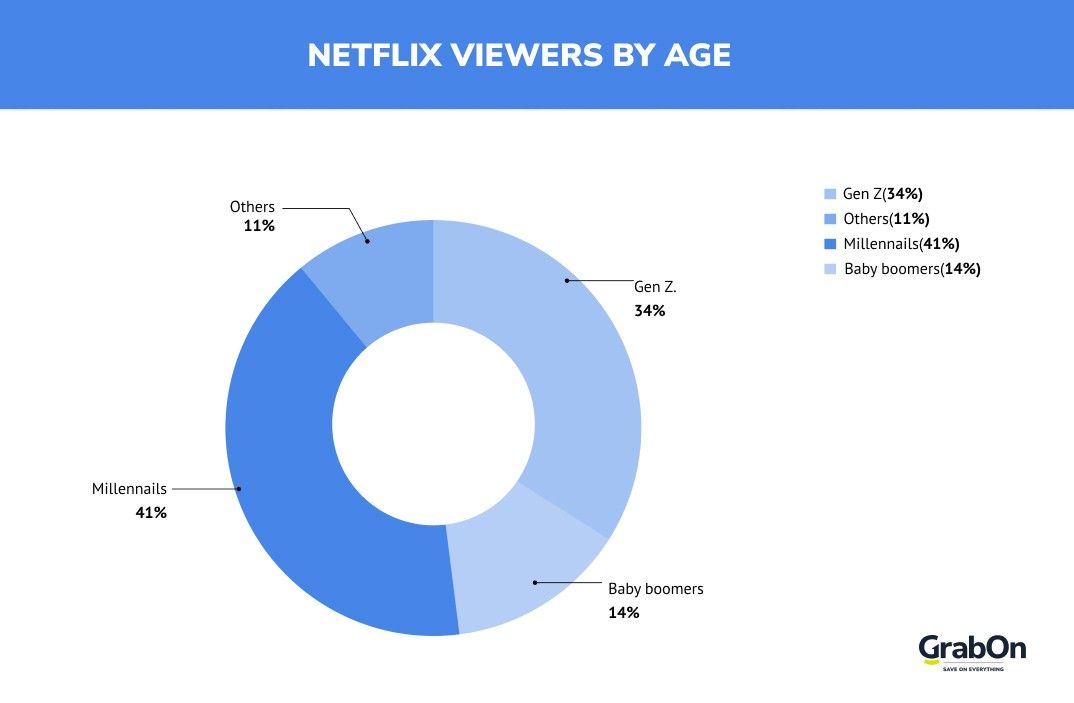
A US-based study found that 47% of the daily viewers were aged between 25 to 34 years old.
-
Millennials make up the most active viewer group on Netflix, with 41 percent of them tuning in at least once a month.
- 34 percent of the daily viewership comes from Gen Z.
- Baby boomers make up only 14% of the viewers.
The median age group of Netflix users lies between 35 and 44.
Source: Statista
Netflix Users by Gender
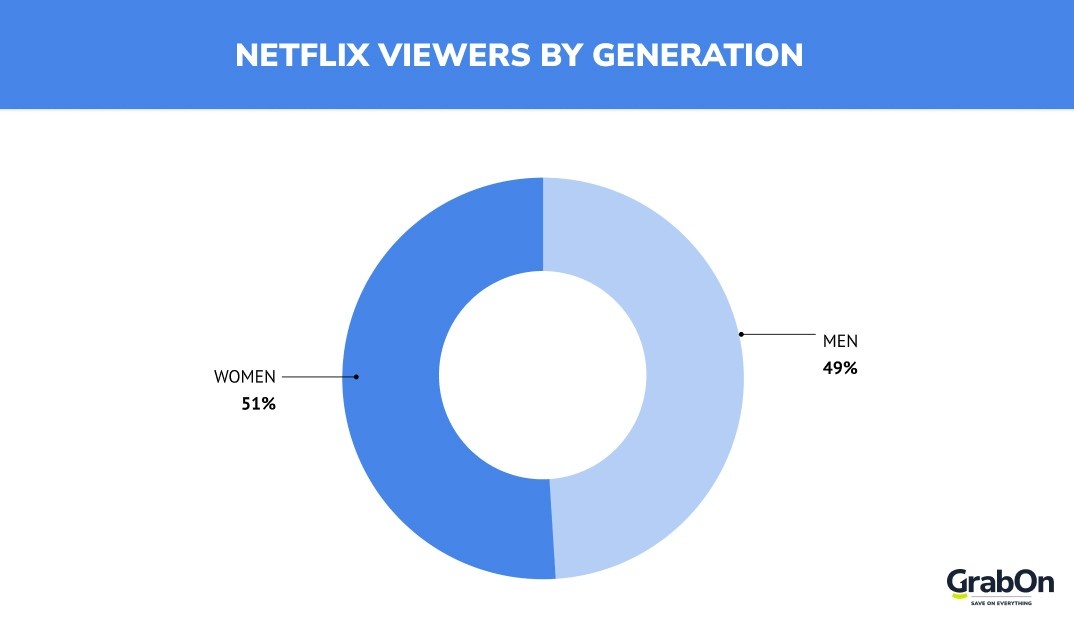
Netflix’s gender wise viewer demographics are almost a 50-50 split, with women being a marginal majority. Women make up nearly 51% of Netflix’s viewers. (Finances Online)
- Women watch an average of 5 hours of Netflix per week. (StatCrunch)
- Men’s watchtime averages around 3.5 hours weekly. (StatCrunch)
Netflix User Engagement Statistics
Netflix accounts for 10% of total TV viewership in all the countries it’s available in. (Netflix)
Netflix remains the largest streaming powerhouse worldwide, despite key players like Amazon Prime and Hulu gaining ground fast.
- In 2023, Netflix accounted for 15% of global streaming traffic. (Statista)
- 47% of Americans prefer Netflix over any other streaming platform.
- In 2025, 64% of American viewers watched Netflix at least once a week. (Statista)
- Netflix ranks second globally in the on-demand streaming category in 2024 after YouTube, accounting for an average of 1.4 GB of downstream traffic per subscriber per day. (Sandvine Global Internet Phenomena Report 2024)
In the first half of 2025, Netflix recorded 95 billion hours in watch time across all its content. (Netflix)
- Netflix users spend approximately two hours per day (per paid membership) on the platform. (Netflix)
- A 2022 survey discovered that US adults spend 62.1 minutes on Netflix per day, on average. (Statista)
- 55% of Netflix’s total watch time comes from Netflix Originals (CNBC)
- 80% of Netflix’s user activity is shaped by personalized recommendations through Netflix’s algorithm. (ResearchGate)
- A ResearchGate article cites a Netflix-commissioned survey that found 61% of its respondents binge-watch Netflix shows regularly.
- The average Netflix subscriber watches at least 7 movies a month. (Netflix)
Which language has the most-watched content on Netflix?
English continues to be the dominant language for the most-watched shows and movies on Netflix globally. As of the second half of 2025, both the top-watched show and the most-watched movies were in English.
- Wednesday: Season 2 was the top-watched show with 123.9 million views, followed closely by the much awaited Season 5 of Stranger Things which clocked in at 94 million views.
- Kpop Demon Hunters was the most-watched movie with 481.6 million views. This Netflix special movie is also the most watched movie on Netflix in a 6 month period.
- Following English, Korean content has emerged as the most-watched language on Netflix, thanks to films including The Great Flood (66M) and Love Untangled (29M). Popular shows like Bon Appétit, Your Majesty (38M), Genie, Make a Wish Season 1 (23M), Culinary Class Wars Season 2 (7M) and the third and final season of Squid Game (79M), also contribute to this ranking.
- Non-English content accounts for only 33% of Netflix’s total watch hours.
Top 10 Most-Watched Shows on Netflix
| Show Name | Views (Millions) |
| Wednesday: Season 2 | 123.9 M |
| Stranger Things 5 | 93.5 M |
| UNTAMED: Season 1 | 92.8 M |
| Squid Game: Season 3 // 오징어 게임: 시즌 3 | 79.0 M |
| Stranger Things | 56.6 M |
| Monster: The Ed Gein Story | 55.8 M |
| Sean Combs: The Reckoning: Limited Series | 50.8 M |
| Wednesday: Season 1 | 47.0 M |
| Ms. Rachel: Season 1 | 46.8 M |
| Stranger Things 2 | 44.6 M |
Top 10 Most-Watched Movies on Netflix
| Movie | Views (Millions) |
| KPop Demon Hunters | 481.6 M |
| Happy Gilmore 2 | 135.1 M |
| Frankenstein | 97.6 M |
| My Oxford Year | 86.1 M |
| The Old Guard 2 | 81.5 M |
| The Woman in Cabin 10 | 80.4 M |
| A House of Dynamite | 75.5 M |
| The Thursday Murder Club | 68.8 M |
| Brick | 66.7 M |
| The Great Flood // 대홍수 | 66.1 M |
Source: Netflix Engagement Report
Netflix Revenue and Market Share
Netflix remains the leading global streaming platform by number of users and significant market share across key markets worldwide. Its presence spans North America, EMEA, LATAM, and APAC, where strong subscriber growth, consistent content investment, and a diverse library keep it ahead of competitors. With expanding originals and localized content, Netflix continues to set the benchmark for global video streaming.
In December 2025, Netflix was set to acquire Warner Bros. in an $82.7 billion deal. The move would have been a seismic shift in the streaming landscape, as it would have absorbed Max, one of its biggest competitors, into its platform. This would have cemented its position as the undisputed monopoly of the global VoD industry. The deal carried enormous revenue prospects for Netflix, from HBO’s premium content library to Warner Bros.’ century-long catalogue of films and television, giving it unprecedented leverage to dictate the direction of the entire streaming market.
However, in late February 2026, Netflix walked away from the deal after Paramount Skydance raised its competing bid for Warner Bros. to $110.9 billion, which Netflix declined to match.
What is Netflix’s Annual Revenue in 2026?
Q1 2026 came in at $12.25 billion, ahead of guidance.
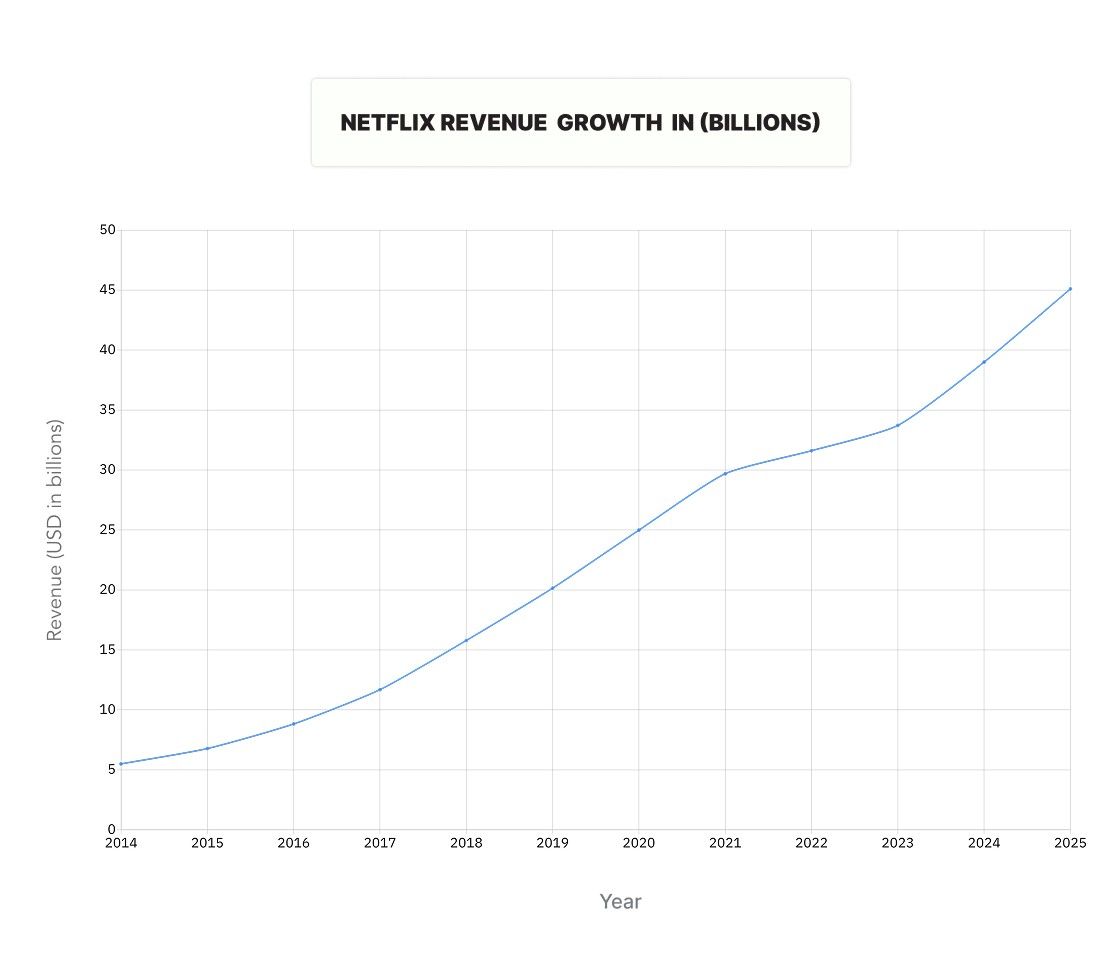
In 2025, Netflix generated $45.2 billion in annual revenue (+15.9% YoY). For 2026, Netflix projects $50.7–$51.7B revenue (+12%–14%), driven by membership growth, pricing, and a projected doubling of ads revenue.
Let’s take a look at Netflix’s annual revenue over the past decade.
| Year | Revenue (USD in billions) | YoY Revenue Growth |
| 2026 (Q1) | $12.2 billion | – |
| 2025 | $45.2 billion | 15.90% |
| 2024 | $39 billion | 15.66% |
| 2023 | $33.72 billion | 6.68% |
| 2022 | $31.61 billion | 6.47% |
| 2021 | $29.69 billion | 18.81% |
| 2020 | $24.99 billion | 24.02% |
| 2019 | $20.15 billion | 27.61% |
| 2018 | $15.79 billion | 35.07% |
| 2017 | $11.69 billion | 32.39% |
| 2016 | $8.83 billion | 30.24% |
| 2015 | $6.78 billion | 23.27% |
| 2014 | $5.5 billion | 15.64% |
Source: Netflix Shareholder Letters (2014-2026)
From $5.5 billion in 2014 to a projected $45.2 billion in 2025, Netflix’s revenue shows a compound annual growth rate of nearly 21%. This is especially impressive considering the video streaming industry was at a fairly nascent stage in 2014.
This consistent revenue increase was driven by original content, membership fees, and ad revenue.
A majority of Netflix’s titles (55%) are in-house productions. This saves the company significant amounts on licensing costs. The membership pricing, Netflix’s biggest revenue driver, is also designed to offer a steady influx of revenue across different markets at different price points.
Besides this, Netflix also aims to increase its net income by lowering its operating margins.
How much does Netflix earn from its ad-supported plan?
In 2025, Netflix’s ad revenue rose by 2.5 times to 1.5 billion dollars (Netflix 2025 Q4 Shareholder Letter).
This number is only expected to grow as Netflix co-CEO Greg Peters estimates ad tier revenue to roughly double year-over-year. His estimates may not be that far off, as the number has indeed doubled in the past two years.
The ad tier also generated $70.44 in revenue per user. However by this year the number is expected to fall to $59.67 per user. Despite that Netflix will still generate more ad revenue that any other streaming platform. (Emarketer)
What is Netflix’s Average Revenue per User in 2026?
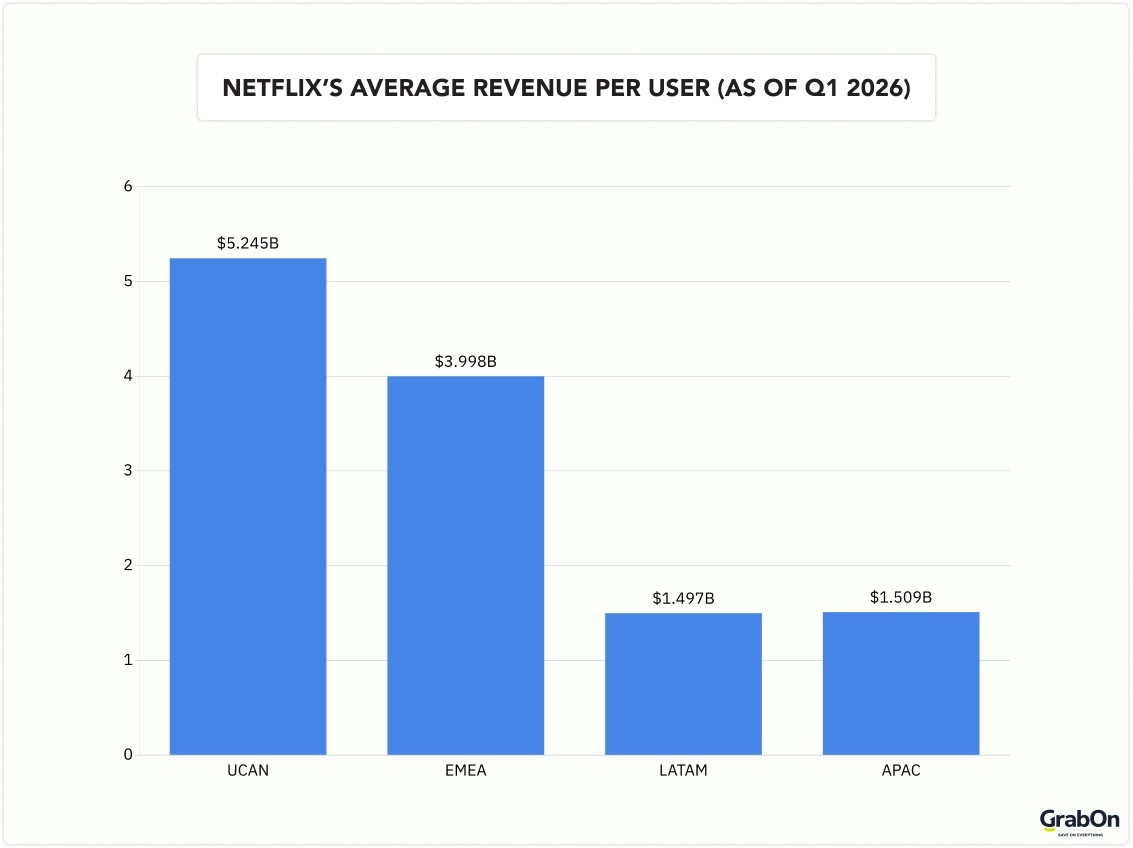
Here’s a look at Netflix’s ARPU by region.
| Region | ARPU (as of Q1 2026) |
| UCAN | $5.245 billion |
| EMEA | $3.998 billion |
| LATAM | $1.497 billion |
| APAC | $1.509 billion |
Source: Netflix
The difference in these ARPUs is designed to maximize profit margins in high-value markets where Netflix already has an established presence. While emerging markets like the APAC have a lower ARPU, to increase audience appeal and promote subscriber growth. This strategy lets Netflix maximize profits while also enhancing subscriber growth.
Which streaming platform has the highest number of subscribers globally in 2026?
Netflix has the highest number of subscribers at 325 million, among all streaming platforms operating globally. (Netflix)
- Netflix holds a 21% market share in the US, ranking second to Amazon Prime with 22% market share. (Statista)
- In Canada, Netflix leads with a 24% market share among streaming platforms.
- Netflix also holds the leading spot in the UK with 17.6 million subscribers. (Statista)
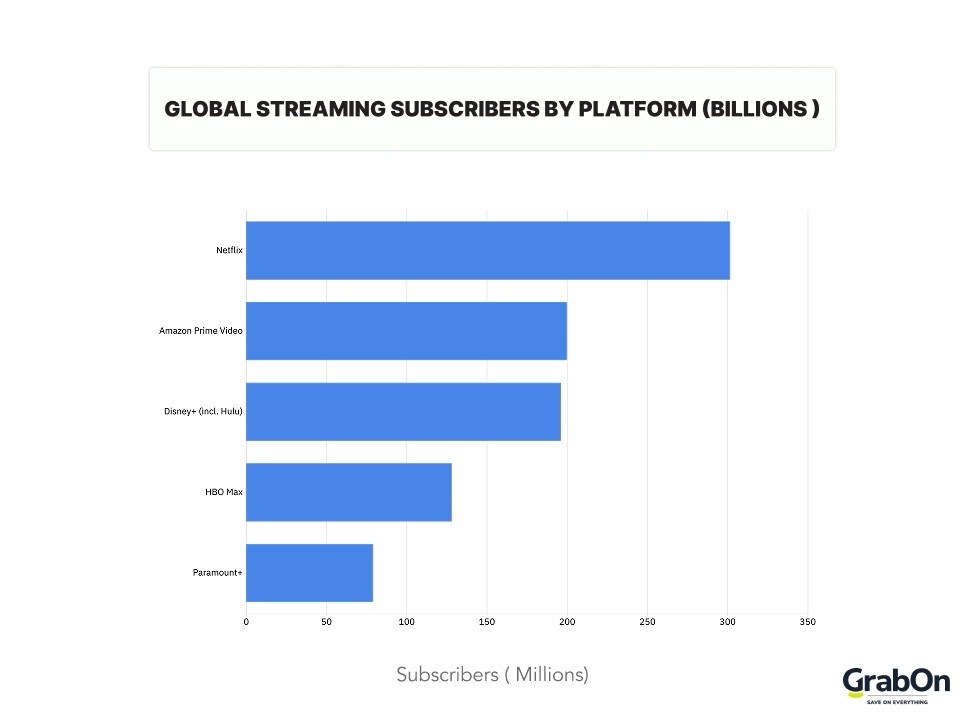
Let’s take a look at Netflix’s global market share according to subscriber count.
| Platform | Subscribers |
| Netflix | 325 million |
| Amazon Prime Video | 200 million |
| Disney+ (incl. Hulu) | 196 million |
| HBO Max | 132 million |
| Paramount+ | 78.9 million |
Source: Netflix, Statista, Forbes, Warner Bros. Discovery Shareholder Letter, Paramount Shareholder Letter
Netflix beats Amazon Prime in terms of total subscribers by nearly 125 million. The gap widens even more, up to as much as 246 million, as we work our way down the list.
This dominant market presence is due to a number of factors, such as content variety, lower operational costs, and innovative technology. A Kantar report, cited by Newscast studio, found that half of new Netflix sign-ups are driven by its content variety. Besides this, Netflix’s personalized recommendation mechanism is also well-loved by its users, helping reduce user drop-off rates. And the algorithm also keeps getting better as Netflix has a constant influx of user data to keep enhancing it.
Summing Up
The global VoD market is expected to grow at a rate of 6.66%, reaching $164.41 billion by 2030 (Statista). Netflix can stand to benefit from this substantially. With its expanding international footprint, strong content production initiatives, and localization efforts, Netflix stands in a prime position to strengthen its presence globally.
This growth extends well beyond Netflix itself. Every major release, from Wednesday to KPop Demon Hunters, drives a wave of fan sites, recap blogs, watchlist trackers and recommendation newsletters. For Indian creators looking to build in this space, a fast, affordable website is the starting point, and our Hostinger coupon codes can bring down the cost of hosting and a domain for the first year.