

When you think of Shopify as a platform, you’ll most likely recognize it as an e-commerce platform, one that has gained quite the name and fame in the industry. Not many know that it started its journey in 2006 as Snowdevil, an online platform for snowboarding equipment.
When you think of Shopify as a platform, you’ll most likely recognize it as an e-commerce platform, one that has gained quite the name and fame in the industry. Not many know that it started its journey in 2006 as Snowdevil, an online platform for snowboarding equipment.
Today, Shopify hosts over 6.07 million sites across 175 countries. The company also registered a revenue of $8.88 billion in 2024, a 25.78% increase compared to 2023. How did Shopify achieve such overwhelming success and become Canada’s third-largest publicly traded company? Read on to get the latest Shopify statistics and how the platform did wonders in a short time span.
Top Shopify Statistics (Editor’s Picks)
- There are 5.6 million active Shopify stores worldwide.
- Shopify has 875 million customers.
- Shopify has a 10.32% market share in the global eCommerce market. This increases to 29% in the US market.
- The global count of active Shopify Plus stores stands at 49,165.
- Mobile devices account for 79% of Shopify’s overall traffic.
How Many Users Does Shopify Have?
As of 2025, Shopify has 4.99 million daily active users.
Between December 2024 and March 2025, Shopify had an average of 4.99 million daily visitors, resulting in a total of 149.83 million visits per month. The highest number of visits was recorded in December 2024, reaching 160.9 million.
Check the table below to see how many Shopify users there are monthly from August 2024 to March 2025.
| Month | Monthly Active Users |
| March 2025 | 152.1 million |
| February 2025 | 136.2 million |
| January 2025 | 152.4 million |
| December 2024 | 160.9 million |
| November 2024 | 148 million |
| October 2024 | 140.5 million |
| September 2024 | 135 million |
| August 2024 | 138.6 million |
Source: Similarweb, Shopify
How Many Shopify Stores Are There?
In 2025, the number of active Shopify stores has shown strong growth, reaching 2,701,805 to date.
This marks a noticeable increase compared to 2024, when the year ended with 2,420,142 active stores, reflecting a rise of approximately 281,663 stores year-over-year.
| Year | Number of Active Shopify Stores |
| 2023 Q1 | 2,092,927 |
| 2023 Q2 | 2,129,998 |
| 2023 Q3 | 2,212,186 |
| 2023 Q4 | 2,294,041 |
| 2024 Q1 | 2,376,721 |
| 2024 Q2 | 2,380,897 |
| 2024 Q3 | 2,404,674 |
| 2024 Q4 | 2,420,142 |
| 2025 Q1 | 2,527,881 |
| 2025 Q2 | 2,587,750 |
| 2025 Q3 | 2,692,227 |
| 2025 (To Date) | 2,701,805 |
Source: Storeleads
Which Are The Top Countries Using Shopify?
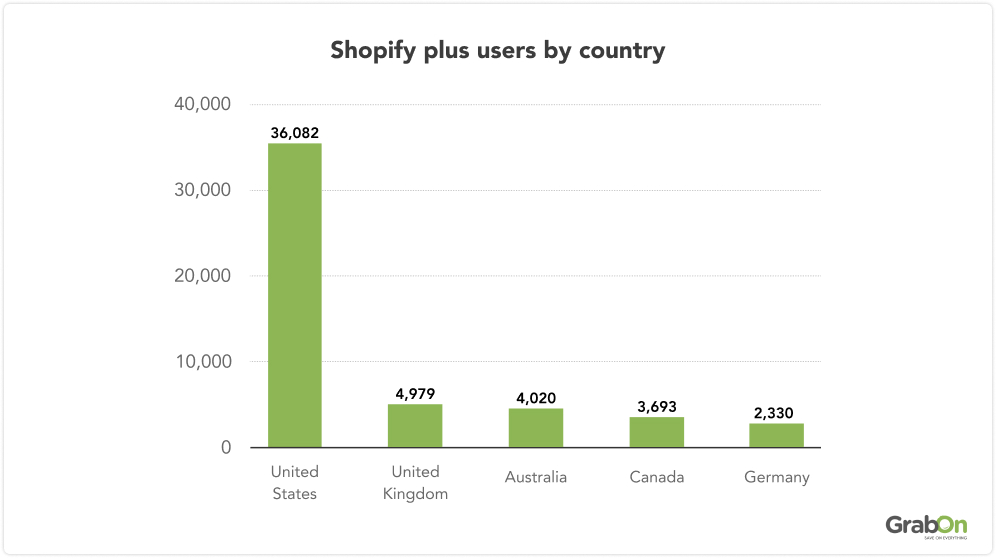
2.67 million Shopify stores are based in the United States, making it by far the largest market for the platform. Following the U.S., the United Kingdom, Australia, and Germany hold notable positions, with store counts ranging from 133,000 to 191,000.
On the lower end, Italy and Japan have relatively fewer stores, with 46,000 and 32,000 respectively, indicating slower adoption in these regions.
| Country | Number of Stores |
| United States | 2.67 million |
| United Kingdom | 191,000 |
| Australia | 138,000 |
| Germany | 133,000 |
| Canada | 107,000 |
| Brazil | 92,000 |
| India | 86,000 |
| France | 71,000 |
| Netherlands | 57,000 |
| Italy | 46,000 |
| Japan | 32,000 |
Source: Craftberry
Top Companies Using Shopify
Big brands are turning to Shopify because it’s super popular for setting up online stores – more than 4 million websites use it! Shopify lets brands sell products on lots of platforms like Facebook and Amazon. It’s easy to start with, and you can quickly make your store look good. Plus, it’s got special features like lots of ways to get paid, and it works well on phones, too. What’s great is that it’s suitable for both small startups and big companies because it’s affordable but still has all the fancy supplies that big businesses may need. That’s why tons of big names are using Shopify these days. Some of them include
| Top Companies Using Shopify |
| Clothing and Fashion |
| Hiut Denim Co. Tentree Macguire Shoes |
| Art and Home Décor |
| Uppercase magazine Artisaire Terre Bleu |
| Electronics and Gadget |
| Bruvi Kulala Pela |
| Subscription-based |
| Cocofloss Loot Crate Pot Gang |
| Jewelry and Accessories |
| United By Blue Manitobah Mukluks Allbirds |
| Food and Drink |
| BLK & Bold Fly by Jing Verve Coffee Roasters |
| Beauty and Wellness |
| The Honey Pot Package Free Beauty Bakerie |
| Other |
| Healthy Roots Dolls GiveMeTap Lunchskins |
Source: Shopify
How Many Customers Does Shopify Have?
Shopify has over 875 million customers, an increase of 175 million from the 700 million customers in 2023. This represents a 25% growth. Shopify experienced significant growth between 2019 and 2024, adding 457 million customers.
This means that 30% of global online shoppers shop with a Shopify store.
Here’s the table showing the number of Shopify customers by year:
| Year | Number of Shopify Customers |
| 2024 | 875 million |
| 2023 | 700 million |
| 2022 | 649 million |
| 2021 | 572 million |
| 2020 | 457 million |
| 2019 | 300 million |
| 2018 | 216 million |
| 2017 | 163 million |
| 2016 | 100 million |
| 2015 | 57 million |
Source: Company data.
Key Performance Metrics for Shopify
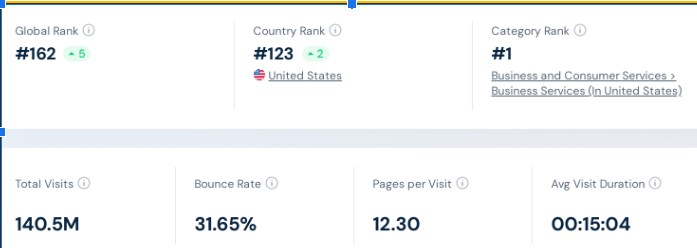
Between March and May 2025, Shopify’s official website recorded a total of 461.1 million visits, with an average of 51.61 million unique visitors each month. During this period, the majority of traffic originated from the United States (37.72%), followed by the United Kingdom (6.58%), India (5.97%), and Canada (5.21%). Most users accessed the site via desktop devices, accounting for 68.65% of visits, while mobile devices contributed 31.35%.
Source: SimilarWeb
Shopify Demographics: Insights into Website Traffic
Shopify website traffic is primarily driven by users aged 25-34, who make up 28.55% of the total audience, making them the largest demographic group. The 35-44 age group follows with 20.19%.
Users aged 45-54 contribute 16.78%, while the 18-24 age group makes up 13.66%, highlighting that Shopify also attracts younger audiences. The 55-64 and 65+ age groups account for 12.75% and 8.07% respectively, indicating lower engagement from older users.
The table below gives a detailed breakdown of the age distribution of Shopify’s shoppers:
| Age Range | Percentage |
| 18-24 | 13.66% |
| 25-34 | 28.55% |
| 35-44 | 20.19% |
| 45-54 | 16.78% |
| 55-64 | 12.75% |
| 65+ | 8.07% |
What is the Audience Primarily Interested In?
- Computers, Electronics and Technology
- Programming and Development of Software
- Fashion and Apparel
- Graphics and Multimedia
- New and Television
Top Shopify Categories Searched by Users
- News, television, and media
- Shopping – Fashion and Apparel
- Software support and development
- Business Development
Source: Similarweb
Shopify Stats: Leading the eCommerce Market
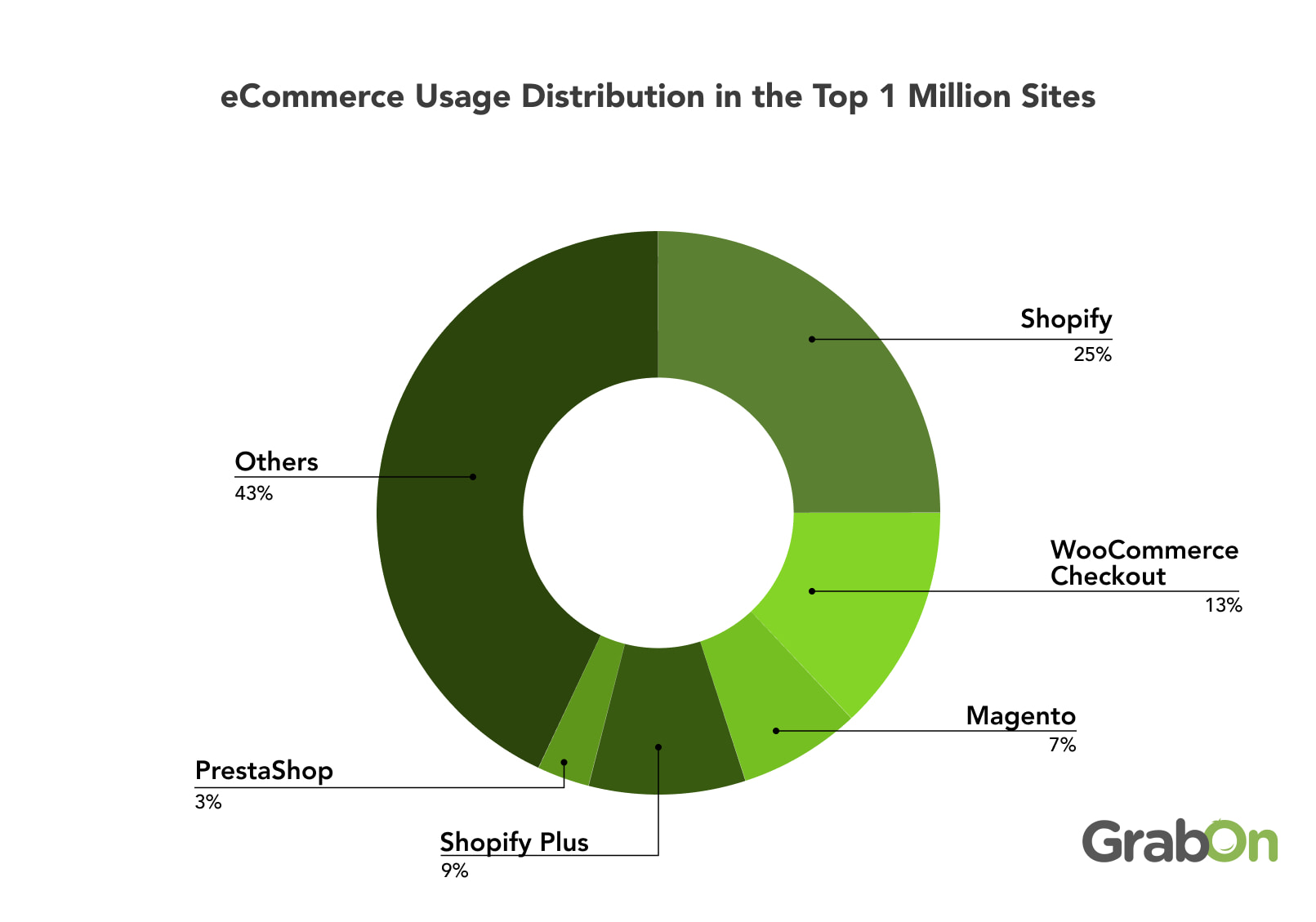
The eCommerce market is very competitive, with different platforms running online stores. Among the top 1 million sites, Shopify leads with 25% of the market. WooCommerce Checkout is next with 13%, while Magento is at 7% and Shopify Plus is at 9%, respectively. PrestaShop has 3% of the market, and various other platforms make up the remaining 43%, showing the diversity in the industry.
Source: BuiltWith
Shopify’s Key Financial Highlights 2024-2025
- Revenue Growth: Shopify generated $2,680 million in revenue by June 30, 2025, up from $2,045 million on June 30, 2024, representing a 31% year-over-year growth.
- Sales Volume (GMV): Shopify’s Gross Merchandise Volume (GMV) rose to $87.84 billion by June 30, 2025, up from $67.25 billion a year earlier, marking a 30.6% year-over-year increase. Customers have spent $182.9 billion on the platform so far this year.
- Profit Margins: Shopify’s gross profit reached $1,302 million by June 30, 2025, up from $1,045 million a year earlier, representing a 24.6% year-over-year increase and a notable improvement in profitability.
- Free Cash Flow: Shopify generated $422 million in free cash flow by June 30, 2025, up from $333 million a year earlier, representing a 26.7% year-over-year increase.
- Annual Outlook: Shopify is on track to exceed $8 billion in annual revenue for 2024.
- In the first half of 2025, Shopify witnessed a 31% revenue growth and a 15.7% free cash flow margin.
- For the second quarter of 2025, Shopify expects the revenue to grow at a mid-twenties percentage rate on a year-over-year basis.
Source: Shopify
How Much Revenue Does Shopify Make?
In the last three years, Shopify’s revenue has shown significant growth, rising from $5.6 billion in 2022 to $7.06 billion in 2023 and reaching $8.88 billion in 2024. This represents a year-over-year increase of approximately $1.46 billion from 2022 to 2023 and $1.82 billion from 2023 to 2024, highlighting the platform’s accelerating revenue growth.
| Year | Shopify Revenue |
| 2013 | $50 million |
| 2014 | $105 million |
| 2015 | $205 million |
| 2016 | $389 million |
| 2017 | $673 million |
| 2018 | $1073 million |
| 2019 | $1578 million |
| 2020 | $2929 million |
| 2021 | $4612 million |
| 2022 | $5600 million |
| 2023 | $7060 million |
| 2024 | $8880 million |
Source: Shoptrial
What Drives Shopify’s Revenue Streams?
Shopify generates its revenue primarily through two avenues:
Subscription Solutions: This involves merchants paying fees to utilize the Shopify platform. Merchants can select from a range of plans, such as Basic Shopify, Shopify, and Advanced Shopify, each providing different features and tools for managing an online store.
Merchant Solutions: This encompasses various services offered to merchants to aid them in selling their products. It includes Shopify Payments, which processes payments for merchants; Shopify Capital, which provides financing options; and Shopify Shipping, which offers shipping solutions and discounts.
What Is Shopify Plus?
Shopify Plus is Shopify’s enterprise-level solution tailored for high-volume merchants and large brands. It’s a fully hosted eCommerce platform offering scalability and customization. With advanced features like customizable checkouts and increased API calls, Shopify Plus addresses the complex needs of growing businesses, providing dedicated support and infrastructure for rapid expansion. It seamlessly integrates with existing systems through APIs, making it a flexible choice for enterprises seeking to enhance their eCommerce capabilities.
Shopify Plus Usage Statistics
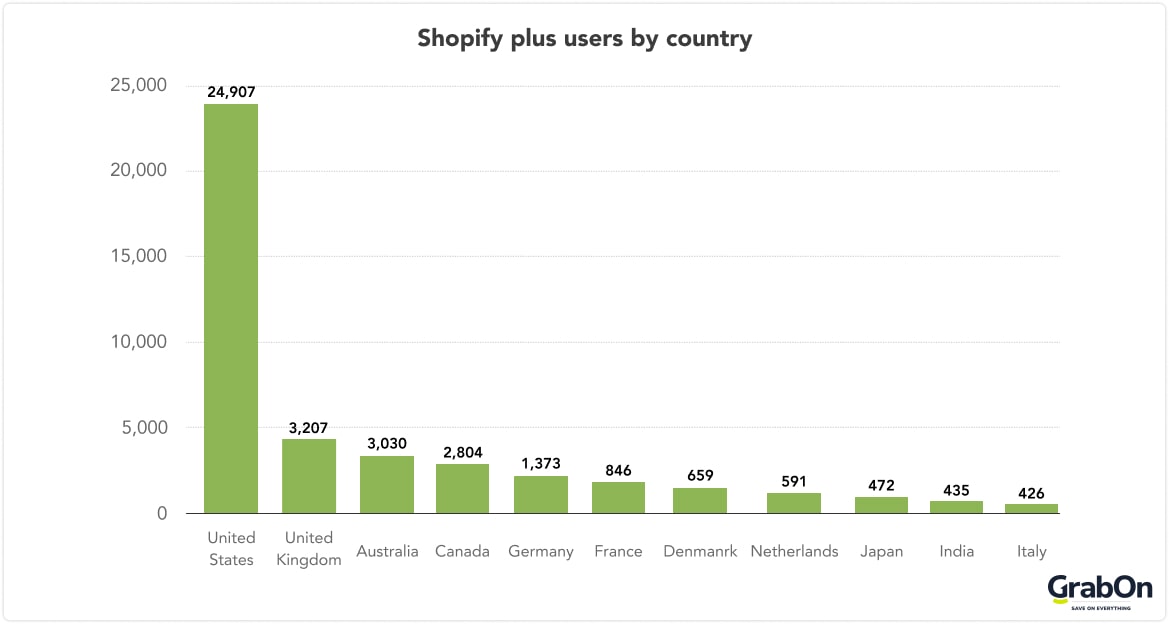
24,907 Shopify Plus stores are based in the United States, making it the largest market by a significant margin. Following the U.S., the United Kingdom, Australia, and Canada each have between 2,800 and 3,200 stores, highlighting strong adoption of Shopify’s enterprise-level solution in these regions.
At the lower end, India and Italy have fewer Shopify Plus stores, with 435 and 426, respectively, indicating limited penetration of the platform’s premium offerings in these markets.
Overall, the data shows that Shopify Plus is predominantly concentrated in North America and select European countries, where enterprise e-commerce adoption is high.
| Country | Number of Shopify Plus Stores |
| United States | 24,907 |
| United Kingdom | 3,207 |
| Australia | 3,030 |
| Canada | 2,804 |
| Germany | 1,373 |
| France | 846 |
| Denmark | 659 |
| Netherlands | 591 |
| Japan | 472 |
| India | 435 |
| Italy | 426 |
Source: Shoptrial
Key Shopify Milestones So Far (2025)
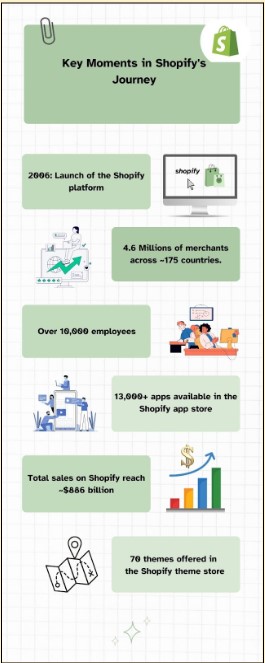
Since its inception in 2006, Shopify has grown remarkably, transforming from a modest platform for selling snowboards into a global e-commerce powerhouse. Today, Shopify supports millions of merchants across approximately 175 countries. The company employs over 8,100 people and offers more than 16,000 apps in its App Store, providing merchants with a wide array of tools to enhance their online stores.
Shopify’s Theme Store features 70 themes, and its network includes over 780 experts. Financially, Shopify has facilitated total sales of around $1 trillion. These milestones highlight Shopify’s extraordinary journey and its substantial influence on the e-commerce landscape.
Source: Shopify
Wrapping Up
Summarizing Shopify’s journey up to 2025 reveals its profound impact on the e-commerce sector. Through ongoing innovation and strategic expansion, Shopify has cemented its position as a pivotal player, offering holistic solutions to businesses worldwide. Its adaptable framework and strong foundation have empowered merchants globally to optimize their online operations and sales tactics with ease. From its inception to its current standing, Shopify’s trajectory reflects a steadfast dedication to excellence and forward-looking strategies that have consistently fueled its growth and triumph in the digital realm.