
Every winter, Indian families collectively spend more on weddings than several state budgets combined. The sector is now valued at approximately $139.33 billion in 2026, and the average couple spends ₹39.5 lakh on a standard multi-day celebration.
The 45-day winter wedding season alone generates ₹6.5 lakh crore in trade from close to 46 lakh weddings, while destination weddings, now a quarter of the market, average ₹58 lakh per event as couples trade guest-list size for a more curated experience.
Below is a comprehensive breakdown of the Indian wedding market size, average spending by city, cost distribution, and emerging behavioral trends for 2026.
Top Picks: Key Wedding Stats for 2026
- India hosts around 10 million weddings annually
- Most Indian weddings have an expenditure between 6 to 10 lakhs.
- The average cost of an Indian destination wedding in 2026 is ₹39.5 Lakhs.
- 1 in 4 Indian weddings is now a destination event.
- Jaipur is the most expensive city to have a destination wedding in, with an average wedding cost of ₹73 lakhs.
- A staggering 45% of Indian brides now choose lab-grown diamonds for their engagement rings.
- Over 70% of all wedding-related purchases in 2026 are locally manufactured, heavily boosting domestic artisans.
What is the Indian Wedding Market Size in 2026?
The economic footprint of Indian weddings spans hospitality, catering, apparel, jewelry, and event management. The sheer volume of marriages makes India the largest wedding market in the world by the number of events.
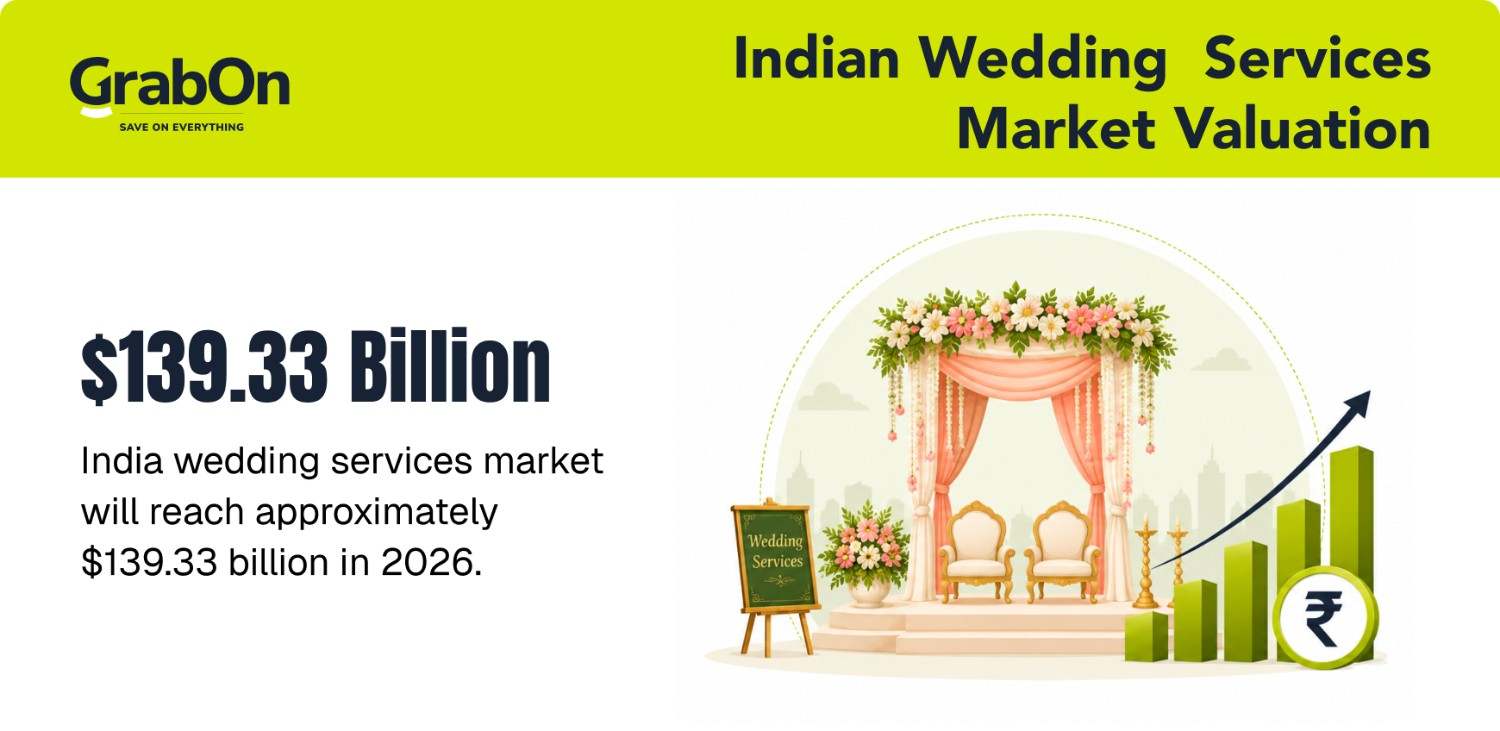
- The India wedding services market is projected to reach approximately $139.33 billion in 2026.
- The core 45-day winter wedding season alone drives ₹6.5 lakh crore in trade from approximately 46 lakh weddings.
- Delhi NCR is a massive contributor, estimated to generate ₹1.8 lakh crore from just 4.8 lakh weddings during the peak season.
- The winter wedding season generates over 1 crore temporary and part-time jobs across hospitality, catering, and logistics.
The ₹6.5 Lakh Crore generated in a mere 45-day window represents an extraordinary velocity of money. It moves capital from accumulated household savings directly into the hands of local artisans, gig workers, and MSMEs faster than almost any corporate sector, acting as a massive, decentralized economic stimulus.
(Sources: Custom Market Insights, CAIT)
How Many Weddings Happen in India Every Year?
- India hosts around 10 million weddings annually. This figure has held steady across government data for several years.
This makes India the largest wedding market in the world by volume of events, even though total spend trails markets like the US.
- Adjusting this for 2026 population growth (from roughly 1.41 billion to approximately 1.46-1.47 billion today) puts the number closer to 10.3-10.5 million weddings by the end of 2026.
The actual number is likely closer to the lower end of that range, since the mean age at marriage has been rising and the birth rate has been falling, both of which slow the growth in new marriages compared to population growth alone.
- At this scale, a wedding happens in India roughly every 3 seconds. This explains how the industry generates over ₹6.5 lakh crore in a single 45-day winter season.
(Source: IBEF)
Average Expenditure of an Indian Wedding
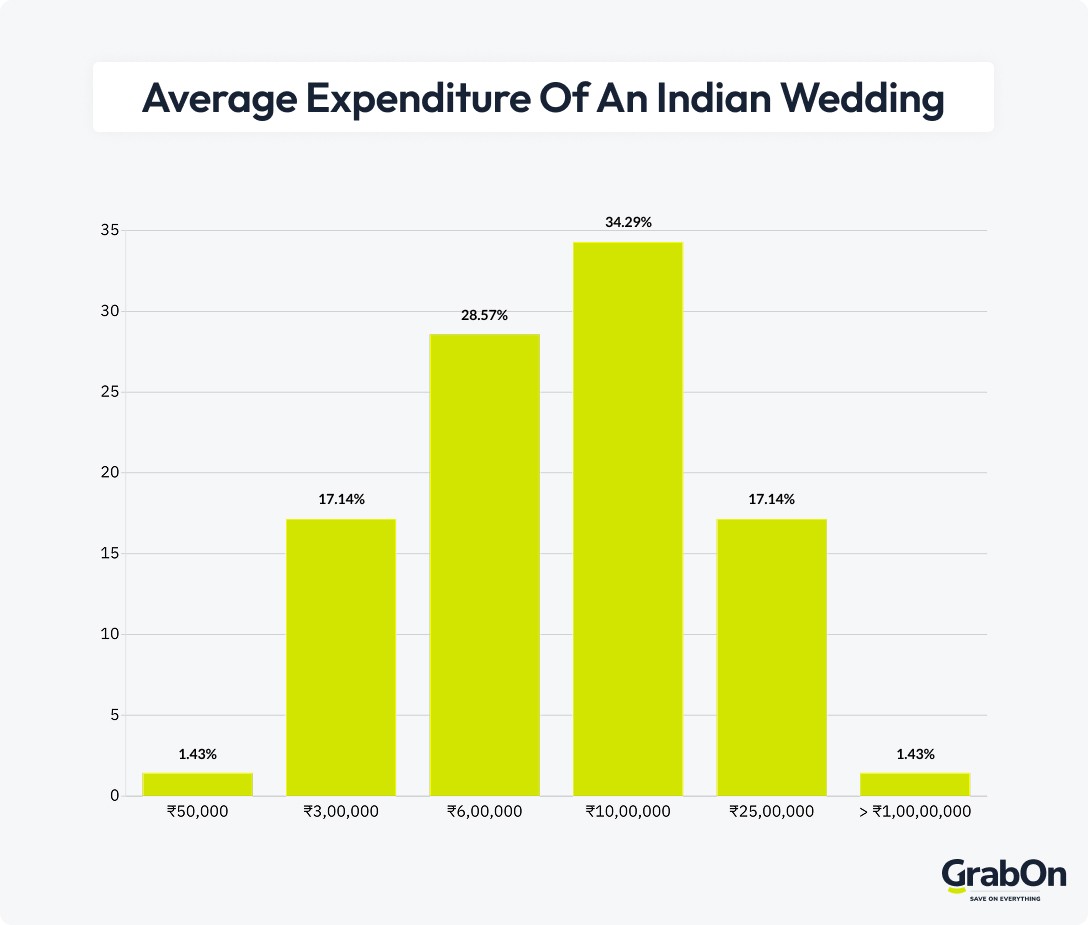
| Estimated Expenditure | Percentage of Indian Weddings |
| Rs. 50,000 | 1.43% |
| Rs. 3,00,000 | 17.14% |
| Rs. 6,00,000 | 28.57% |
| Rs. 10,00,000 | 34.29% |
| Rs. 25,00,000 | 17.14% |
| > Rs. 1,00,00,000 | 1.43% |
A large share of the indian weddings falls in the middle range, with 34.29% spending around Rs. 10 lakh and 28.57% spending around Rs. 6 lakh. Another 17.14% of weddings are estimated at Rs. 3 lakh, while the same percentage falls under the Rs. 25 lakh category. This shows that for most families, wedding expenses are not limited to a small budget and can go up considerably.
At the same time, only 1.43% of the weddings fall in the Rs. 50,000 category, while another 1.43% spend more than Rs. 1 crore. These figures show that extremely low- and extremely high-budget weddings are less common in comparison to weddings in the Rs. 6–25 lakh range. Overall, the table reflects how wedding celebrations can involve a significant amount of spending, with most families opting for a moderate to high expenditure.
Source: IBEF.
Average Destination Wedding Cost in India by City
Location dictates a wedding budget more than almost any other factor. Heritage tourism and venue scarcity in major metros drive significant price variances across India.
The figures below reflect destination-style celebrations in each city, where couples travel with guests and book premium venues rather than hosting at a local, hometown setup.
Average Wedding Costs in Top Indian Cities (Based on 300-400 Guests):
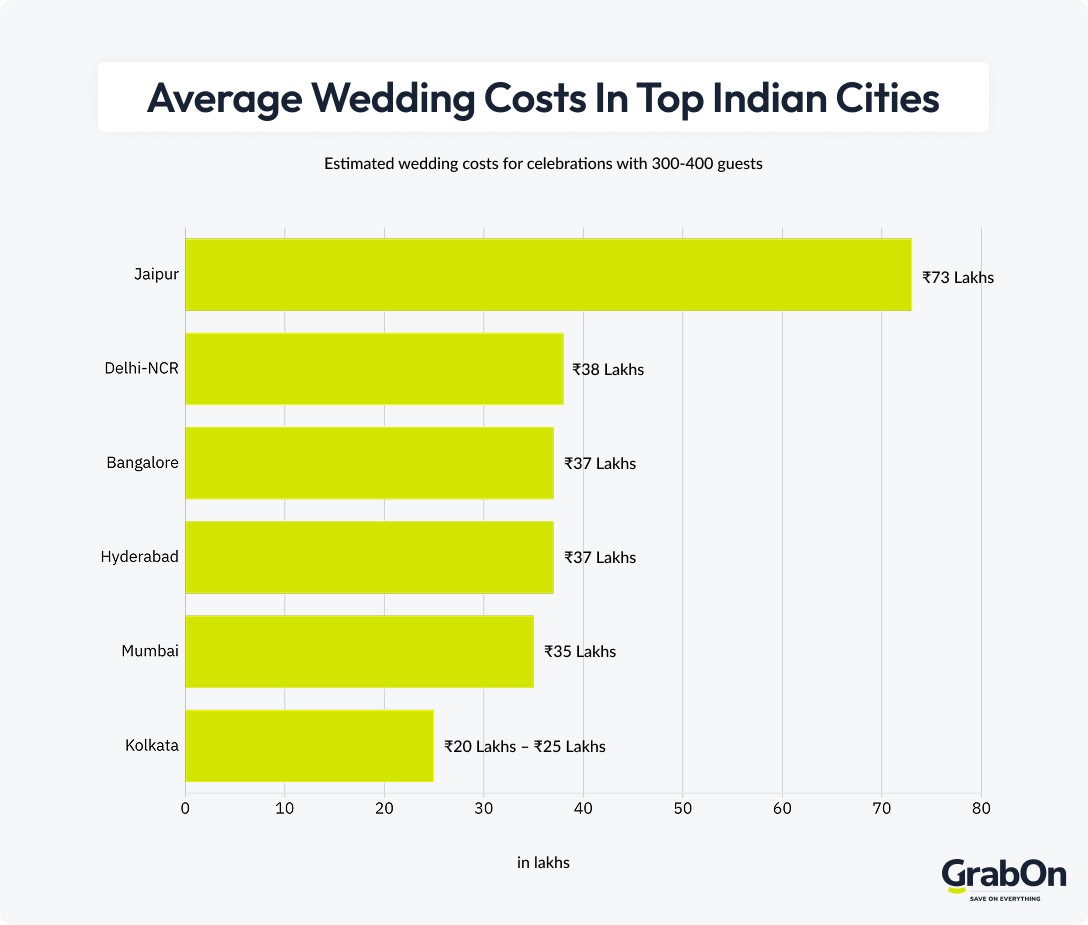
| City | Average Cost (₹) | Key Cost Drivers |
| Jaipur | ₹73 Lakhs | Royal forts, palatial heritage venues, premium destination demand |
| Delhi-NCR | ₹38 Lakhs | Chattarpur farmhouses, elaborate baraat culture, premium catering |
| Bangalore | ₹37 Lakhs | Luxury hotel bookings, premium tech-crowd spending |
| Hyderabad | ₹37 Lakhs | Grand Nizami-style celebrations, lavish multi-cuisine spreads |
| Mumbai | ₹35 Lakhs | High vendor rates and expensive, space-constrained luxury venues |
| Kolkata | ₹20 Lakhs – ₹25 Lakhs | Cost-efficient, elaborate traditional Bengali weddings |
(Source: First Resort)
Indian Wedding Budget Breakdown: Where Do Couples Spend?
Understanding budget allocation is critical for accurate planning. In 2026, catering and venues consume nearly half the budget, while jewelry remains the single largest retail expenditure category.
Standard Expense Breakdown by Category (Based on a ₹39.5L Average Budget):
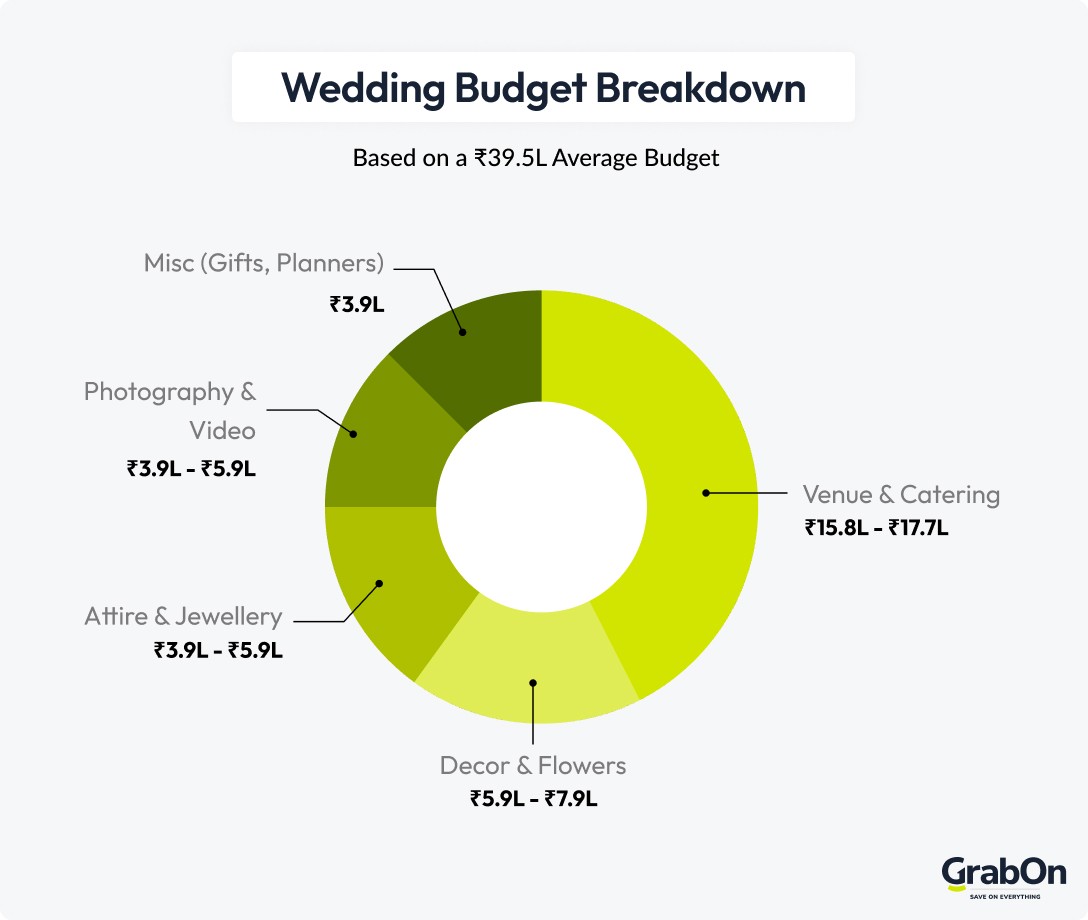
| Expense Category | % of Total Budget | Estimated Spend (₹) |
| Venue & Catering | 40% – 45% | ₹15.8L – ₹17.7L |
| Decor & Flowers | 15% – 20% | ₹5.9L – ₹7.9L |
| Attire & Jewellery | 10% – 15% | ₹3.9L – ₹5.9L |
| Photography & Video | 8% – 10% | ₹3.1L – ₹3.9L |
| Misc (Gifts, Planners) | 10% | ₹3.9L |
Key insight: Photography and event planner fees are generally fixed, meaning they rarely change regardless of the guest list size. Catering and transport are highly variable and scale directly with every additional attendee.
(Source: Wedding Asia)
Destination vs. Local Weddings: Cost Comparison
Destination weddings fundamentally restructure how a wedding is planned and produced, shifting from a high-volume model to a high-experience model.
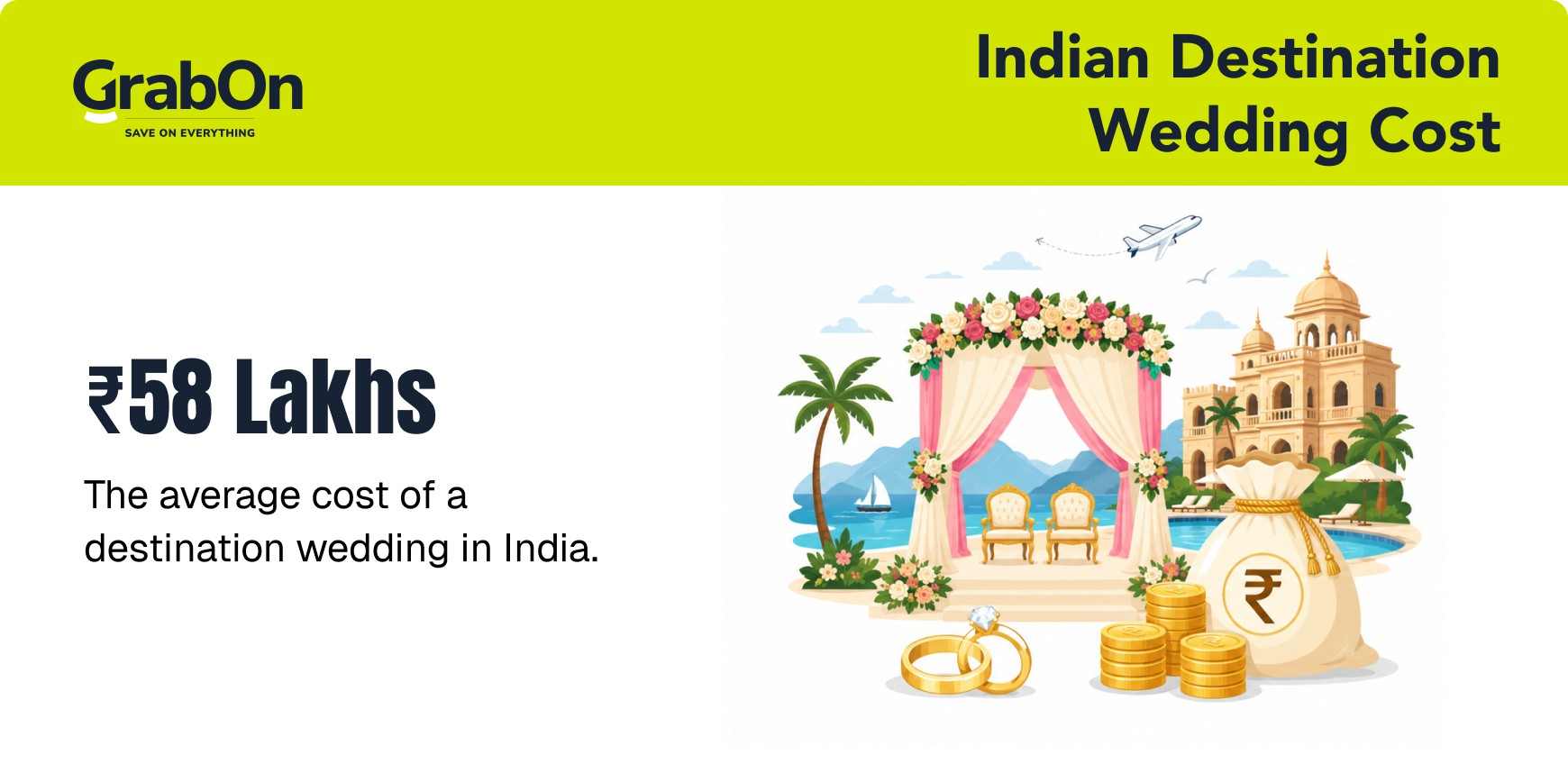
| Metric | Local/Hometown Wedding | Destination Wedding |
| Average Cost | ₹39.5 Lakhs | ₹58 Lakhs |
| Average Guest Count | 420 Guests | 280 Guests |
| Event Duration | 1 to 2 Days | 3 to 5 Days |
| Venue & Food Allocation | 30% – 35% of total budget | 40% – 50% of total budget |
| Guest Attire Spend | Standard | ₹3 Lakh – ₹5 Lakh (due to 4-6 distinct dress codes) |
| Core Experience | Community-focused, massive scale | Immersive, vacation-style, high per-guest spend |
Paying a 40% premium for a destination wedding is rarely just about spending more money; it acts as a highly effective social filter. Couples use the logistical hurdle of travel to cut their guest list from 500 down to 200. This allows them to redirect funds toward curating a high-end, immersive experience for their closest circles.
(Source: First Resort)
Bridal and Groom Fashion Spend in 2026
Wedding apparel is shifting toward utility and high-end personalization, moving away from ultra-heavy traditional garments that can only be worn once.
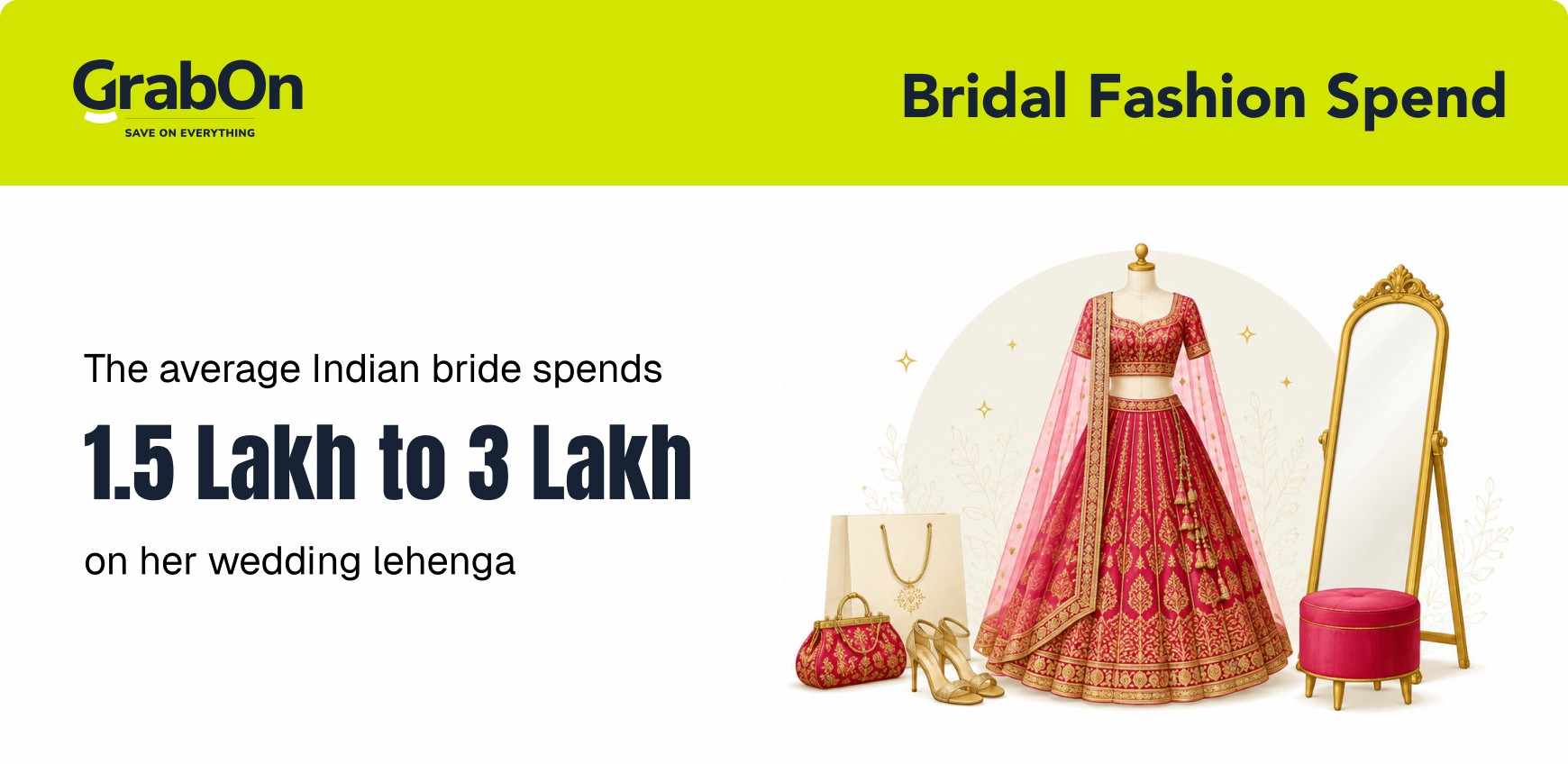
- The average Indian bride spends ₹1.5 Lakh to ₹3 Lakh on her primary wedding lehenga. Fashion and attire drive ₹10,000 crore in spending annually.
- To offset high costs, roughly 18% of couples in Tier-1 cities are now opting to rent heavy designer wear for pre-wedding events like Sangeet and Haldi.
- Historically a fraction of the bride’s budget, groom wear spending has surged by 40% over the last five years.
The rise of rental fashion and lighter designer wear marks a shift from emotional buying to practical investment. Modern couples recognize that spending ₹3 Lakhs on a heavy outfit for a 4-hour event is a terrible cost-per-wear ratio. Instead, they are investing in experiences, like premium honeymoon travel or down payments on real estate.
(Source: Kotak)
Catering and Food Costs for Indian Weddings
- In 2026, premium catering in Tier-1 cities averages ₹2,500 to ₹4,500 per plate for vegetarian spreads, and ₹3,500 to ₹6,000+ for non-vegetarian menus.
- Catering consumes 10% to 15% of the overall wedding budget according to trade data from the Confederation of All India Traders (CAIT).
- Over 65% of mid-to-high budget weddings now swap standard buffets for interactive live counters, such as fresh sushi bars and wood-fired pizza setups.
- An estimated 10% to 20% of all banquet food goes to waste, amounting to roughly $14 billion in annual losses across India.
- While a mid-sized wedding discards 30 kg to 50 kg of food, large luxury celebrations can throw away up to 800 kg of uneaten meals.
- Caterers report a steady surge in requests for dedicated Jain, vegan, and gluten-free live counters to accommodate specific guest preferences.
(Source: First Resort, Food Tank)
How Do Indians Pay for Weddings? (Savings vs. Loans)
As average costs approach ₹40 Lakhs, the way Indian families pay for weddings is shifting. The reliance on credit is growing faster than in previous decades.
- The vast majority of couples and their families fund weddings entirely through personal savings.
- Over 15% of couples now use personal loans to fund their celebrations, with the average wedding loan size sitting at ₹15.5 Lakhs.
- Around 6% of families liquidate assets (such as real estate or mutual funds) to cover premium wedding expenses.
The fact that a significant segment of couples now finances weddings through personal loans signals a cultural shift in how marriage is viewed. Weddings are increasingly treated as a premium personal milestone, which younger Indians feel comfortable financing against their future earning potential, rather than relying on generational family wealth.
(Source: Kotak)
Modern Wedding Trends: AI, Eco-Friendly, and Digital Planning
The 2026 wedding market is seeing a generational shift in values and technology adoption.
- Over 50% of couples actively make eco-conscious choices, such as using biodegradable confetti, zero-waste catering, and digital invitations.
- Over 80% of couples now use dedicated wedding planning platforms and apps for research and vendor discovery.
- AI-powered planning tools reduce overall event preparation time by up to 40%.
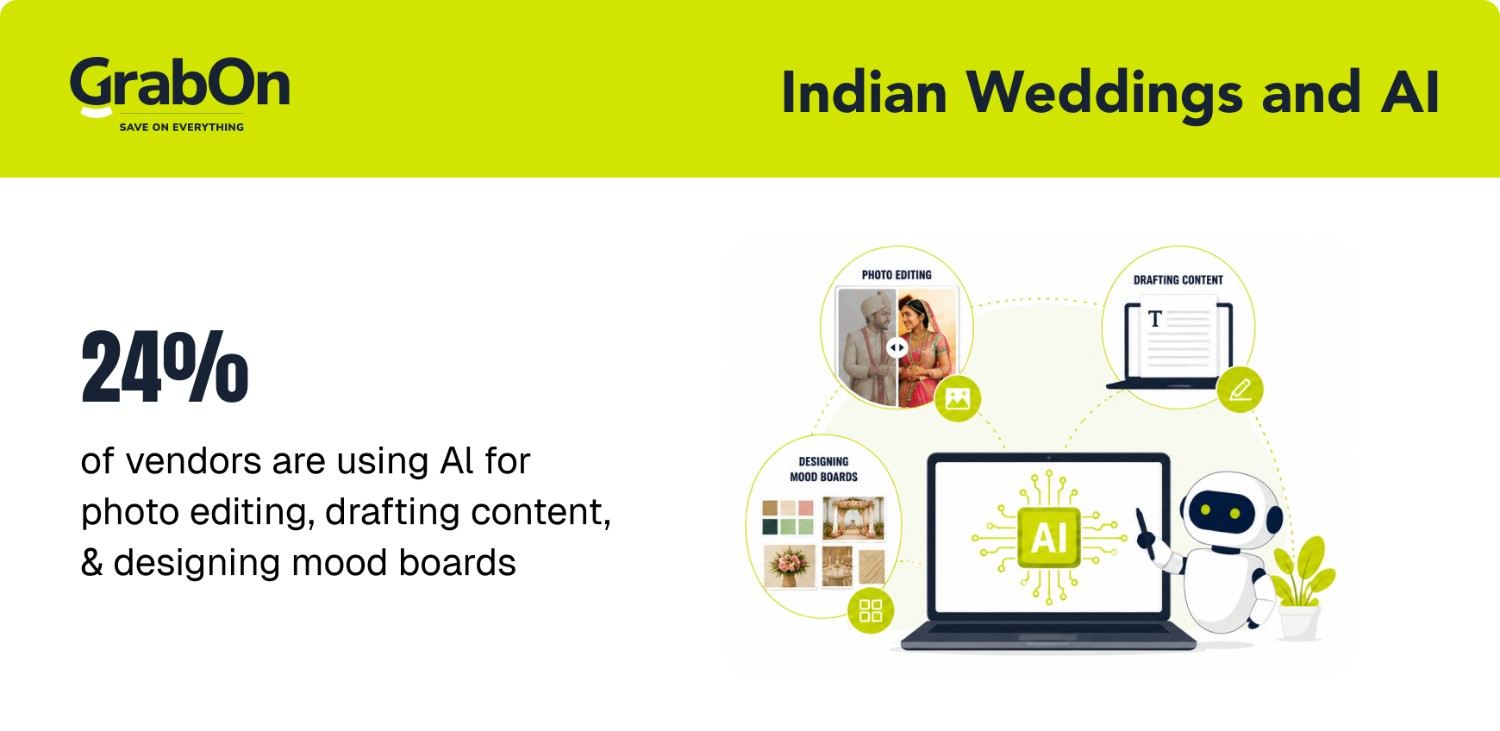
- Nearly 24% of vendors are utilizing AI tools for photo editing, drafting content, and building design mood boards, significantly reducing turnaround times.
- 40% of brides use Augmented Reality (AR) features for virtual jewelry try-ons before making a purchase.
- 38% of vendor transactions are now made digitally via UPI and net banking, shifting away from cash-only deals.
(Sources: WedMeGood)
What’s Next for the Wedding Industry?
The Indian wedding industry is projected to reach $502.56 billion by 2035. Future growth will be driven by the expansion of luxury destination venues in Tier-2 cities and AI-driven guest management services.
- Expansion into Tier-2 and Tier-3 Hubs: As venue pricing in metros reaches peak levels, luxury resort chains and wedding planners are expanding heavily into cities like Jaipur, Chandigarh, Indore, and Vizag, which are projected to drive 40% of new destination wedding bookings over the next three years.
- AI as a Standard Concierge: Guest management, personalized travel itineraries, and automated photo delivery using facial recognition will move from premium add-ons to standard vendor offerings.
- Mandatory Eco-Audits: Zero-waste catering, solar-powered venues, and carbon-offset travel options will become core selection criteria rather than optional features, driven by Gen Z couples enforcing strict sustainability requirements.
Conclusion
India’s wedding market has shifted its focus from sheer crowd sizes to higher-quality events. With the national average spend sitting at ₹39.5 Lakhs and total industry spending crossing $139 Billion, families are reallocating their budgets. The rise of destination venues, digital planning tools, and eco-friendly setups shows a clear trend: today’s couples prefer spending on a better experience for a smaller group rather than simply feeding a massive guest list.