
Online shopping now accounts for the majority of discretionary card spending among Indian consumers. From electronics on Flipkart to groceries on BigBasket, fashion on Myntra to travel on Cleartrip, the platforms have multiplied, and so have the credit cards competing for your wallet share.
The right credit card can earn 2% to 5% back on your online spending as cash back or rewards, effectively lowering the price of everything you buy. The wrong card, or no card at all, means you are leaving thousands of rupees on the table every year.
This guide covers seven credit cards that deliver genuine value on online purchases in 2026. Each card is evaluated on its cashback or reward rate for online transactions, annual fee and waiver threshold, monthly or quarterly caps on earnings, the list of excluded categories, and practical ease of use. No card on this list is perfect for everyone; the best pick depends on where you shop, how much you spend, and whether you prefer flat cashback or platform-specific accelerated rewards.
A note before we begin: Credit card terms change frequently. Issuers revise reward structures, tighten caps, and expand exclusion lists, sometimes with just a few weeks’ notice. The details below reflect publicly available terms as of May 2026. Always verify the latest terms on the issuer’s website before applying.
Best Credit Cards for Online Shopping (Quick Comparison)
| Card | Annual Fee | Fee Waiver Threshold | Online Cashback / Reward Rate | Monthly / Quarterly Cap | Best For |
| SBI Cashback | ₹999 + GST | ₹2 lakh annual spend | 5% on all online spends | ₹2,000/month online (source) | Broad online shoppers across all platforms |
| Amazon Pay ICICI | Nil (lifetime free) | N/A | 5% on Amazon (Prime), 3% non-Prime, 2% Amazon Pay partners | Unlimited, no cap | Amazon-heavy shoppers |
| HDFC Millennia | ₹1,000 + taxes | ₹1 lakh annual spend | 5% on 10 partner brands | 1,000 CashPoints per category per cycle (source) | Multi-platform digital spenders |
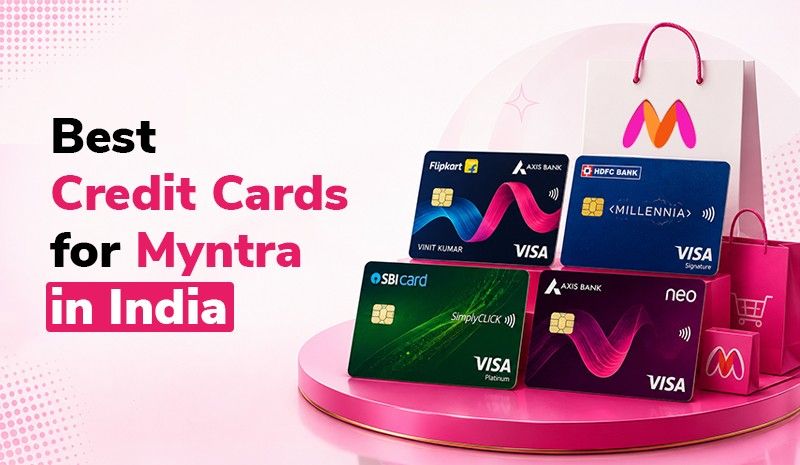
| Flipkart Axis Bank | ₹500 | ₹3.5 lakh annual spend | 7.5% Myntra, 5% Flipkart, 5% Cleartrip, 4% Swiggy/Uber/PVR/Cult.fit (unlimited) | ₹4,000/quarter per merchant (7.5% and 5% tiers); 4% tier is unlimited (source) | Flipkart and Myntra loyalists |
| Axis ACE | ₹499 + GST | ₹2 lakh annual spend | 5% bills via Google Pay, 4% Swiggy/Zomato/Ola, 1.5% all other spends | ₹500/month combined (5% + 4% categories) (source) | Mixed online and utility spenders |
| SBI SimplyClick | ₹499 + GST | ₹1 lakh annual spend | 10X RP on partner brands, 5X on other online spends | 10,000 points/month on 5X tier | Entry-level card for first-time users |
| IDFC First Select | Nil (lifetime free) | N/A | 3X base (up to ₹20K/month), 10X above ₹20K/month; 10X from first rupee on dining, travel, international, birthday spends (effective June 2026) | No hard cap on points | Lifetime-free seekers with ₹20K+ monthly spend |
1. SBI Cashback Credit Card
Why it stands out for online shopping: This card offers a flat 5% cashback on all online transactions without restricting you to specific merchants or platforms. Whether you are buying on Amazon, booking on MakeMyTrip, ordering on Swiggy, or subscribing to an OTT service, the 5% rate applies uniformly. That merchant-agnostic structure is its defining advantage over every co-branded card on this list.
Annual fee: ₹999 + GST, waived if you spend ₹2 lakh in the preceding subscription year.
How the cashback works: You earn 5% on eligible online spends and 1% on offline POS transactions. Cashback is credited to your SBI Card account within two days of the next statement generation. There is no reward point conversion or redemption portal; the savings appear directly on your bill.
The cap to know about: Effective 1st April 2026, SBI Card revised the cashback structure. The maximum online cashback is now ₹2,000 per statement cycle, with a separate ₹2,000 cap on offline cashback. The combined ceiling is ₹4,000 per cycle, down from the earlier ₹5,000. You hit the online cap at roughly ₹40,000 of eligible online spending per month. Beyond that, additional online purchases earn nothing.
Exclusions: Fuel, digital gaming platforms, tolls, government-related spends, wallet loads, rent payments, jewellery, school and educational services, utility bills, insurance premiums, railways, EMIs, quasi-cash transactions, and member financial institution payments are all excluded from the 5% rate.
Who should consider it: Anyone who spends ₹15,000 to ₹40,000 monthly across multiple online platforms and wants a single, simple card that does not require tracking which merchant qualifies. If you routinely exceed ₹40,000 in online spending per month, pair this with a second card to capture value beyond the cap.
Who should skip it: Shoppers who concentrate spending on a single ecosystem (Amazon or Flipkart) where a co-branded card may offer better effective rates without a cap. Also less useful if a large portion of your spending falls into excluded categories like utility bills or rent.
2. Amazon Pay ICICI Credit Card
Why it stands out for online shopping: If Amazon is your default marketplace for electronics, household goods, groceries (via Amazon Fresh), and entertainment, this card turns every purchase into an automatic saving. The cashback is uncapped and credited directly to your Amazon Pay balance, making it immediately usable on your next order.
Annual fee: Nil. This is a lifetime free card with no joining fee and no renewal charges.
How the cashback works: Prime members earn 5% cashback on all Amazon purchases and travel bookings made on Amazon. Non-Prime members earn 3% on the same categories. On partner merchant websites that accept Amazon Pay, both Prime and non-Prime members earn 2%. All other eligible transactions (offline or non-partner online) earn 1%. Cashback is credited automatically to your Amazon Pay balance at the end of each billing cycle, with no redemption steps required.
Important 2026 changes: From 15th January 2026, ICICI Bank introduced a 1% fee on wallet loads of ₹5,000 or more, and a 2% fee on skill-based gaming transactions. These effectively negate cashback on those categories.
Exclusions: Physical and digital gold purchases on Amazon, rent and tax payments, utility payments outside Amazon, fuel, education, EMI transactions, and international spends do not earn cashback.
Who should consider it: Frequent Amazon shoppers, particularly Prime members who already pay for the membership. The combination of zero annual fee, uncapped 5% on Amazon, and 2% on a wide network of Amazon Pay merchants makes this one of the highest-value free cards in India. The card has crossed 5 million customers, a milestone reached in August 2024.
Who should skip it: Shoppers whose primary platforms are Flipkart, Myntra, or Swiggy, where the card earns only 1%. The cashback is also locked into the Amazon Pay ecosystem; you cannot receive it as a statement credit or bank transfer.
3. HDFC Millennia Credit Card
Why it stands out for online shopping: Rather than tying you to a single platform, this card offers 5% value-back across ten popular brands: Amazon, BookMyShow, Cult.fit, Flipkart, Myntra, Sony LIV, Swiggy, Tata CLiQ, Uber, and Zomato. For someone whose spending is spread across shopping, food delivery, entertainment, and transport, it covers a wide surface area with a single card.
Annual fee: ₹1,000 + taxes, waived on annual spending of ₹1 lakh or more. That works out to roughly ₹8,334 per month, a threshold most regular card users will cross without effort.
How the rewards work: Earnings come in the form of CashPoints, not direct cashback. You earn 5% on the ten partner brands listed above and 1% on all other eligible transactions. Each CashPoint is worth ₹1 at redemption against your statement balance. CashPoints can be redeemed as statement credits (minimum 500 points), against SmartBuy bookings, or for gift vouchers. Redemption for statement credit and catalogue items attracts a ₹99 + taxes charge per transaction. Points expire two years from accumulation.
The cap to know about: Earning is capped at 1,000 CashPoints per category per statement cycle (official HDFC Bank page). That means a maximum of 1,000 CashPoints (₹1,000) from accelerated 5% spends and 1,000 CashPoints (₹1,000) from the base 1% category, for a combined maximum of ₹2,000 per month. Redemption for cashback is separately capped at 3,000 CashPoints per calendar month.
Milestone benefit: A choice between one complimentary domestic lounge visit or a ₹1,000 brand voucher on spending ₹1 lakh in a calendar quarter.
Exclusions: Fuel, rent, EMIs, wallet loads, government payments, and insurance premiums do not earn CashPoints. The exclusion list has expanded in recent years, so check the latest terms.
Who should consider it: Digitally active spenders who use multiple platforms regularly and want a single card that rewards across categories. If you already bank with HDFC, the application process is typically smoother and pre-approved offers are common.
Who should skip it: Anyone who prefers direct cashback to a points system. The CashPoints mechanism adds friction: redemption fees, point expiry, and minimum redemption thresholds that flat-cashback cards do not have.
4. Flipkart Axis Bank Credit Card
Why it stands out for online shopping: This card offers some of the highest accelerated cashback rates in the market on specific platforms: 7.5% on Myntra, 5% on Flipkart, 5% on Cleartrip, and an unlimited 4% on preferred merchants (Swiggy, Uber, PVR, and Cult.fit). If these are your primary spending destinations, the effective savings are hard to beat.
Annual fee: ₹500, waived on annual spending of ₹3.5 lakh, excluding rent and wallet load transactions.
How the cashback works: Cashback is credited directly to your card account as a statement credit. There are no reward points to track or convert. The 1% base rate applies to all other eligible spends.
The cap structure:
- 7.5% on Myntra: capped at ₹4,000 per statement quarter
- 5% on Flipkart: capped at ₹4,000 per statement quarter
- 5% on Cleartrip: capped at ₹4,000 per statement quarter
- 4% on preferred merchants (Swiggy, Uber, PVR, Cult.fit): unlimited, no cap
- 1% on all other spends: unlimited
Critically, the ₹4,000 quarterly cap applies per merchant separately, not as a single combined ceiling. A user spending heavily across all three capped platforms could earn up to ₹12,000 per quarter in accelerated cashback before hitting any individual merchant ceiling.
Welcome benefit: ₹250 Flipkart voucher on the first transaction (applicable only on paid cards with joining fee). Additionally, a 50% instant discount up to ₹100 on the first Swiggy order (applicable on all cards, paid and free).
Who should consider it: Regular Flipkart and Myntra shoppers who buy electronics, fashion, or household items on these platforms several times a month. The Cleartrip integration also makes it useful for booking domestic flights and hotels.
Who should skip it: If your online shopping is spread across Amazon, Ajio, Nykaa, and other platforms not in the accelerated list, the base 1% rate is not compelling. The ₹3.5 lakh fee waiver threshold is also relatively high for an entry-level card.
5. Axis ACE Credit Card
Why it stands out for online shopping: The Axis ACE is designed for everyday digital life rather than a single shopping platform. Its 5% cashback on utility bills paid via Google Pay, 4% on food delivery (Swiggy, Zomato) and Ola Cabs, and a flat 1.5% on all other spends make it a strong all-rounder. The 1.5% base rate is one of the highest flat-rate returns available at this fee level.
Annual fee: ₹499 + GST, waived on annual spending of ₹2 lakh, excluding rent and wallet loads.
How the cashback works: Cashback is automatically credited to your card account each billing cycle. No points, no conversion, no redemption portal.
The cap to know about: Effective 15th June 2023, the combined cap for both the 5% (Google Pay bills) and 4% (Swiggy, Zomato, Ola) categories together is ₹500 per month. That means roughly ₹10,000 to ₹12,500 of spending across these categories exhausts the accelerated benefit each month. The 1.5% base cashback on all other online and offline spends carries no cap, which is where this card’s long-term value lies.
Other benefits: Four complimentary domestic airport lounge visits per calendar year, subject to a minimum eligible spend of ₹50,000 in the preceding three calendar months. Also includes a 1% fuel surcharge waiver on transactions between ₹400 and ₹4,000, capped at ₹500 per statement.
Who should consider it: Spenders who want a single card that performs decently across online shopping, food delivery, cabs, and bill payments. The uncapped 1.5% base rate makes it particularly useful as a default card for purchases that do not qualify for accelerated rates on other cards.
Who should skip it: Heavy online shoppers looking for 5% returns across e-commerce platforms. The ACE’s accelerated benefits are focused on utilities and food, not general online retail.
6. SBI SimplyClick Credit Card
Why it stands out for online shopping: This entry-level card earns 10X reward points on a curated list of partner brands: Apollo 24×7, BookMyShow, Cleartrip, Dominos, Myntra, Netmeds, Swiggy, Yatra, GyFTR, and Tata CLiQ. With 1 reward point valued at ₹0.25, the 10X rate translates to roughly 2.5% value-back on partner spends. On all other online transactions, it earns 5X reward points (roughly 1.25% value-back). For a card with a ₹499 annual fee, that is a reasonable return.
Annual fee: ₹499 + GST, waived on annual spending of ₹1 lakh.
How the rewards work: 1 reward point equals ₹0.25. You earn 10 reward points per ₹100 spent on partner brands and 5 reward points per ₹100 on other online transactions. The 5X online rate is capped at 10,000 points per month. Offline POS transactions earn 1 point per ₹100.
Saving tip: If you’re shopping with any of the above-listed partner merchants, consider applying eligible merchant offers, such as Domino’s coupon codes, before paying with the card. This can help you save upfront while still earning reward points on the final transaction amount, provided your purchase qualifies.
Milestone benefits: E-vouchers worth ₹2,000 on reaching ₹1 lakh in annual online spending, and another ₹2,000 on reaching ₹2 lakh. These are typically Cleartrip or Yatra vouchers.
Welcome benefit: A ₹500 Amazon gift card upon payment of the joining fee, effectively offsetting the first-year cost.
Who should consider it: First-time credit card holders or those with modest monthly spending (₹10,000 to ₹25,000) who want to start earning rewards on online purchases without a high fee commitment. The income eligibility threshold is approximately ₹18,000 per month, one of the lower bars on this list.
Who should skip it: Anyone spending more than ₹25,000 monthly online. At that level, the SBI Cashback card’s flat 5% direct cashback delivers significantly more value. SimplyClick’s reward point system, while not complicated, adds a conversion step that flat-cashback cards avoid.
7. IDFC First Select Credit Card
Why it stands out for online shopping: This is a lifetime free card with no joining or annual fee, and it rewards spending across categories without merchant restrictions. The accelerated reward structure kicks in above ₹20,000 monthly spend, making it particularly suited to mid-to-high spenders who want broad-based returns without paying any annual fee.
Annual fee: Nil. Lifetime free.
How the rewards work:
- 3 reward points per ₹200 spent on monthly spends up to ₹20,000
- 10 reward points per ₹200 spent on incremental spends above ₹20,000 per billing cycle
- Effective 18th June 2026: 10X reward points from the very first eligible transaction on dining, travel, international purchases, and birthday spends, without needing to cross the ₹20,000 monthly threshold first
Each reward point is worth ₹0.25, giving an effective reward rate of approximately 0.375% on base spending and 1.25% on incremental spending above the ₹20,000 threshold. A ₹99 + GST convenience charge applies per redemption.
Important January 2026 change: The reward points base was revised from ₹150 to ₹200 per reward point, effective 18th January 2026. Additionally, if the minimum amount due is not paid by the due date in any billing cycle, reward points for that cycle are not credited, and any already posted may be reversed.
Other benefits: A low forex markup of 1.99% (against the industry standard of approximately 3.5%), making it a sensible card for international online purchases billed in foreign currency. Domestic airport lounge access is available at one visit per quarter, conditional on spending ₹20,000 or more in the preceding calendar month. Four railway lounge visits per quarter are also included.
Who should consider it: Spenders with monthly card expenses of ₹25,000 or more who want a zero-fee card with broad reward coverage. The low forex markup also makes it useful for international shopping.
Who should skip it: Low spenders. Below ₹20,000 monthly, the effective reward rate of 0.375% is one of the lowest on this list, and lounge access is not available either. The ₹99 + GST per redemption charge also eats into the value for small redemptions.
How to Choose the Right Card for Your Spending Pattern
Rather than picking a card based on the headline cashback rate alone, map your actual monthly spending to the card’s reward structure. Here is a practical decision framework:
- If most of your online spending is on a single platform: Pick the co-branded card for that platform. Amazon shoppers benefit most from the Amazon Pay ICICI card. Flipkart and Myntra shoppers should look at the Flipkart Axis Bank card.
- If your spending is spread across multiple platforms: The SBI Cashback card (flat 5% on all online purchases) or HDFC Millennia (5% across ten brands) will serve you better than any co-branded option.
- If you want zero annual fees with no conditions: The Amazon Pay ICICI and IDFC First Select are both lifetime free. The Amazon card is stronger for platform-specific cashback; the IDFC card is stronger for broad-based spending and international transactions.
- If your monthly online spending is below ₹15,000: An entry-level card like SBI SimplyClick gives you reasonable rewards without requiring high spend thresholds for fee waivers.
- If utility bills and food delivery dominate your spending: The Axis ACE’s structure (5% on Google Pay bills, 4% on Swiggy/Zomato/Ola, uncapped 1.5% on everything else) is purpose-built for this pattern.
Exclusions That Most Online Shoppers Overlook
Almost every card on this list excludes some or all of the following from accelerated rewards or cashback: rent payments, wallet loads (Paytm, PhonePe, Freecharge), fuel, insurance premiums, education fees, EMI transactions, government-related payments, and jewellery. Some also exclude gift card purchases, which matters if you use gift cards as a spending strategy.
The practical implication: if a significant portion of your monthly online spend falls into these excluded categories, the card’s effective cashback rate on your total spend will be lower than the headline number suggests. Before applying, list your top five monthly spending categories and check each against the card’s exclusion list in the Most Important Terms and Conditions (MITC) document, available on each issuer’s website.
A Note on Stacking Cards
Many experienced cardholders use two or three cards in combination. For example: the Amazon Pay ICICI card for all Amazon purchases, the SBI Cashback card for general online spending, and the Axis ACE for utility bills and food delivery. This approach requires more effort in managing multiple cards, tracking due dates, and staying within caps, but it maximises returns across the full spectrum of monthly spending.
If you go this route, ensure each card’s annual fee waiver threshold is realistic given the share of spending you plan to route through it. A card that costs ₹1,000 per year in fees but earns only ₹800 in rewards because you split your spending too thin is a net negative.
Wrapping Up
The Indian credit card market in 2026 offers genuine competition among issuers, which works in the consumer’s favour. Cards like the SBI Cashback and Amazon Pay ICICI deliver meaningful savings without requiring a high income. The trick is to choose a card that aligns with your actual spending habits rather than getting swayed by flashy promotions. Before you apply, be sure to read the MITC (Minimum Information to Consumer). Keep track of your cashback credits to ensure they’re credited as promised. Always pay your statement balance in full each month; carrying a balance at rates up to 3.75% per month can quickly outweigh any cashback you might earn.
Disclaimer: This article is for informational purposes only and does not constitute financial advice. Credit card terms, reward rates, fees, and eligibility criteria are subject to change at the issuer’s discretion. Always refer to the official card issuer’s website and MITC for the most current terms before making a decision. GrabOn is not a financial advisor and does not endorse any specific credit card product.