
When booking a domestic flight in India, most travellers find themselves choosing between Air India Express and IndiGo. Both airlines have carved out distinct positions in the market, but which one actually delivers better value and reliability for your money? GrabOn took the matter and dug deep into reports to give you a data-backed answer.
This comparison examines real performance data from 2025 and early 2026 to help you make an informed decision for your next trip. We have covered pointers on punctuality, flight availability, service quality, fare structures, loyalty programs, baggage policies, passenger rights, and overall passenger experience.
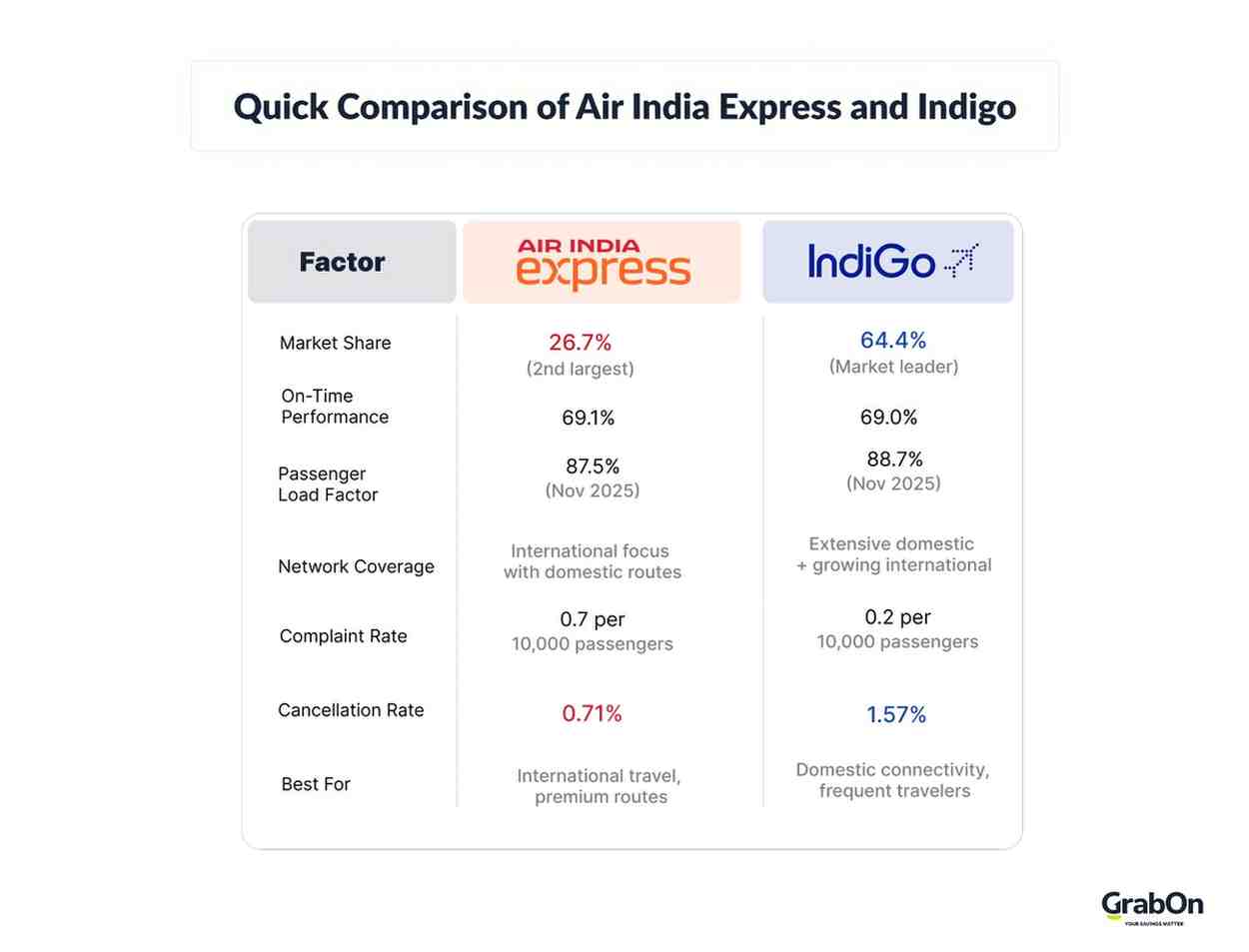
Quick Comparison of Air India Express and IndiGo
| Factor | Air India Express | IndiGo |
| Market Share | 26.7% (2nd largest) | 64.4% (Market leader) |
| On-Time Performance | 69.1% | 69.0% |
| Passenger Load Factor | 87.5% (Nov 2025) | 88.7% (Nov 2025) |
| Network Coverage | International focus with domestic routes | Extensive domestic + growing international |
| Complaint Rate | 0.7 per 10,000 passengers | 0.2 per 10,000 passengers |
| Cancellation Rate | 0.71% | 1.57% |
| Fare Tiers | Xpress Lite / Value / Classic / Flexo | Saver / Flexi / UpFront / Stretch |
| Loyalty program | NeuPass | IndiGo BluChip |
| Fleet size | 115 aircraft | 437+ aircraft |
| Best For | International travel, premium routes | Domestic connectivity, frequent travelers |
Understanding the Airlines
Air India Express operates as part of the Air India Group and has traditionally focused on connecting India with international destinations, particularly in the Middle East and Southeast Asia. In 2025, the airline carried approximately 40.75 lakh passengers in November alone, making it the second-largest carrier in India’s domestic market with a 26.7% share.
IndiGo dominates Indian aviation with an unmatched network spanning the entire country. As the market leader with 64.4% share, IndiGo carried 96.93 lakh passengers in November 2025 alone. The airline has built its reputation on extensive connectivity, with flights reaching even smaller cities that other carriers don’t serve regularly.
On-Time Performance: The Numbers Tell a Surprising Story
P.s.: These figures are from November 2025 (The latest available official aviation data)
When it comes to punctuality, both airlines perform almost identically. In November 2025, Air India Express achieved a 69.1% on-time performance rate, while IndiGo stood at 69.0%. This means roughly seven out of ten flights from either airline depart and arrive on schedule.
However, airport-specific performance reveals important differences. At major hubs, IndiGo shows more consistency. At Mumbai’s Chhatrapati Shivaji International Airport, IndiGo’s OTP was 43.4% compared to Air India Express’s 58.0%. In Delhi, the numbers were closer, with IndiGo at 58.3% versus Air India Express at 66.8%. Chennai emerged as the most reliable airport for both carriers, with IndiGo achieving 89.5% and Air India Express reaching 80.9%.
For travellers, this means your departure city matters significantly. If you’re flying from Chennai or Bangalore, both airlines deliver strong punctuality. But from Mumbai, expect more potential delays regardless of your choice, though Air India Express edges slightly ahead.
Flight Availability and Network Reach
This is where IndiGo’s dominance becomes clear. The airline operated 636,812 domestic departures through November 2025, compared to Air India Express’s 116,334 domestic departures. What does this mean for you? Simply put, IndiGo offers far more flight options throughout the day on most routes.
If you’re travelling between major metros like Delhi-Mumbai or Bangalore-Hyderabad, you’ll find IndiGo flights every hour or two. Air India Express operates fewer frequencies, which means less flexibility if you miss a flight or need to change plans. However, Air India Express maintains a stronger international presence with 42,336 international departures compared to IndiGo’s 90,850.
For domestic travellers prioritising flexibility and multiple daily options, IndiGo wins. For international routes, particularly to the Middle East, Air India Express provides better connectivity.
Passenger Load Factors: What They Mean for Your Comfort
Both airlines consistently fly with high occupancy rates. In November 2025, Air India Express recorded an 87.5% passenger load factor, while IndiGo reached 88.7%. These numbers indicate that most flights on both carriers are nearly full.
Throughout 2025, IndiGo’s load factors ranged from 81.5% to 91.7%, while Air India Express varied between 77.3% and 87.5%. What this tells you is straightforward: expect full flights on both airlines, especially during peak travel months like February and March. The middle seat is likely occupied, and overhead bin space fills up quickly. Early check-in and seat selection become more important when booking with either carrier.
Cancellations and Reliability
Air India Express demonstrates stronger reliability with a 0.71% cancellation rate, meaning only about 7 in every 1,000 flights get cancelled. IndiGo’s cancellation rate stands higher at 1.57%, translating to roughly 16 cancelled flights per 1,000.
While neither rate is alarmingly high, Air India Express’s lower cancellation rate suggests better operational consistency. For business travellers with tight schedules or passengers with connecting flights, this difference matters. IndiGo affected 89,826 passengers with cancellations in November 2025, compared to Air India Express’s 12,488 affected passengers.
There was one major exception worth noting. In January 2026, the DGCA imposed a Rs 22.20 crore fine on IndiGo after large-scale disruptions in early December 2025. The airline cancelled 2,507 flights and delayed another 1,852, affecting over three lakh passengers across multiple airports. While the incident was out of the ordinary, it also reflected the operational complexity of running India’s largest domestic airline.
Fare Tiers and Pricing
Both airlines offer multiple fare tiers, and choosing the right one can make a noticeable difference to the total cost of your trip. A cheaper ticket is not always the better deal if you end up paying separately for baggage, meals, or seat selection.
Air India Express offers four economy fare tiers under its Xpress branding:
- Xpress Lite: Includes 7 kg cabin baggage only, with no checked baggage and the strictest cancellation terms. A good option if you’re travelling light.
- Xpress Value: Includes 7 kg cabin baggage and 15 kg checked baggage, along with moderate cancellation and change fees.
- Xpress Classic: Comes with 15 kg checked baggage, a complimentary standard seat, and a Lite Bite meal. Change fees are also lower if you modify your booking more than three days before departure.
- Xpress Flex: Includes 20 kg checked baggage, complimentary premium or standard seat selection, a meal, zero convenience fee, and free date changes made more than three days before departure.
IndiGo restructured its fares in January 2026 under the 6E Ways to Fly portfolio:
- Saver: Includes 15 kg checked baggage on domestic flights, but meals and seat selection are not included. This is the fare most travellers see when they first search.
- Flexi: Adds a complimentary meal and seat selection, along with more flexible cancellation and change policies.
- UpFront (introduced in 2026): Includes 20 kg checked baggage, front-row seats (Rows 1 to 4), priority boarding, and a complimentary snack. It usually costs Rs 1,500 to Rs 2,500 more than Saver.
- Stretch / Stretch+: IndiGo’s premium offering on select routes, with extra legroom, upgraded meals, and priority services.
If you’re taking a short domestic flight with just cabin baggage, Xpress Lite and IndiGo Saver are usually the cheapest options. Once you need checked baggage, a meal, or more flexibility, it’s worth comparing the bundled fare against the base fare with add-ons. In many cases, pre-booking extras or choosing the next fare tier works out cheaper than paying for everything separately at the airport.
Loyalty Programs
If you fly even a few times a year, a loyalty program can help you get more value from every booking. While IndiGo BluChip is built around earning free flights, Tata NeuPass offers rewards that extend beyond travel into the wider Tata ecosystem.
| Feature | IndiGo BluChip | Tata NeuPass (Air India Express) |
| Launched | 2024, replacing 6E Rewards | Tata NeuPass launched in 2023 and is used by Air India Express |
| Membership | Free | Free |
| Reward Rate | 8 BluChips per Rs 100 spent on the base fare and fuel surcharge, up to 16 BluChips per Rs 100 for Blu 1 members booking directly | Up to 8 NeuCoins per Rs 100 spent on eligible bookings |
| Reward Value | Redeem BluChips for IndiGo flights | 1 NeuCoin = Rs 1 |
| Where You Can Redeem | Any IndiGo flight with no blackout dates | Air India Express bookings and Tata brands including BigBasket, Westside, IHCL Hotels, Qmin, and 1mg |
| Expiry | No expiry as long as there is at least one earning or redemption activity every 24 months | 365 days from the date of earning |
| Extra Perks | Earn BluChips on eligible Turkish Airlines and Qantas codeshare flights | Up to 4% tier-based discount on domestic and international fares. Expected to integrate with Air India’s Maharaja Club in the future. |
Bottom line: Choose BluChip if you fly IndiGo regularly and want a simple way to earn free flights. NeuPass is the better fit if you already spend across Tata brands and want rewards you can use beyond air travel. Its planned integration with Maharaja Club could also make it more valuable for international travellers.
Passenger Complaints and Service Quality
The complaint data reveals a significant quality difference. IndiGo receives just 0.2 complaints per 10,000 passengers, the lowest among all Indian carriers. Air India Express sees 0.7 complaints per 10,000 passengers, which is still reasonable but more than three times higher than IndiGo.
In November 2025, IndiGo received 230 total complaints while Air India Express recorded 296, despite IndiGo carrying more than double the passengers. The most common complaints across both airlines relate to flight problems (50.6%), baggage handling (17.9%), and refund issues (12.5%).
Both airlines maintain strong complaint resolution, with IndiGo closing 100% of its complaints and Air India Express resolving all but a handful. However, IndiGo’s lower complaint rate suggests better initial service delivery and fewer issues requiring resolution.
Denied Boarding and Passenger Rights
When flights are overbooked, IndiGo denied boarding to 53 passengers in November 2025, while Air India Express affected 639 passengers. Given IndiGo’s much larger operation, their rate per passenger is actually lower. Both airlines provided alternate flights and compensation as required, with Air India Express spending ₹59.02 lakhs on facilitation and IndiGo spending ₹3.55 lakhs.
For travelers, this data suggests overbooking happens infrequently on both carriers, but arriving early and completing online check-in reduces your risk of being bumped from your flight.
Delays Beyond Two Hours
Extended delays significantly disrupt travel plans. In November 2025, Air India Express had 46,323 passengers affected by delays exceeding two hours, while IndiGo affected 75,150 passengers. Both airlines provided refreshments and rebooking options as mandated.
The primary causes for delays across Indian aviation are “reactionary” issues (67%), meaning delays cascade from earlier problems. Air Traffic Control contributes 11%, as do operational factors, while weather accounts for just 1%. This pattern affects both airlines similarly, suggesting external factors beyond airline control drive the most significant delays.
In-Flight Experience and Value
IndiGo and Air India Express offer similar low-cost flying experiences, but higher fare tiers add more comfort and convenience.
IndiGo offers upgraded options such as Flexi Plus and UpFront. Beyond basic fares, Flexi Plus includes complimentary standard seat selection, a free meal, and reduced change/cancellation fees. For maximum comfort, UpFront bundles front-row seating with extra legroom, complimentary meals, higher baggage allowances, and priority deplaning with flexible flight changes.
Air India Express also offers additional benefits through its higher fare tiers. The airline’s Xpress Classic tier includes 15 kg check-in baggage, a complimentary standard seat, a Lite Bite snack, and drastically reduced modification fees. Upgrading to Xpress Flex boosts your check-in baggage allowance to 20 kg while unlocking free Prime seat selection, zero date-change fees (when rescheduled 3+ days prior), and lower cancellation penalties.
If budget is not the primary concern, travellers can also consider Air India, the parent company of Air India Express, provided it operates a suitable route. As a full-service carrier, Air India can offer a more comprehensive in-flight experience for travellers who value comfort and included services over the lowest base fare. Those considering Air India can also check Air India coupon codes for available discounts before booking.
Route Performance and Premium Fares
Looking at revenue data from the highest fare buckets reveals interesting patterns. Air India Express sells 0.50% to 1.52% of seats in the highest fare category on select routes, earning 1.32% to 4.47% of revenue from these premium bookings. IndiGo, interestingly, shows 0% across all tracked routes, suggesting a more uniform pricing approach without extreme fare spikes.
For travellers, this indicates Air India Express implements more dynamic pricing with occasional premium fares, while IndiGo maintains steadier, more predictable pricing across its network.
What Reddit Travelers Say: Real Experiences from Air India Express vs IndiGo
Beyond official statistics, real passenger experiences shared on Reddit communities like r/AirTravelIndia offer valuable ground-level insights into how these airlines actually perform day-to-day. A recent discussion thread comparing first-flight experiences between these carriers reveals nuanced perspectives that data alone cannot capture.
The First-Timer’s Perspective
One Reddit user shared their maiden flight experience, noting that both airlines delivered comparable service quality for domestic travel. The original poster emphasised that, as budget carriers, neither airline offers premium frills, but both get the job done reliably. This sentiment reflects a broader Reddit consensus: expectations should align with the low-cost carrier model.
IndiGo: Consistency and Network Strength
Reddit travellers consistently praise IndiGo for operational reliability and extensive route coverage. Multiple users highlight the airline’s strength in connecting smaller tier-2 and tier-3 cities, something few other carriers manage effectively. One frequent flyer noted that IndiGo’s multiple daily flights on popular routes offer crucial flexibility for business travellers.
The professionalism of ground staff receives regular appreciation, with several Redditors noting that check-in and boarding processes feel more organised compared to competitors. The airline’s mobile app and digital experience also earn positive mentions for being user-friendly and functional.
However, the Reddit community doesn’t shy away from criticism. The most common complaint centers on crowded cabins and the “no-frills” experience feeling particularly austere during peak hours. Several users describe boarding as chaotic when flights are full, and note that crew members can seem rushed or transactional rather than warm. As one Redditor put it, “You’re getting from Point A to Point B efficiently, but don’t expect anyone to make you feel special about it.”
Pricing practices generate mixed reactions. While some appreciate IndiGo’s generally competitive fares, others express frustration with dynamic pricing that can spike dramatically during festivals or holiday periods.
Air India Express: The International Connector
Reddit discussions about Air India Express often focus on its strength in international connectivity, particularly to Middle Eastern destinations. Users traveling to Dubai, Abu Dhabi, or other Gulf cities frequently recommend Air India Express for better schedules and competitive international fares. If you’re comparing options for a Gulf trip, our guide on Air India vs Air India Express can help you decide whether the full-service parent or the low-cost subsidiary makes more sense for your route.
Several Redditors note that as part of the merged Air India Group, the airline has been improving its service standards. One user mentioned experiencing better in-flight announcements and slightly more attentive crew compared to their previous Air India Express flights, suggesting ongoing service enhancements.
The seat comfort and cabin experience receive neutral-to-positive reviews, with some users claiming Air India Express aircraft feel marginally less cramped than IndiGo on similar routes, though this appears aircraft-dependent rather than a consistent difference.
On the downside, Reddit users point out limited domestic frequency as a significant weakness. Multiple commenters mention that if an Air India Express flight gets cancelled or delayed significantly, rebooking options are far more limited compared to IndiGo’s extensive network. One traveler shared an experience where a cancelled Air India Express flight left them with a 6-hour wait for the next available flight, whereas IndiGo would have offered multiple alternatives.
The Practical Consensus
The Reddit community’s practical advice boils down to route-specific recommendations. For purely domestic travel, especially between metros or to smaller cities, the consensus leans heavily toward IndiGo for frequency, reliability, and rebooking flexibility. As one highly-upvoted comment stated: “IndiGo is boring, predictable, and exactly what you want when you just need to get somewhere.”
For international connections or specific routes where Air India Express offers better timings, Redditors consider it a perfectly acceptable choice, particularly praising its lower cancellation rates and integration with Air India’s broader network.
Several experienced travelers note that both airlines have similar baggage policies, seat pitch, and in-flight purchase options, making the actual flying experience comparable. The real differentiator, according to Reddit wisdom, is network coverage and flight frequency rather than any substantial service quality gap.
What Reddit Gets Right
These ground-level experiences align remarkably well with the statistical data. IndiGo’s dominance in market share (64.4%) and extensive network matches Reddit users’ observations about flight availability and connectivity. Air India Express’s lower cancellation rate (0.71% vs 1.57%) supports Redditors who praise its operational reliability, even if the limited frequencies remain a concern.
The Reddit community’s emphasis on “managing expectations” for budget carriers proves valuable. Both airlines operate in the low-cost segment, and traveller satisfaction seems highest when passengers understand they’re paying for transportation rather than a premium experience. As one thoughtful Redditor summarised: “Compare prices, compare timings, pick whichever works better for your specific trip. They’re both fine airlines that will get you there safely and mostly on time.”
Which Airline Should You Choose?
Choose Air India Express if:
- You’re travelling internationally, especially to Middle Eastern destinations
- You prefer a carrier with lower cancellation rates
- You’re flying from airports where they show stronger on-time performance (Chennai, Delhi, Bangalore)
- You value being part of the Air India ecosystem with potential loyalty benefits
Choose IndiGo if:
- You need maximum flexibility with multiple daily flight options
- You’re travelling domestically between smaller cities with limited air connectivity
- You prioritize the lowest complaint rate and customer service responsiveness
- You value IndiGo’s extensive network, reaching more destinations across India
- You’re a frequent flyer who benefits from having more flight choices throughout the day
For most domestic travellers, IndiGo’s extensive network, lower complaint rate, and greater flight frequency make it the practical choice. The airline’s market leadership stems from genuine operational advantages that benefit passengers: more flights, more destinations, and statistically better service delivery.
However, Air India Express holds distinct advantages for international travel and delivers marginally better reliability on cancellations. Business travellers on specific metro routes where both airlines compete might find Air India Express’s slightly better on-time performance valuable, though the difference is minimal.
Bottom Line
Both airlines serve Indian aviation well, but they excel in different areas. IndiGo dominates domestic connectivity and maintains the industry’s best complaint resolution record. Air India Express offers strong international options and demonstrates slightly better operational reliability, measured by cancellations.
The right choice depends entirely on your specific route, schedule flexibility, and whether you’re travelling domestically or internationally. Check both airlines for your particular journey, compare not just prices but departure times and frequency, and consider whether you need the flexibility of multiple daily options or if a single well-timed flight suffices.
Ready to book your next flight? Compare current fares and check for exclusive flight discount codes on GrabOn to maximise savings on either Air India Express or IndiGo flights.
FAQs
Is Air India Express cheaper than IndiGo for domestic flights?
On overlapping domestic routes, the fare difference between Air India Express and IndiGo is typically under Rs 500 either way when comparing the same fare tier. Air India Express’s Xpress Lite fare (cabin baggage only, no checked bag) can undercut IndiGo’s Saver fare on certain routes, but IndiGo’s larger inventory means more fare buckets are available, and you are more likely to find a low-priced seat on a less-popular time slot. The real savings come from comparing both airlines on the same route and date, and then stacking a GrabOn coupon code or bank offer on top.
What happens if my IndiGo or Air India Express flight is cancelled?
Under DGCA rules (CAR Section 3, Series M, Part IV), you are entitled to a full refund or an alternate flight on any carrier. If the cancellation is within the airline’s control and communicated less than 24 hours before departure, you may also be entitled to compensation of up to Rs 20,000, plus meals and hotel accommodation during the wait. The new 48-hour free cancellation rule (effective March 2026) also lets you cancel your booking within 48 hours without paying airline fees, regardless of the reason.
Which airline has more legroom, Air India Express or IndiGo?
Standard economy seat pitch on both carriers is comparable at approximately 28-30 inches on narrowbody aircraft. IndiGo’s Stretch fare offers extra-legroom seats (rows 1, 12, 13 on A320 aircraft) with roughly 34-36 inches of pitch. Air India Express offers a Business/Premier cabin on select Boeing 737-8 routes with enhanced seat pitch, though availability is limited. Neither airline offers a significant legroom advantage in standard economy.
Do IndiGo and Air India Express charge for seat selection?
Both airlines charge for seat selection at the base fare tier (Saver/Lite). IndiGo’s Flexi and above include complimentary seat selection, while Air India Express’s Xpress Classic and above include a standard seat at no extra charge. DGCA mandates that seat selection is an optional unbundled service (per ATC 04 of 2026), meaning you will be assigned a free seat at check-in if you choose not to pay for selection.
What is the best time to book cheap flights on IndiGo and Air India Express?
Book 3-6 weeks ahead for domestic flights and 6-10 weeks ahead for international routes. Both airlines release promotional sales periodically: IndiGo runs its Mega Sale and anniversary sales (typically January and August), while Air India Express runs PayDay Sales at month-end. Tuesday and Wednesday departures tend to be the cheapest
Which airline is better for students and senior citizens?
Both IndiGo and Air India Express offer special concessions for students, senior citizens, and armed forces personnel on select bookings. Air India Express typically applies these discounts at the booking stage on its website and app. IndiGo also offers student and senior citizen fares on select routes. The discount amount varies by route and season, so compare both at the time of booking.