



SutiSancha Coupons & Promo Codes
Best 7 Coupons & Offers last validated on October 27th, 2026
- All (7)
- Offers (7)
Existing User
- All (7)
- Offers (7)
New Arrivals: Get Up To 52% OFF On Newly Launched Sarees
- Save up to 52% OFF on your purchases
- The offer is applicable for newly launched sarees
- The prices start at Rs 1250 & above
Avail Up To 40% OFF On Handloom Sarees
- Grab up to 40% OFF on handloom sarees.
- The price starts from Rs 1800.
- Valid for all users.
Grab Up To 35% OFF On Your Products
- Get up to 35% OFF on selected sarees
- The price starts from Rs 1880
- Cash on delivery is avail
Avail Up To 45% OFF On LoomLush Saree
- Avail Up To 45% OFF on LoomLush Saree
- Starting from Rs 1,295
- Valid for all users
Top Cashback Cards

AU Small Finance Bank
LIT Credit Card
SutiSancha Coupon Codes and Discounts
Soulful Thread Sarees - Up To 55% OFF
- Get Soulful Thread Sarees & avail Up To 55% OFF
- Pricing starts at Rs 799
- Valid for all users
Grab Up To 25% OFF On TissueTales Purchases
- Save up to 25% instant discount on tissuetales orders
- Price starts from Rs 1850
- Avail free shipping
Avail Free Shipping On All Your Orders
- Shop your favourite sarees and get this deal
- Avail free shipping on your orders
- Minimum order value is not required
Trendy SutiSancha Coupons & Discount Codes For Oct 2026
| Category | SutiSancha Coupon Codes & Offers |
| Sitewide Offer | Up To 40% OFF + Extra Rs 200 OFF |
| Handloom Sarees | Get Up To 40% OFF |
| New Launches | Avail Up To 35% OFF |
| Mulmul Cotton Sarees | Grab Up To 32% OFF |
| On All Orders | Free Shipping |
About Sutisancha
Sutisancha on the GrabOn India coupon page covers the India D2C handloom and cotton saree label operating the direct online storefront at sutisancha.com. The label sits in the broader India D2C handloom-saree category alongside Suta, Taneira, Fabindia, Okhai, Tilfi, GoCoop, GoVintage, Jaypore, and the wider weaver-direct online-saree cohort that grew from the 2015-to-2025 D2C wave in the Indian ethnic-wear category. The catalogue spans Bengal handloom cotton sarees, tant sarees, jamdani sarees, linen sarees, mulmul sarees, silk sarees, khadi sarees, and the broader cotton-heritage ethnic-wear range with the matching blouse, dupatta, and ethnic-stole accessories.
The Sutisancha operating thesis runs on three pillars: the weaver-direct sourcing pillar, the cotton-and-handloom heritage pillar, and the everyday-wearability pillar. The first pillar means the label sources from handloom weavers in West Bengal and adjacent handloom clusters rather than from machine-loom power-loom factories, which positions the catalogue at the cotton-handloom-craftsmanship end of the saree retail spectrum. The second pillar means the design vocabulary draws from the long Bengal handloom heritage including the tant weave (the lightweight Bengal cotton saree with thin transparent texture), the jamdani weave (the intricate supplementary-weft cotton-on-cotton motif technique), the linen and mulmul light-weave cottons, the khadi handspun-cotton tradition, and the regional silk traditions including the muga, eri, and pat silks. The third pillar means the catalogue targets the everyday-wearability use case (the Indian working woman picking the cotton or linen saree for the office or college day) more than the heavy bridal or red-carpet occasion-wear category, although the silk and festive sub-line covers the wedding-guest and festive use case.
The catalogue spans eight primary saree families with category-level price bands typically falling in this range. The Bengal Handloom Cotton Saree family covers the classic tant-weave Bengal cotton saree at the everyday-wear and office-wear use case (typical price range Rs 999 to Rs 2,999). The Jamdani Saree family covers the intricate supplementary-weft motif handloom saree at the festive and wedding-guest use case (typical price range Rs 1,999 to Rs 6,999 depending on motif density and silk content). The Linen Saree family covers the lightweight linen-cotton blend saree at the summer and monsoon office-wear use case (typical price range Rs 1,499 to Rs 4,999). The Mulmul Saree family covers the ultra-light mulmul muslin cotton saree at the summer and travel-friendly use case (typical price range Rs 999 to Rs 2,999). The Silk Saree family covers the festive silk-weave saree at the wedding-guest and pooja use case (typical price range Rs 2,999 to Rs 9,999 depending on silk grade and weave complexity). The Khadi Saree family covers the handspun khadi-cotton saree at the everyday-wear and Gandhi-Jayanti-and-Khadi-week use case (typical price range Rs 1,499 to Rs 3,999). The Half-and-Half and Designer Saree family covers contrasting-pallu and contemporary designer sarees at the festive and party-wear use case. The Blouse and Accessory family covers the matching blouse fabric, the readymade blouse, the ethnic stole, the dupatta, and the saree-fall-and-petticoat accessory at supporting price points.
Indian buyer profiles at Sutisancha split into five cohorts. The working-woman buyer (the Indian office-going woman, the teacher, the bank-employee, the government-sector-employee, and the corporate-office-employee picking the cotton or linen saree for the office-wear and daily-wear use case) picks the Bengal handloom cotton, the linen, or the mulmul family for the lightweight breathable everyday-wear path. The festive and wedding-guest buyer (the Indian woman picking the saree for a friend's or relative's wedding, the festive pooja, the sangeet, or the family-gathering occasion) picks the jamdani, silk, or designer half-and-half saree family on the medium-to-premium price band. The bridal-trousseau buyer (the Indian bride or the bride's family picking sarees for the trousseau gift-pack to the daughter, daughter-in-law, sister-in-law, or mother-in-law) picks the silk and jamdani family on the premium price band with the multi-saree cart through the festive-and-wedding-sale window. The gift-buyer (picking the saree as a Karwa Chauth, Bhai Dooj, Rakhi, birthday, or anniversary gift for the wife, mother, sister, mother-in-law, or daughter) picks the gift-pack format or the single saree on the medium price band. The Bengali-cultural-heritage buyer (the Indian Bengali or fellow-traveller picking the tant or jamdani saree for the Durga Pujo wear, the Saraswati Pujo wear, the Poila Boisakh wear, or the cultural-heritage wardrobe) picks the Bengal handloom and jamdani family through the festive cluster.
Sutisancha Offer Types and Discount Tiers
The Sutisancha coupons listed on the coupon page cluster into seven recurring offer types. Knowing which type applies to your shopping intent helps pick the right code at checkout rather than trying every listed code in trial and error. The active codes refresh as the brand runs new sale windows, festive promotions, and partner campaigns.
- Sitewide flat-percentage discount (10 to 25 percent off across the saree catalogue): Sutisancha runs sitewide flat-percentage codes across the saree catalogue during sale windows. The depth typically lands at 10 to 25 percent off the cart total. Suits the multi-saree cart buyer (the bridal-trousseau cohort, the gift-buyer picking multiple sarees, the festive shopper layering the family-wedding wardrobe) and the single-saree buyer through the festive-sale cluster.
- First-order welcome discount (Flat Rs 200 to Rs 500 off the first order): The brand emails a welcome discount code to new email subscribers and new account-registrations after the newsletter signup. The code typically saves Rs 200 to Rs 500 off the first order on a minimum cart value of Rs 1,499 to Rs 1,999. Suits the first-time Sutisancha buyer registering the account before the first purchase.
- Bundle and multi-buy combo discount (Buy 2 and save more, Buy 3 and save even more): Sutisancha runs multi-buy bundle promotions where the cart auto-discounts when two, three, or four sarees are added. The depth typically lands at 15 to 30 percent off the cart total on the multi-saree cart, with deeper depth on the larger cart. Suits the bridal-trousseau buyer, the multi-occasion festive shopper, and the gift-and-self combo buyer.
- Free shipping on the cart threshold (Free pan-India shipping over Rs 999 or Rs 1,499): The brand operates free pan-India standard shipping on the cart value crossing the threshold (typically Rs 999 to Rs 1,499 depending on the prevailing brand policy at the time of order). Most single-saree carts cross the threshold naturally given the saree price band, which means the free-shipping policy applies on most direct-shop orders.
- Category-specific discount (Flat 15 to 30 percent off jamdani, silk, linen, or festive collection): Sutisancha runs category-specific discount codes targeting individual weave families (jamdani, silk, linen, mulmul, khadi) or seasonal collections (summer-cotton, monsoon-mulmul, festive-jamdani, wedding-silk). The depth typically lands at 15 to 30 percent off the category-tier cart. Suits the buyer with a clear weave-family preference.
- Festive-and-gift-pack saves (Diwali, Durga Pujo, Karwa Chauth, Rakhi, Holi gift bundles): The brand runs festive-and-gift-pack promotions during the Indian-festive cluster (Diwali, Durga Pujo, Karwa Chauth, Rakhi, Holi, Saraswati Pujo, Poila Boisakh, Pongal, Onam, Ugadi). The depth typically lands at 20 to 35 percent off the festive-collection cart plus complimentary gift-packaging on selected price bands. Suits the festive-and-gifting buyer through the seasonal cluster.
- End-of-season-sale (EOSS) clearance (Up to 50 to 60 percent off select inventory in January and July): Sutisancha runs the End-of-Season Sale clearance window through the January and July cluster aligned with the broader Indian ethnic-wear and fashion EOSS cycle. The depth typically lands at 30 to 50 percent off select inventory across the cotton, linen, and seasonal-collection sub-lines, with selected jamdani and silk pieces at up to 60 percent off the original list price.
Stacking rules to remember: the bundle and multi-buy combo discount typically applies independently of the sitewide flat-percentage code, the category-specific code applies only to the eligible weave family, and the welcome and first-order code applies only to the first order on the new account with the eligible cart threshold.
Saree Families and Weaves at Sutisancha
The Sutisancha catalogue covers the cotton-handloom-and-silk saree category across eight primary weave families with the matching blouse and accessory line. Each family carries its own ideal buyer scenario. Here is a family-by-family breakdown.
Bengal Handloom Cotton Saree (Tant Weave)
The Bengal Handloom Cotton Saree family is the flagship product line at Sutisancha. The classic tant-weave Bengal cotton saree carries the lightweight transparent body, the contrasting border, the woven motif, and the regional Bengal handloom heritage. Indicative pricing runs at Rs 999 to Rs 2,999 depending on motif density and border complexity. Suits the working-woman buyer for office-wear and daily-wear, the Bengali-cultural-heritage buyer for Durga Pujo and Saraswati Pujo wear, and the cotton-handloom-collector buyer building the Bengal-saree wardrobe stack. The tant weave breathes well in the Indian summer and monsoon climate and works as the everyday-wear cotton-saree default.
Jamdani Saree
The Jamdani Saree family covers the intricate supplementary-weft motif handloom saree. Jamdani is the cotton-on-cotton motif technique where the motif is hand-woven into the body during the weaving process rather than printed or embroidered. Indicative pricing runs at Rs 1,999 to Rs 6,999 depending on motif density, weave-fineness, and silk-content in the cotton-silk blend variants. Suits the festive and wedding-guest buyer for the sangeet, reception, and family-gathering occasion, the bridal-trousseau buyer for the trousseau gift-pack, and the cultural-heritage buyer building the jamdani-weave wardrobe stack. The jamdani weave carries a distinct heritage tag and the saree-collector buyer typically picks one or two jamdani pieces per season.
Linen Saree
The Linen Saree family covers the lightweight linen-cotton-blend saree at the summer and monsoon office-wear use case. Linen breathes well, drapes lightly, and carries the contemporary-classic crisp finish that suits the corporate-office and the modern-Indian-working-woman wardrobe. Indicative pricing runs at Rs 1,499 to Rs 4,999 depending on linen-grade and blend ratio. Suits the working-woman buyer for office-wear, the summer-saree buyer in the metro cities, and the modern-Indian-classic wardrobe buyer.
Mulmul Saree
The Mulmul Saree family covers the ultra-light mulmul muslin cotton saree at the summer and travel-friendly use case. Mulmul is the soft, light, muslin-cotton weave traditionally associated with the Bengal and the broader Indian summer-cotton heritage. Indicative pricing runs at Rs 999 to Rs 2,999. Suits the summer-saree buyer in the hot-and-humid climate, the travel-friendly saree buyer packing light for the multi-day trip, and the everyday-wear buyer prioritising comfort over weight or formality.
Silk Saree
The Silk Saree family covers the festive silk-weave saree at the wedding-guest and pooja use case. The line typically covers Bengal silk (the Murshidabad silk, the Bishnupuri silk), the Bhagalpur tussar silk from Bihar, the Assam muga silk, the Banarasi silk, and selected southern silk-handloom traditions. Indicative pricing runs at Rs 2,999 to Rs 9,999 depending on silk grade and weave complexity. Suits the wedding-guest buyer for the reception or sangeet occasion, the festive buyer for Diwali, Durga Pujo, or Karwa Chauth, the bridal-trousseau buyer for the gift-pack, and the silk-saree-collector buyer building the festive wardrobe stack.
Khadi Saree
The Khadi Saree family covers the handspun khadi-cotton saree at the everyday-wear and Gandhi-Jayanti and National Handloom Day use case. Khadi carries the long Indian-nationalist-handloom heritage and the natural-fibre breathability suited to the everyday-wear path. Indicative pricing runs at Rs 1,499 to Rs 3,999. Suits the Khadi-heritage buyer, the natural-fibre and sustainable-fashion buyer, and the everyday-wear cotton-saree buyer looking for a heritage-tagged option beyond the standard mill-cotton.
Half-and-Half and Designer Saree
The Half-and-Half and Designer Saree family covers contrasting-pallu and contemporary designer sarees at the festive and party-wear use case. The half-and-half saree carries one colour or print on the body and a contrasting colour or motif on the pallu (the decorative end-piece draped over the shoulder), which gives the look a contemporary-fusion edge. Suits the modern-Indian buyer who wants the cotton-handloom base with the contemporary-design overlay.
Blouse, Dupatta, and Saree Accessory
The Blouse, Dupatta, and Saree Accessory family covers the matching blouse fabric and the readymade blouse stitched in standard sizes, the ethnic stole, the dupatta, the saree-fall-and-petticoat accessory, and the saree-pin and saree-care kit. The matching blouse fabric ships with most saree orders by default. Suits the buyer wanting the complete saree-and-blouse-and-accessory stack from a single label rather than sourcing the blouse stitching separately from the local tailor.
How to Apply a Sutisancha Coupon
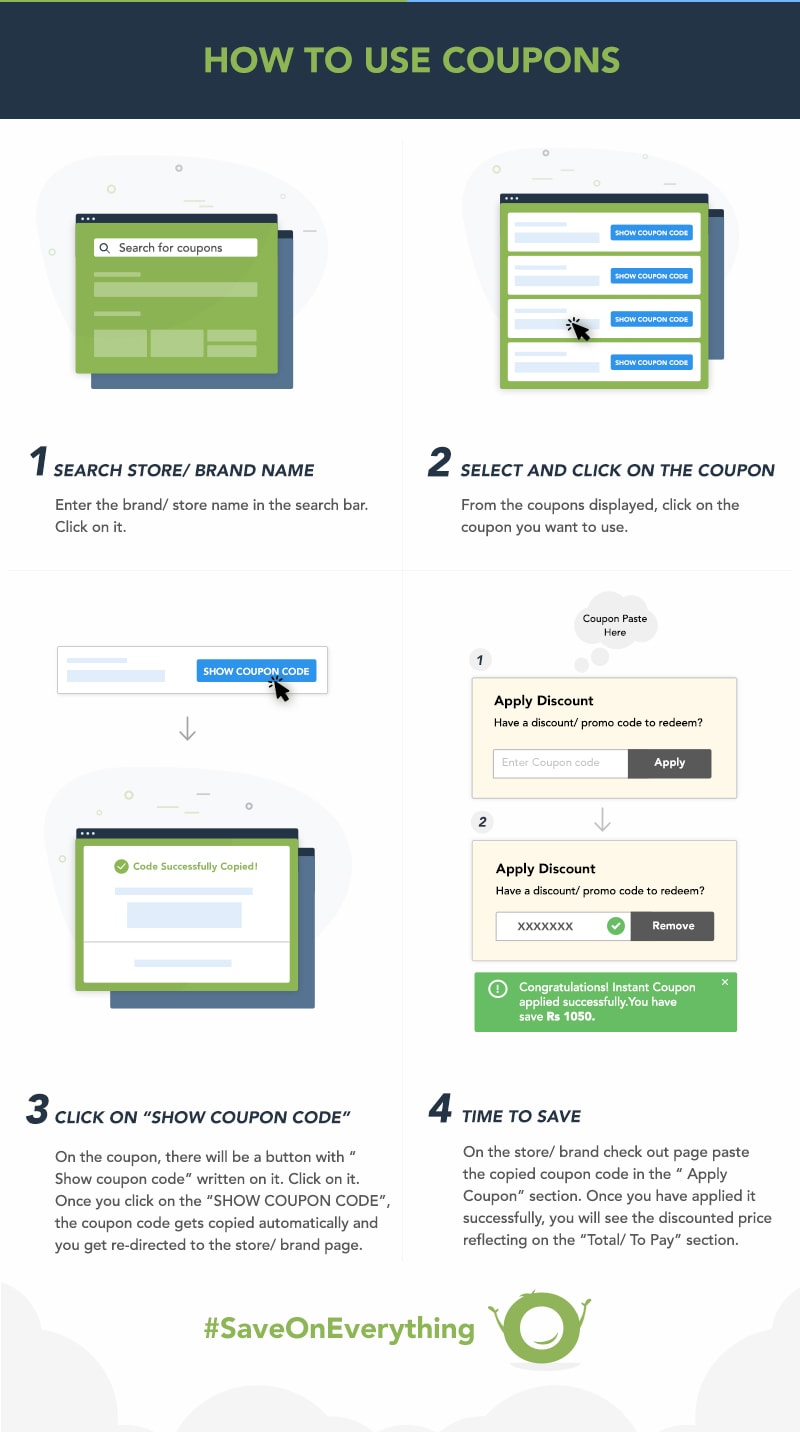
The redemption flow at sutisancha.com is straightforward and works the same way on both the desktop site and the mobile site. Follow these steps to apply a coupon code at checkout.
- Open the Sutisancha coupons page on GrabOn on a desktop or mobile browser. The page lists active codes including sitewide flat-percentage discount, first-order welcome, bundle and multi-buy combo, free-shipping threshold, category-specific weave-family code, festive-and-gift-pack code, and end-of-season-sale clearance code.
- Pick the coupon that matches your shopping intent. Sitewide codes apply broadly across the catalogue, welcome codes work only for first-time buyers on a new account, bundle codes need two or more sarees in the cart, category codes apply only to the eligible weave family (jamdani, silk, linen, mulmul, khadi), festive codes work during the called-out festive cluster, and EOSS codes work during the January and July clearance window.
- Tap Show Code or Get Deal on the chosen coupon card. The code copies to the clipboard and a new tab opens sutisancha.com with the coupon ready to paste at checkout.
- Browse the catalogue and add the sarees, blouses, or accessories to the cart. Use the weave-family filter on the left rail of the catalogue page (tant, jamdani, linen, mulmul, silk, khadi, half-and-half) to narrow the browse to the preferred weave.
- Click the cart icon at the top right of the site and review the cart summary. The cart page shows the line items, the subtotal, the shipping section, and the Apply Coupon Code field.
- Paste the code into the Apply Coupon Code field on the cart page or the checkout page. Click Apply. The discount line appears below the subtotal with the revised payable amount and the savings figure.
- Enter the delivery address with the full pin code and the contact-mobile-number. The cart page shows the estimated delivery timeline based on the pin code and the prevailing shipping policy. Most metro pin codes typically see 2 to 5 business day delivery on the standard shipping path.
- Pick the payment method. The cart accepts UPI (PhonePe, Google Pay, Paytm, BHIM), credit and debit cards (Visa, Mastercard, RuPay, American Express), net banking, EMI on selected cards, and Cash on Delivery on the supported pin codes. Click Place Order to confirm. The brand sends an order-confirmation email and SMS with the order number and the estimated delivery window.
Copy the code from the GrabOn Sutisancha page before opening the cart checkout. The copy-to-clipboard button on each coupon card eliminates manual typing errors that can otherwise cause an invalid-code rejection. For the first-order welcome code, register the account and confirm the email before adding the saree to the cart since the welcome code is account-linked and triggers on the new-account-first-cart path.
Best Sutisancha Offers Available
The active Sutisancha coupons map to several distinct buyer profiles. Use the table below to quickly match the right code to your cart.
| Offer Type | Discount Depth | Cart Path | Best Buyer Profile |
|---|---|---|---|
| Sitewide flat-percentage discount | 10 to 25 percent off | All sarees, single or multi-saree cart | Festive-shopper, gift-buyer, regular-wardrobe-stack buyer |
| First-order welcome | Rs 200 to Rs 500 off, min Rs 1,499 cart | First-time direct-shop buyer | New account, newsletter subscriber |
| Bundle and multi-buy combo | 15 to 30 percent off cart on 2 or more sarees | Multi-saree cart | Bridal-trousseau, multi-occasion festive, gift-and-self combo |
| Free pan-India shipping | Free over Rs 999 to Rs 1,499 cart | Single-saree typical cart | Standard direct-ship buyer |
| Category-specific weave | 15 to 30 percent off category | Jamdani, silk, linen, mulmul, khadi | Weave-family-preference buyer |
| Festive and gift-pack | 20 to 35 percent off festive cart | Diwali, Durga Pujo, Karwa Chauth, Rakhi | Festive and gifting buyer |
| End-of-season-sale clearance | Up to 50 to 60 percent off select inventory | January and July cluster | Wardrobe-stack buyer, sale-window deepest-discount buyer |
Codes refresh on the listing as the brand launches new sale windows and partner campaigns. The verified tag indicates a code that has been tested in the last 7 days.
Sale Events and Promotional Windows
The Sutisancha sale calendar follows the Indian ethnic-wear and saree retail calendar with strong overlap to the festive-and-wedding-shopping cluster. Some windows reliably carry the deepest depth of the year, others run lighter category-specific or seasonal-collection promotions. Here is the year-round schedule.
Republic Day and New Year Window (January)
The Republic Day and New Year Window runs through January with the End-of-Season Sale clearance plus the Republic Day promotional cluster. Depth typically lands at 30 to 50 percent off select inventory across the cotton, linen, and seasonal-collection sub-lines. Suits the working-woman buyer restocking the office-wear wardrobe at the year's first deep-discount window.
Saraswati Pujo and Basant Panchami Window (Late January to February)
The Saraswati Pujo and Basant Panchami Window pairs the Bengali-cultural-festive cluster with the broader spring-fashion cycle. Yellow and pastel saree variants see strong demand for the Saraswati Pujo wear. Depth typically lands at 15 to 25 percent off the festive-and-yellow-collection cart.
Poila Boisakh and Bengali New Year Window (April)
The Poila Boisakh and Bengali New Year Window runs through mid-April on the Bengali-cultural-festive cluster. White-and-red saree variants (laal-paar shada saree, the classic Bengali festive look) see strong demand. Depth typically lands at 15 to 25 percent off the festive collection with category-specific promotion on the Bengal handloom tant and jamdani family.
Mother's Day and Gift Window (May)
The Mother's Day and Gift Window runs through early-to-mid May on the gift-buying cluster. Depth typically lands at 15 to 20 percent off the gift-collection cart with complimentary gift-packaging on selected price bands. Suits the gift-buyer picking the saree for the mother, mother-in-law, or grandmother.
Monsoon and Mulmul-Light-Saree Window (June to August)
The Monsoon and Mulmul-Light-Saree Window runs through the Indian monsoon cluster with category-specific promotion on the mulmul, linen, and lightweight-cotton sub-lines. Depth typically lands at 10 to 20 percent off the category-tier cart. Suits the summer-and-monsoon working-woman buyer prioritising lightweight breathable cotton over the heavier silk or jamdani.
National Handloom Day Window (Around August 7)
The National Handloom Day Window runs around the August 7 cluster (the date marking the Swadeshi Movement and the Indian handloom heritage). Sutisancha typically runs depth of 15 to 25 percent off the handloom-collection cart plus the khadi and tant sub-line promotion through the cluster. Suits the handloom-heritage buyer building the cotton-handloom wardrobe stack.
Independence Day and Khadi Week Window (August)
The Independence Day and Khadi Week Window pairs the Indian-national-day cluster with the Khadi-and-Village-Industries cluster. Depth typically lands at 15 to 25 percent off the khadi and cotton-heritage cart through the cluster.
Onam, Ganesh Chaturthi, Pongal Regional Festive Windows (Variable)
The Onam (August-September, Kerala), Ganesh Chaturthi (August-September, Maharashtra), and Pongal (January, Tamil Nadu) regional festive windows see selective regional-specific promotions across the South Indian buyer base. Depth typically lands at 15 to 25 percent off the regional-festive collection.
Durga Pujo Window (September to October)
The Durga Pujo Window runs through Mahalaya, Shashthi, Saptami, Ashtami, Navami, and Dashami across the four to five days of the festival. The window is the deepest festive-saree-buying cluster for the Bengali-cultural-heritage buyer and the broader Indian saree-shopper. Sutisancha typically runs depth of 20 to 35 percent off the festive-collection cart with category-specific promotion on the jamdani, silk, and Bengal handloom family. Suits the Durga Pujo buyer picking four or five sarees for the multi-day festival wardrobe.
Karwa Chauth Window (October to November)
The Karwa Chauth Window runs through the late-October or early-November cluster. Red and traditional saree variants see strong demand for the Karwa Chauth wear. Depth typically lands at 20 to 30 percent off the festive-and-red-collection cart.
Diwali Window (October to November)
The Diwali Window runs through the late-October to early-November cluster aligned with the Diwali festive-shopping calendar. Depth typically lands at 25 to 35 percent off the festive-collection cart plus complimentary gift-packaging on selected price bands. The window is the deepest festive-discount cluster of the Indian saree-shopping calendar across most ethnic-wear labels.
Wedding-Season and Trousseau Window (October to February)
The Wedding-Season and Trousseau Window runs through the Indian wedding-season cluster from October to February with the multi-saree bridal-trousseau cart as the primary demand profile. The bundle and multi-buy combo discount typically runs well on the multi-saree cart through the cluster.
Black Friday and Cyber Monday Window (Late November)
The Black Friday and Cyber Monday Window runs through the late-November weekend with depth of up to 40 percent off sitewide aligned with the global retail-festive-cluster that Indian D2C labels increasingly mirror. Suits the wardrobe-stack buyer stocking up at the deepest pre-winter discount window.
Year-End and Holi-Spring-Collection Window (December to March)
The Year-End and Holi-Spring-Collection Window runs through December to March with depth of 15 to 30 percent off sitewide on the spring-and-summer-collection cart through the cluster. Suits the spring-wardrobe-refresh buyer ahead of the summer-saree cluster.
Payment, Card, and Billing Offers
Sutisancha operates on the standard Indian D2C ethnic-wear billing workflow. The Indian buyer typically pays through UPI, credit card, debit card, net banking, or Cash on Delivery on the supported pin codes. Here is the payment framework.
- UPI payment on the standard UPI-app workflow through PhonePe, Google Pay, Paytm, BHIM, and the bank-app UPI-flow. UPI is the most common payment method on Indian D2C ethnic-wear orders and typically processes the cart instantly on the standard UPI-flow.
- Credit card and debit card payment on Visa, Mastercard, RuPay, and American Express on the standard checkout-card-flow. EMI on selected credit cards may apply on the cart above a minimum threshold (typically Rs 3,000 to Rs 5,000 depending on the issuing-bank policy at the time of order).
- Net banking on the major bank list including HDFC, ICICI, Axis, SBI, Kotak Mahindra, Yes Bank, IDBI, Punjab National Bank, Canara Bank, Union Bank of India, and the wider Indian bank coverage.
- Cash on Delivery on the supported pin codes. Most metro pin codes and tier-1 city pin codes support COD on the standard cart-value-and-pincode-eligibility check. Selected high-value carts (typically above Rs 5,000 to Rs 7,500) may not support COD per the prevailing brand-and-COD-eligibility policy.
- Bank-card credit-card offer days: Selected HDFC, ICICI, Axis, SBI, Kotak Mahindra, and Yes Bank credit cards may run cashback or instant-discount offer days on the Sutisancha checkout through the festive-sale cluster. Buyers should check the bank-card-offer-day banner on the brand site and the cart page before confirming the payment.
- CRED and cashback-wallet stacks: Indian buyers paying through CRED, Amazon Pay, Mobikwik, and similar wallet-and-cashback platforms can stack the wallet-level cashback on the Sutisancha card-billing path. Cashback typically lands at 1 to 5 percent on the wallet platform depending on the prevailing cashback-tier at the time of order.
- GST on Indian-buyer-billing: Sutisancha bills in INR with the prevailing GST on Indian ethnic-wear and apparel per the standard GST framework. Sarees and apparel typically carry the standard textile-and-apparel GST rate at the time of billing.
- Order tracking and confirmation: After the order, the brand sends an order-confirmation email and SMS with the order number, the estimated delivery window, and the tracking link once the order ships. Buyers can track the order from the my-account dashboard on sutisancha.com.
UPI is the most common payment method on Indian D2C ethnic-wear orders given the speed and the zero-MDR cost. Indian buyers should check the bank-card-offer-day banner on the cart page before confirming the payment to maximise the instant-discount stack.
Shipping, Returns, and Service Policies
Understanding the shipping and return framework before ordering avoids surprises later. Here is the policy framework for Sutisancha.
- Shipping coverage: Sutisancha ships pan-India through the standard courier network on the supported pin codes. The brand typically supports all metro pin codes, tier-1 and tier-2 city pin codes, and most tier-3 city and small-town pin codes across India. Selected remote pin codes may not support standard shipping per the prevailing courier coverage.
- Delivery timeline: Standard shipping to the metro pin codes typically runs 2 to 5 business days from the order-confirmation. Tier-2 and tier-3 city pin codes typically run 4 to 8 business days. Remote pin codes typically run 7 to 12 business days. The brand sends the tracking link once the order ships and the buyer can track the order from the my-account dashboard.
- Free shipping threshold: Free pan-India standard shipping applies on the cart value crossing the threshold (typically Rs 999 to Rs 1,499 depending on the prevailing brand policy at the time of order). Most single-saree carts cross the threshold naturally given the saree price band, which means the free-shipping policy applies on most direct-shop orders.
- Return and exchange policy: The brand typically supports the return-and-exchange policy within a 7-to-15-day window from delivery on the saree-and-blouse-and-accessory range, subject to the product being in unused, unwashed, original-packaging condition with the tags-and-label intact. Handloom sarees may carry minor weave-and-colour variations as part of the handloom-and-natural-fibre process; these are not treated as defects under the standard return policy.
- Refund timeline: Refunds on the returned saree typically process to the original payment instrument within 5 to 10 business days from the return-pickup-and-quality-check completion. Prepaid orders typically refund to the original card or UPI account. COD orders refund as bank-transfer or store-credit per the prevailing brand-refund-policy.
- Damaged-on-arrival and defective-saree policy: Indian buyers should photograph the damaged or defective saree at delivery and raise the return-and-refund request within 48 hours of delivery for the smoothest claim handling. The brand typically replaces the defective saree at no additional cost on the verified-defect path.
- Weave and colour-variation transparency: Handloom sarees carry minor weave-and-colour variations as part of the natural-fibre and handloom-craftsmanship process. The brand typically discloses the natural-variation policy on the product page. Buyers should read the weave-and-colour-variation policy before ordering to set the expectation correctly.
- Customer support and contact: Sutisancha customer support runs through the email-support channel, the WhatsApp business chat channel, the in-site contact-form, and the social-media DM channel on Instagram and Facebook. Standard support response window is typically within 24 to 48 hours on business days. The brand also publishes the saree-care-and-wash guide on the brand site for the long-term saree-care reference.
How It Compares With Competitors
Sutisancha competes in the India D2C handloom-and-cotton saree category against several long-running and emerging labels and the broader ethnic-wear marketplace. The D2C handloom-saree direct-competitor stack covers Suta (the Mumbai-and-Bengal-handloom direct-to-consumer label founded by sisters Sujata and Taniya Biswas, with strong tant and jamdani coverage), Taneira (the Tata-group ethnic-wear label with the multi-region saree catalogue and the city-store retail network), Fabindia (the long-running Indian handloom-and-handicraft retailer with the broader apparel-home-and-personal-care catalogue), Okhai (the artisan-direct ethnic-wear label with the Gujarat-handcraft and the cotton-heritage focus), Tilfi (the Banarasi silk and jamdani specialist with the premium-positioning), GoCoop (the handloom-cooperative-direct platform aggregating across regional handloom clusters), and the wider weaver-direct online-saree cohort. The marketplace ethnic-wear stack covers Myntra (the Flipkart-group fashion marketplace with the wide ethnic-wear and saree catalogue across hundreds of seller-and-brand listings), Ajio (the Reliance Retail fashion platform with the Indi-collection ethnic-wear sub-line), Tata Cliq (the Tata-group commerce platform with the Cliq Luxury and ethnic-wear coverage), Nykaa Fashion (the ethnic-wear sub-line of the Nykaa platform), Amazon India (the broad ethnic-wear catalogue across thousands of seller listings), Flipkart (the broad ethnic-wear catalogue across thousands of seller listings), and the wider marketplace platform stack. The Bengal-and-Kolkata local saree-store ecosystem covers the standalone Kolkata saree stores (Adi Mohini Mohan Kanjilal, Tantuja, Saha Textiles, and the wider Kolkata saree-retail network), the Bengal handloom-cluster physical retail, the Kala Niketan and similar pan-India saree-house network, and the wider regional saree-retail category. The Indian D2C handloom-saree buyer typically picks Sutisancha for the Bengal-handloom-heritage focus, the cotton and tant weave depth, the weaver-direct sourcing model, the everyday-wear price-band positioning, and the everyday-wear-to-festive coverage range. Sutisancha differentiates on the Bengal-handloom focus against the multi-region labels (Taneira, Fabindia), on the cotton-and-everyday-wear focus against the premium-silk specialists (Tilfi), on the direct-D2C model against the marketplace listings (Myntra, Ajio, Tata Cliq), and on the saree-cataloguing depth against the broader apparel-and-home brands (Fabindia, Okhai). For the everyday cotton-saree wardrobe-stack use case, Sutisancha sits in the value-to-mid-premium band with the broader Suta and Taneira competitor set; for the jamdani and silk premium use case, the category competes with Tilfi and the Bengal-and-Banaras local saree-house network on the weave and design vocabulary.
Coupon Not Working: Troubleshooting
Codes occasionally fail to apply at the Sutisancha checkout. Walk through this checklist before assuming the code is dead.
- Check the minimum-cart-value threshold. Most codes need the cart subtotal to cross a minimum threshold (typically Rs 999 to Rs 2,499 depending on the code-and-tier). A cart below the threshold will not pick up the discount. Add a small-value accessory (matching blouse, dupatta, saree-fall) to push the cart over the threshold.
- Confirm the category-and-weave eligibility. Category-specific codes apply only to the eligible weave family (jamdani-only, silk-only, linen-only, mulmul-only, khadi-only). Mixing a jamdani in the cart with a sitewide-percentage code that excludes jamdani will not pick up the discount on the jamdani line item.
- Verify the welcome-code first-order eligibility. Welcome and first-order codes work only for first-time buyers on a new account. A repeat buyer on the same email or mobile number will hit the usage block. Use a different email-and-mobile combination only if the buyer-account is genuinely a new household account, not a workaround.
- Confirm the expiry window. Codes carry expiry dates and seasonal codes work only during the called-out window. The coupon card flags expiring-soon codes with an orange tag.
- Check the pin-code-and-COD eligibility. Selected codes apply only on prepaid orders and not on COD orders, or apply only on the supported pin codes. The coupon card should detail the eligible-payment scope. Switch the payment method from COD to prepaid (UPI, card, net banking) and retry.
- Refresh the page or clear the cart and retry. Sometimes the session times out or the cookie state corrupts. Refreshing the cart page, clearing the browser cookies, or signing out and signing back in can reset the eligibility check.
- Confirm the case sensitivity. Promo codes are typically case-sensitive. The copy-to-clipboard button on the GrabOn coupon card handles this automatically; manual typing may flip a case and break the code.
- Check the bundle-and-multi-buy stacking-conflict. Bundle and multi-buy codes need two or more sarees in the cart. Adding only one saree will not trigger the bundle discount. Sitewide-percentage codes typically do not stack with the bundle discount; the cart auto-picks the deeper of the two discounts.
- Look for the bank-card-and-instant-discount overlap. Bank-card instant-discount offers occasionally conflict with the platform-percentage-discount code. Try the bank-card offer or the coupon code separately to see which path gives the deeper effective discount.
- Reach Sutisancha customer support. If the code is listed as verified but consistently fails, contact the brand's customer support through the WhatsApp business chat, the email-support channel, or the in-site contact-form with the screenshot. Standard response window is typically within 24 to 48 hours on business days.
Is Sutisancha Worth Using?
Best for
The working-woman buyer (the Indian office-going woman picking the cotton or linen saree for office-wear and daily-wear) on the Bengal handloom cotton, linen, and mulmul family through the sitewide-percentage code and the first-order welcome code; the festive and wedding-guest buyer on the jamdani, silk, and designer half-and-half family through the festive-and-gift-pack code stack; the bridal-trousseau buyer (picking sarees for the trousseau gift-pack) on the multi-saree cart through the bundle-and-multi-buy combo code; the Bengali-cultural-heritage buyer (picking the saree for Durga Pujo, Saraswati Pujo, or Poila Boisakh wear) on the Bengal handloom and jamdani family through the regional-festive cluster; and the gift-buyer (picking the saree as a Karwa Chauth, Bhai Dooj, Rakhi, birthday, or anniversary gift) on the gift-collection cart through the seasonal-festive discount window.
Be careful if
Handloom sarees carry minor weave-and-colour variations as part of the natural-fibre and handloom-craftsmanship process; these are not treated as defects under the standard return policy. Buyers should read the weave-and-colour-variation policy on the product page before ordering to set the expectation correctly. The return-and-exchange window is typically 7 to 15 days from delivery, subject to the product being in unused, unwashed, original-packaging condition with the tags-and-label intact. Selected codes apply only on prepaid orders and not on COD orders. Bundle and multi-buy codes need two or more sarees in the cart and do not stack with the sitewide-percentage discount. Saree-care matters since handloom cotton and silk need gentle wash, low-heat iron, and the saree-care-and-wash guide on the brand site documents the recommended care path. The Sutisancha catalogue focuses on the Bengal-handloom-heritage and cotton-everyday-wear use case rather than the heavy bridal-wear or the red-carpet occasion category.
Best saving move
The single deepest saving move on Sutisancha is to time the bridal-trousseau or multi-saree cart against the Durga Pujo plus Diwali festive cluster (late September through November) when depth lands at 25 to 35 percent off the festive-collection cart plus the bundle and multi-buy combo discount on the multi-saree cart plus complimentary gift-packaging on selected price bands. Stack the GrabOn coupon code with the bank-card-instant-discount on HDFC, ICICI, SBI, or Axis credit cards on the festive-sale offer-day for the cumulative effective discount. For the first-time direct-shop buyer, the deepest move is the first-order welcome code (Rs 200 to Rs 500 off) combined with the sitewide-percentage code where the cart-value crosses the eligible threshold. For the wardrobe-stack buyer, the deepest move is the End-of-Season Sale clearance window in January or July with depth of 30 to 50 percent off select inventory, including handloom-cotton, tant, and linen pieces at the deepest annual discount. For the Karwa Chauth buyer, the deepest move is the red-and-traditional-collection cart in the late-October-to-early-November cluster with the festive-and-gift-pack code.
Frequently Asked Questions
How do I apply a Sutisancha coupon at the sutisancha.com checkout?
Open the GrabOn Sutisancha coupons page, tap Show Code on the offer card matching your shopping intent (sitewide flat-percentage, first-order welcome, bundle and multi-buy combo, free-shipping threshold, category-specific weave-family code, festive-and-gift-pack, or end-of-season-sale), the code copies to the clipboard and a new tab opens sutisancha.com with the coupon ready to paste at checkout, then browse the catalogue and add the sarees, blouses, or accessories to the cart, click the cart icon at the top right and review the cart summary, paste the code into the Apply Coupon Code field on the cart page or the checkout page, click Apply to see the discount line below the subtotal, enter the delivery address with the full pin code and the contact-mobile-number, pick the payment method (UPI, credit card, debit card, net banking, or COD on the supported pin codes), and click Place Order to confirm. The brand sends the order-confirmation email and SMS with the order number and the estimated delivery window.
What does Sutisancha sell and what's the catalogue focus?
Sutisancha is an India D2C handloom and cotton saree label operating at sutisancha.com on the weaver-direct sourcing model with the Bengal-handloom-heritage focus. The catalogue spans eight primary saree families. Bengal Handloom Cotton (tant weave) is the flagship line at Rs 999 to Rs 2,999 for everyday office-wear. Jamdani Saree covers the intricate supplementary-weft motif handloom at Rs 1,999 to Rs 6,999 for festive and wedding-guest wear. Linen Saree covers lightweight linen-cotton-blend at Rs 1,499 to Rs 4,999 for summer office-wear. Mulmul Saree covers ultra-light muslin cotton at Rs 999 to Rs 2,999 for summer and travel. Silk Saree covers festive Bengal silk, Bhagalpur tussar, Assam muga, and Banarasi silk at Rs 2,999 to Rs 9,999 for wedding-guest wear. Khadi Saree covers handspun khadi at Rs 1,499 to Rs 3,999. Half-and-Half Designer Sarees and Blouse plus Accessory complete the catalogue.
Are Sutisancha sarees genuine handloom?
Yes, Sutisancha sources from handloom weavers in West Bengal and adjacent handloom clusters on the weaver-direct sourcing model rather than from machine-loom power-loom factories. The label positions the catalogue at the cotton-handloom-craftsmanship end of the saree retail spectrum. Handloom sarees carry minor weave-and-colour variations as part of the natural-fibre and handloom-craftsmanship process; these are not treated as defects under the standard return policy. The brand typically discloses the natural-variation policy on the product page so buyers can set the expectation correctly before ordering. The catalogue includes the classic tant weave from Bengal, the jamdani supplementary-weft cotton-on-cotton motif technique, the lightweight linen-cotton blend, the mulmul muslin tradition, the khadi handspun-cotton tradition, and the regional silk traditions across the Bengal, Bihar, Assam, and Banarasi clusters.
What is the difference between tant, jamdani, mulmul, and khadi?
Tant is the classic Bengal handloom cotton saree with a lightweight transparent body, contrasting border, and woven motif, suited to everyday and office-wear. Jamdani is the cotton-on-cotton supplementary-weft motif weave where the motif is hand-woven into the body during the weaving process rather than printed or embroidered, suited to festive and wedding-guest wear. Mulmul is the ultra-light soft muslin cotton weave traditionally associated with the Bengal and the wider Indian summer-cotton heritage, suited to summer and travel-friendly use cases. Khadi is the handspun handwoven cotton tradition with the strong Indian-nationalist-handloom heritage, suited to everyday wear and the Khadi-and-handloom-heritage wardrobe stack. Sutisancha covers all four weave traditions with distinct sub-catalogues on the saree page.
Does Sutisancha ship pan-India and do they offer Cash on Delivery?
Yes, Sutisancha ships pan-India through the standard courier network on the supported pin codes including metro cities, tier-1 and tier-2 cities, and most tier-3 cities and small towns across India. Selected remote pin codes may not support standard shipping. Delivery to metro pin codes typically runs 2 to 5 business days from order-confirmation, tier-2 and tier-3 cities run 4 to 8 business days, and remote pin codes run 7 to 12 business days. Free pan-India standard shipping applies on the cart value crossing the threshold (typically Rs 999 to Rs 1,499). Cash on Delivery is supported on most metro and tier-1 city pin codes on the standard cart-value-and-pincode-eligibility check, although selected high-value carts (above Rs 5,000 to Rs 7,500) may not support COD per the prevailing brand policy.
Can I return a Sutisancha saree?
Yes, the brand typically supports the return-and-exchange policy within a 7-to-15-day window from delivery on the saree-and-blouse-and-accessory range, subject to the product being in unused, unwashed, original-packaging condition with the tags-and-label intact. Handloom sarees carry minor weave-and-colour variations as part of the natural-fibre and handloom-craftsmanship process; these are not treated as defects under the standard return policy. Refunds on the returned saree typically process to the original payment instrument within 5 to 10 business days from the return-pickup-and-quality-check completion. Prepaid orders refund to the original card or UPI account. COD orders refund as bank-transfer or store-credit per the prevailing brand-refund-policy. For damaged-on-arrival or defective sarees, raise the return-and-refund request with photographs within 48 hours of delivery for the smoothest claim handling.
How do I care for a handloom cotton or silk saree?
Handloom cotton sarees (tant, jamdani, mulmul, khadi, linen-cotton blends) need gentle hand-wash in cold or lukewarm water with mild detergent on the first two to three washes, dry-clean is acceptable after the first colour-fastness wash, and the saree dries best in shade rather than direct sunlight which can fade natural dyes. Iron at low-to-medium heat on the reverse side. Silk sarees (Bengal silk, Bhagalpur tussar, Assam muga, Banarasi silk) need dry-cleaning at a reputable dry-cleaner rather than home wash. Store the saree in a clean cotton-cloth wrapper rather than plastic to allow the natural fibres to breathe. Refold the saree along different lines every few months to prevent permanent crease lines along the original folds. The brand typically publishes the saree-care-and-wash guide on the brand site for the long-term saree-care reference.
When does Sutisancha run the deepest sale of the year?
The deepest sale window on the Sutisancha calendar is the Durga Pujo plus Diwali festive cluster (late September through November) with depth of 25 to 35 percent off the festive-collection cart plus the bundle-and-multi-buy combo discount on the multi-saree cart plus complimentary gift-packaging on selected price bands. The Karwa Chauth Window (late October to early November) sees strong red-and-traditional-collection discounts. The End-of-Season Sale (January and July) runs 30 to 50 percent off select inventory across cotton, linen, and seasonal-collection sub-lines with selected jamdani and silk pieces at up to 60 percent off the original list price. The Black Friday and Cyber Monday window (late November) runs depth of up to 40 percent off sitewide. The Saraswati Pujo, Poila Boisakh, Mother's Day, Monsoon-Mulmul, National Handloom Day, and Independence Day windows run lighter category-specific promotions through the year.
Looking for Sutisancha Alternatives?
Sutisancha's handloom cotton and khadi sarees are made in small batches, so popular prints can sell out fast and restocks take time. Biba coupons keep ready-to-wear ethnic staples in stock year-round if you need something reliable in a hurry. Want a wider spread of handloom and printed sarees from multiple weavers instead of one small-batch label? Ajio coupons aggregate saree collections from hundreds of ethnic sellers so you're not stuck waiting on a single maker.
How To Use SutiSancha Coupons On GrabOn?
Filters
USER TYPES
Categories

More About SutiSancha
Coupons Info
-
Coupons & Offers
:7
-
Verified
:7
Top Cashback Cards
AU Small Finance Bank
LIT Credit Card
Coupons You May Like

SITEWIDE OFF
Sitewide Offer - Up To 50% OFF On Your Purchase

SITEWIDE OFF
Sitewide Offer - Up To 70% OFF + Extra 20% OFF
Coupons from Similar Stores
Popular Stores

Subscribe Now
Get The Latest & Best Coupon/Offer Alerts
