
Google has led the global search engine market since we can remember. But the platform today looks very different from what it was a decade ago. With AI-powered experiences becoming deeply integrated into search, users now expect direct answers, comparisons, summaries, and recommendations instantly.
Search has evolved from a traditional ranking system into an AI-powered discovery engine where content quality, authority, structured data, and user intent play a bigger role than ever.
In India, Google is doubling down on this shift, bringing AI Mode to 7 regional languages – Bengali, Kannada, Malayalam, Marathi, Tamil, Telugu, and Urdu – in addition to English and Hindi.
Within just 1 year of AI Mode’s introduction, it now caters 2 billion people every day across the globe.
Now, let’s dive into the numbers and data to understand why and how Google Search remains the world’s most trusted window to the web.
Google Search Statistics: Top Picks
- Google processes over 5 trillion searches every year.
- AI Overviews of Google reach more than 2 billion people monthly.
- Google holds a 91% global search engine market share in 2026.
- Google’s parent company Alphabet reported approximately $350+ billion in annual revenue, with Google Search advertising remaining its largest revenue contributor.
- 80% of Gen Z rely on Google Search for shopping, discovery, research, and decision-making.
Google Search Usage & Consumer Behavior
- A massive 80% of Gen Z depends on Google Search for shopping, discovery, research, and decision-making. With social commerce rising, this shows that Google remains the starting point of the online journey for younger users.
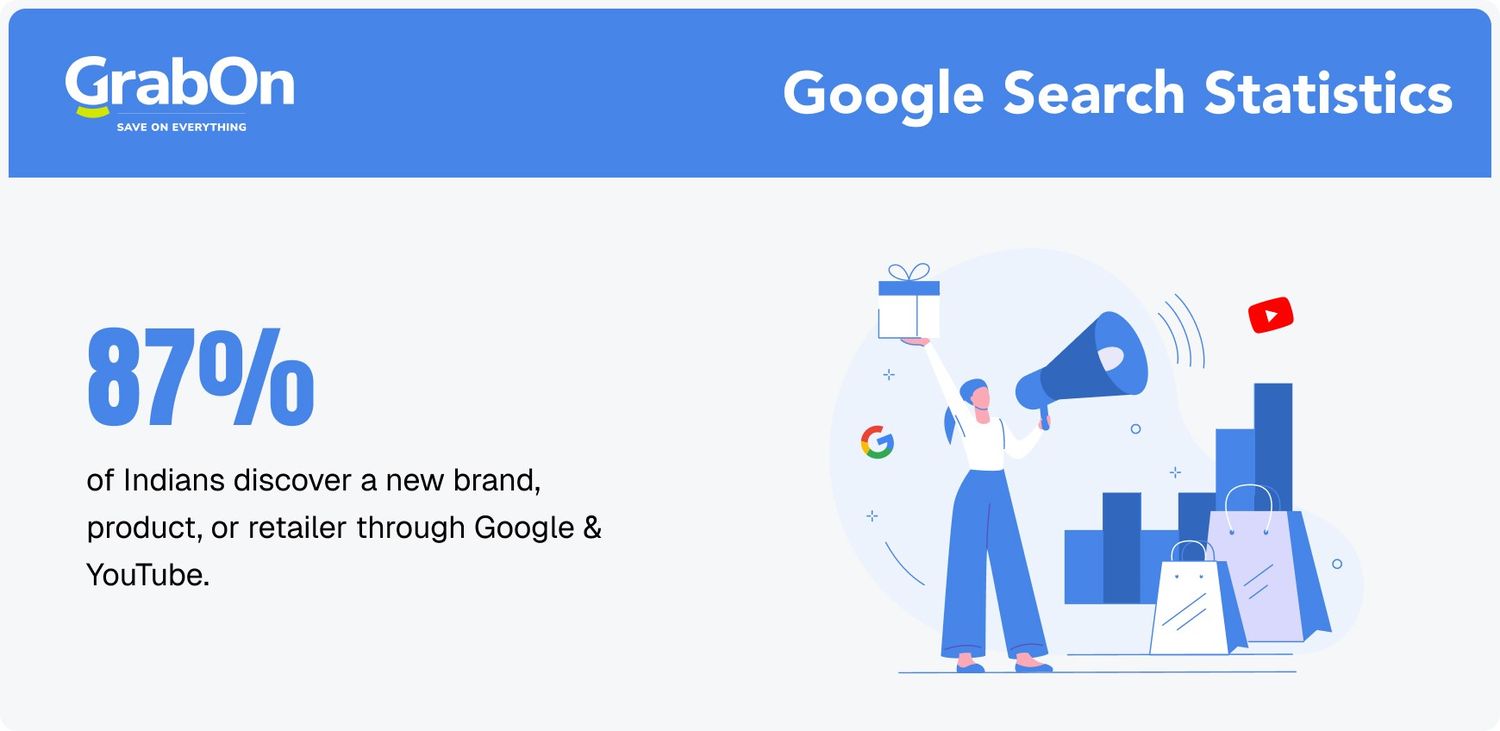
- 87% of Indian consumers say they discovered a new brand, product, or retailer on Google and YouTube. The platform is still the most influential tool in the shopping funnel, from awareness and comparison to decision-making.
Google confirms that AI tools such as Google Lens, AI Overviews, and AI Mode are opening up new ways to explore information.
For Indian businesses, that makes a fast, findable website the starting point for being discovered. Small businesses setting up their first site can use our Hostinger discount codes to reduce set-up costs.
- AI Overviews alone have led to a 10% increase in the types of queries showing these results in major markets like India and the US.
With the rollout of AI Overviews, commercial query volume has significantly increased. - Google states that 15% of searches made every single day are completely new, highlighting how diverse and ever-changing user needs are.
- Google’s research has shown that when people discover products on social media, 70% of them still turn to Google Search to evaluate, compare, and validate those products before making a decision.
- Over 80% of Google Search ad spend comes from users exploring new information rather than searching for specific websites. This shows that people use Google mainly to discover and evaluate new brands or products.
(Source: Google Blog, Think with Google)
AI Adoption and Search Behaviour of Google
- Google reports a 10% increase in query types that display AI Overviews in major markets such as India and the US. The rollout of AI Overviews has also led to an increase in commercial search volume, indicating higher engagement with product-related queries.
AI features like Google Lens, AI Overviews, and AI Mode are introducing new ways of searching apart from typed queries.
- AI Overviews reach over 2 billion people each month, helping users engage more and make detailed, multi-step searches.
- Google Lens is used for more than 20 billion visual searches every month, and nearly one in four of those visual searches carries commercial intent.

(Source: Google Blog, Think with Google)
Google Search Volume and Global Usage
- Google processes more than 5 trillion searches every year, making it the world’s largest search platform by search volume. This equals roughly 13.7 billion searches per day.
- Google receives approximately 32.56 million visits per month, reflecting strong recurring usage.
- 83.90% of users access Google Search from PCs or laptops, while 16.10% use the platform from mobile phones.
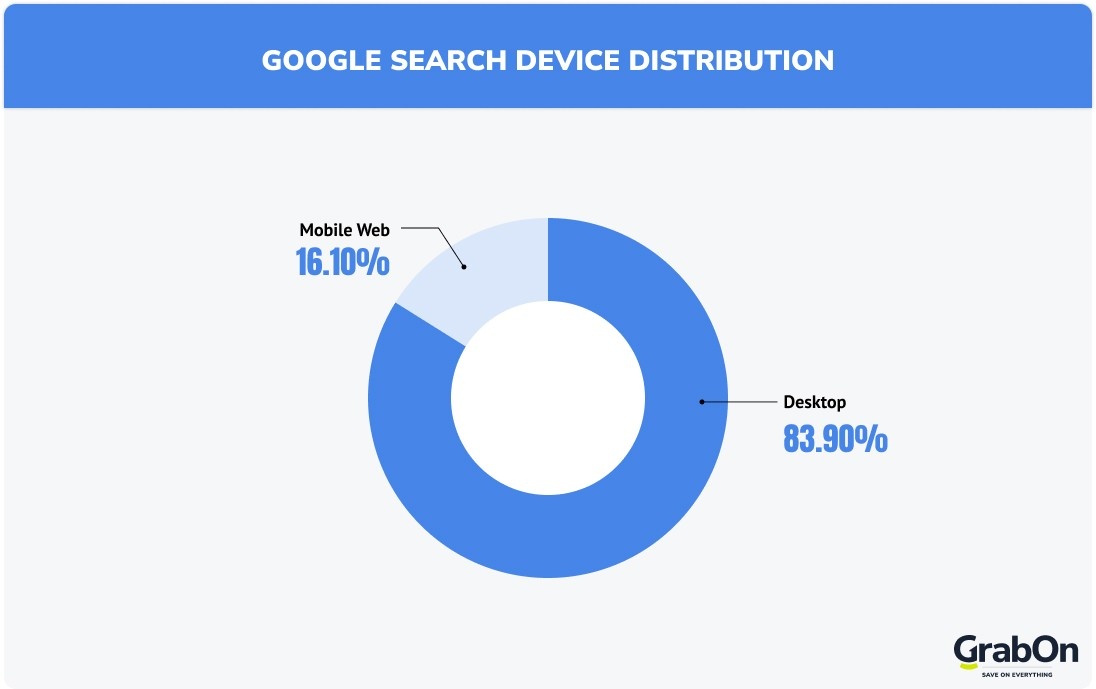
This breakdown emphasizes that despite the mobile revolution, desktop search continues to play a crucial role, especially for work, research, and long-form content.
(Source: Google Blog, Similarweb)
Global Search Engine Market Share (2026 Data)

- Google has a 91% market share in the search engine industry in 2026. This is followed by Microsoft Bing with a 4.6% market share.
- Yahoo holds 1.2% of the global desktop search engine market share in 2025.
- Yandex accounts for 0.8% of the market, maintaining a strong presence in Russia and surrounding regions.
- DuckDuckGo has a 0.7% share, driven by users seeking privacy-focused, no-tracking search experiences.
- Baidu has 0.4% of the global share, as its usage is primarily concentrated within China’s internet ecosystem.
| Search Engine | Market Share |
| 91% | |
| Bing | 4.6% |
| Yahoo | 1.2% |
| Yandex | 0.8% |
| DuckDuckGo | 0.7% |
Geographic Reach of Google Search
- The United States contributes the highest share of Google search traffic at 16.22%, followed by India at 8.75%, reflecting the country’s rapidly growing digital adoption.
- Japan generates 8.24% of the Google search traffic, highlighting strong digital adoption.
- France contributes 4.62% of overall Google search traffic, driven by high search engagement across devices.
- Germany accounts for 4.05% of global traffic, maintaining its position among the top five sources.
Top Countries Driving Google Search Traffic
| Country | Traffic Share |
| United States | 16.22% |
| India | 8.75% |
| Japan | 8.24% |
| France | 4.62% |
| Germany | 4.05% |
(Source: Similarweb)
Google Revenue Insights
- Google generated $348.16 billion in revenue in 2024, marking a record year for the company.
Most of this revenue came from advertising, with search ads continuing to be Google’s strongest revenue driver.
These figures reaffirm Google’s dominance in digital advertising, especially through query-based intent marketing.
(Source: Statista)
Interesting Facts About Google
- Larry Page and Sergey Brin built Google’s first server storage rack out of colorful LEGO pieces because it was cheap, expandable, and easy to modify.
- Google was originally named “BackRub.” The founders chose this name because the engine analyzed backlinks to rank websites. It was renamed “Google” in 1997.
- The name “Google” came from a misspelling. It was meant to reference the word “googol,” which means 1 followed by 100 zeros. This represented the huge amount of information the search engine aimed to organize.
- Google’s homepage is simple because the founders didn’t know HTML.
- In 2009, Google hired approximately 200 goats to graze and naturally trim grounds at its Mountain View, California headquarters.
- Scientists discovered a previously undocumented rainforest in Mozambique through satellite images on Google Earth.
Frequently Asked Questions
How do you reset your Google searches?
To reset your Google searches, you can clear your search history by going to your Google Account’s “Data & Personalization” section, then navigate to “My Activity,” where you can delete search activity by date or entirely. You can also clear your browser cache and cookies to remove saved search data and reset personalized results.
How to search Google with an image?
To search Google with an image, use Google Images and click on the camera icon in the search bar. You can either upload an image from your device or paste an image URL, and Google will find visually similar images and related information based on the image content.
What are the latest updates in search engine algorithms that impact SEO?
Google’s latest algorithm updates focus heavily on improving content quality, reducing spam, and supporting AI-driven search results. Recent core and spam updates place stronger emphasis on helpful, user-focused content, while reducing the influence of low-quality backlinks and third-party “parasite” pages.
User experience factors like Core Web Vitals, site speed, and mobile performance matter more than ever. With the rise of AI Overviews and AI Mode, Google is also reshaping how results are displayed, meaning sites must optimise for conversational, structured, and intent-driven queries to stay visible in search.