
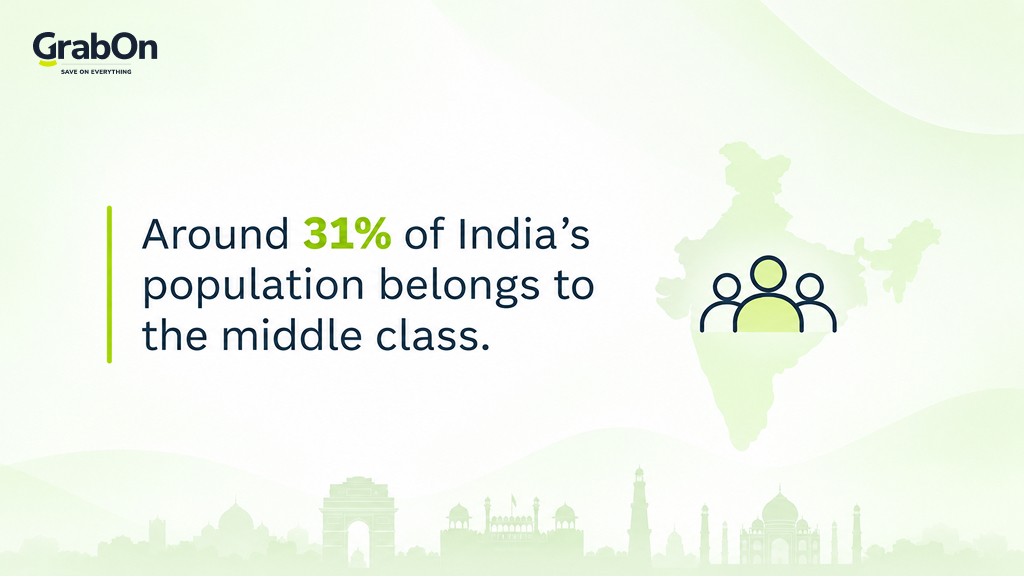
India’s middle class is becoming one of the country’s biggest economic drivers. Rising household incomes, better access to financial services, urbanization and changing consumer preferences are reshaping how millions of Indians earn, save and spend. According to a 2026 government estimate, the middle class accounts for around 31% of India’s population and has grown at an annual rate of 6.3% between 1995 and 2021.
Its influence is expected to expand further, with middle-class and affluent consumers projected to drive 93% of India’s spending by 2036. However, rising household debt, uneven salary growth and inflation continue to affect purchasing power.
Middle Class India Statistics 2026 (Editor’s Picks)
- India’s middle class accounts for roughly 31% of the country’s population.
- India’s middle-class population grew at an annual rate of 6.3% between 1995 and 2021.
- India has an estimated 184 million middle-class households in FY26, including 110 million lower-middle-class and 74 million upper-middle-class households
- Middle-class and affluent consumers accounted for an estimated 80% of India’s spending in 2026, a share projected to reach 93% by 2036.
- The number of tax returns filed by individuals earning between ₹10 lakh and ₹50 lakh in salary income increased sevenfold between FY13 and FY23.
- Household debt reached 45.5% of India’s GDP by September 2025
Sources: Press Information Bureau, NSE Prospectus, WEF, Hindustan Times, RBI.
How Big Is India’s Middle Class in 2026?
India’s middle class has expanded significantly over the past three decades. According to a June 2026 PIB backgrounder, the segment accounts for approximately 31% of India’s population and grew at an annual rate of 6.3% between 1995 and 2021.
More recent household income estimates also point to a shift towards middle- and higher-income groups. Data from the National Stock Exchange’s September 2026 Red Herring Prospectus estimates that India had 184 million middle-class households in FY26. This includes 110 million lower-middle-class households and 74 million upper-middle-class households.
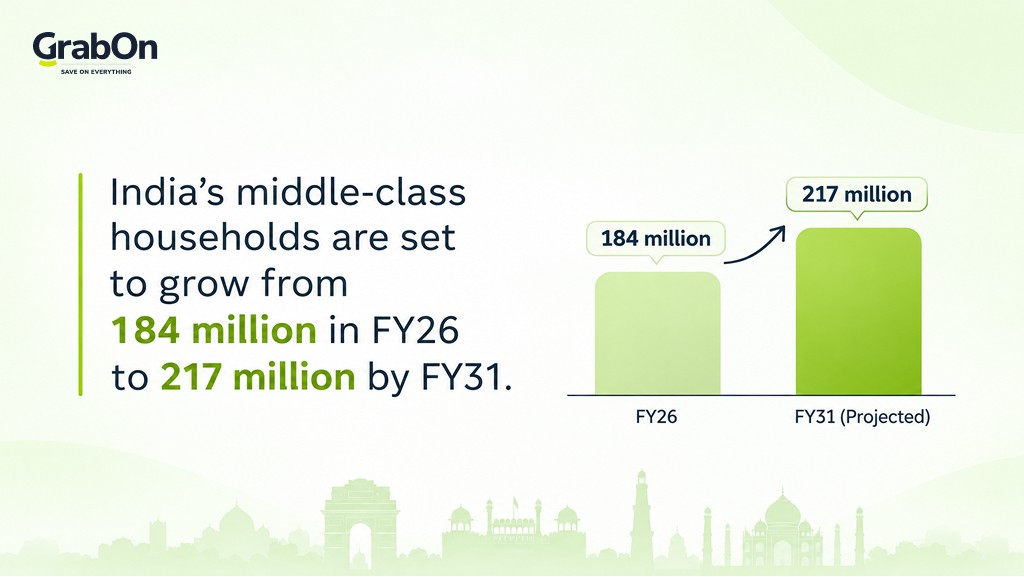
The same research projects that the number of middle-class households will increase to 217 million by FY31, indicating a continued shift towards higher household income brackets.
India’s Middle-Class Household Growth
| Income group | FY26 | FY31 (projected) |
| Lower middle class (₹3–8 lakh annually) | 110 million households | 119 million households |
| Upper middle class (₹8–10 lakh annually) | 74 million households | 98 million households |
| Total middle class | 184 million households | 217 million households |
Source: NSE Red Herring Prospectus, September 2026
These estimates suggest that India’s middle-class segment will continue to expand over the next five years. However, the projected increase in households should not be confused with an equivalent increase in the number of middle-class individuals.
What Is Considered Middle Class in India?
There is no single official income threshold for India’s middle class. Different research organizations use different household income ranges, which is why the estimates vary.
RedSeer’s classification in the September 2026 NSE prospectus puts middle-class households in the ₹3 lakh to ₹10 lakh annual income range.
| Income category | Annual household income |
| Low income | Below ₹3 lakh |
| Lower middle class | ₹3 lakh–₹8 lakh |
| Upper middle class | ₹8 lakh–₹10 lakh |
| High income | Above ₹10 lakh |
Based on this classification, India had 184 million middle-class households in FY26, including 110 million lower-middle-class and 74 million upper-middle-class households. The number is projected to reach 217 million by FY31.
Source: NSE prospectus
What Is the Average Income of India’s Middle Class?
India’s middle-class households earn between ₹3 lakh and ₹10 lakh annually, or approximately ₹25,000 to ₹83,333 per month, according to RedSeer research cited in the NSE’s September 2026 prospectus.
The research estimates that 110 million households belonged to the ₹3 lakh–₹8 lakh lower-middle-class segment in FY26, while 74 million households were in the ₹8 lakh–₹10 lakh upper-middle-class segment. Together, these groups accounted for 184 million households.
The number of households earning ₹8 lakh–₹10 lakh annually is projected to increase from 74 million in FY26 to 98 million by FY31. The lower-middle-class segment is also expected to expand from 110 million to 119 million households over the same period.
India’s Household Income Distribution
| Income group | FY26 | FY31 (projected) |
| Below ₹3 lakh | 119 million | 98 million |
| ₹3 lakh–₹8 lakh | 110 million | 119 million |
| ₹8 lakh–₹10 lakh | 74 million | 98 million |
| Above ₹10 lakh | 46 million | 64 million |
| Total households | 349 million | 379 million |
Source: NSE Red Herring Prospectus, September 2026
The estimates point to a gradual shift towards higher household income groups, with the combined number of lower- and upper-middle-class households projected to rise from 184 million in FY26 to 217 million by FY31.
How Has India’s Salaried Middle Class Grown?
An analysis published in Hindustan Times defines India’s salaried middle class as individuals earning between ₹10 lakh and ₹50 lakh annually. Using Income Tax Department statistics for FY13 and FY23, the analysis examined how this income group grew and how its earnings changed over the decade.
The analysis found that:
- The number of income-tax returns filed by this group increased approximately sevenfold between FY13 and FY23.
- The group’s share of total salary income increased from just over one-fourth in FY13 to almost half in FY23.
- Average salary income within this group rose from ₹16.86 lakh in FY13 to ₹17.33 lakh in FY23, representing less than 3% growth over the decade.
Despite the sevenfold increase in the number of returns filed, average salary income in this group barely changed. This points to a gap between the growing number of people entering higher salary brackets and the actual growth in their earnings.
Source: Hindustan Times
How Much Does India’s Middle Class Spend?
India’s middle-class and affluent consumers accounted for an estimated 80% of the country’s total spending in 2026, according to the World Economic Forum’s February 2026 report. Their share is projected to reach 93% by 2036, highlighting their growing influence on India’s consumer economy.
The government’s Household Consumption Expenditure Survey (HCES) provides additional context on how much Indian households spend each month.
The latest completed survey available is HCES 2023–24, which covered 261,953 households across rural and urban India. It reported an average monthly per capita consumption expenditure (MPCE) of:
| Area | Monthly per capita consumption expenditure |
| Rural India | ₹4,122 |
| Urban India | ₹6,996 |
When the estimated value of free goods and services received through government welfare schemes is included, the figures increase to ₹4,247 for rural households and ₹7,078 for urban households.
These figures cover all household income groups and are not specific to the middle class. However, they provide a useful benchmark for understanding India’s broader consumption economy.
Source: MoSPI’s HCES 2023–24 report.
How Much Does India’s Middle Class Borrow?
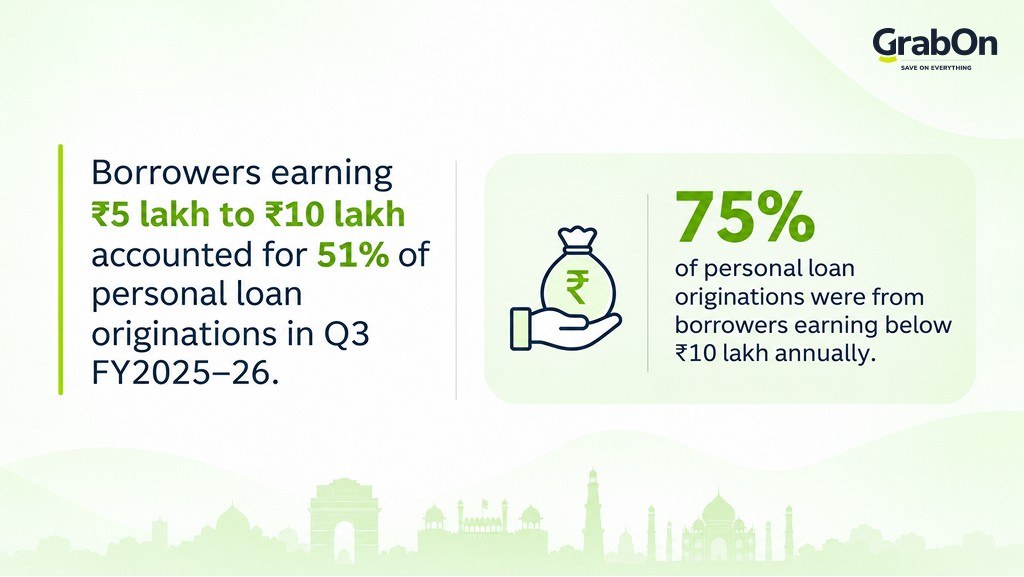
Households earning ₹5 lakh to ₹10 lakh annually accounted for 51% of personal loan originations in Q3 FY2025–26, making this the largest income group among borrowers in the RBI’s analysis. Borrowers earning below ₹5 lakh accounted for another 24%.
| Borrower income | Share of personal loan originations |
| Below ₹5 lakh | 24% |
| ₹5 lakh–₹10 lakh | 51% |
| ₹10 lakh–₹15 lakh | 15% |
| ₹15 lakh and above | 8% |
| Income not available | 2% |
Borrowers earning below ₹10 lakh accounted for 75% of personal loan originations. This shows where unsecured personal lending is concentrated by income, although it doesn’t mean 75% of the middle class has a personal loan.
Source: RBI, Financial Stability Report, June 2026.
Where Is India’s Middle-Class Consumer Base Growing?
India’s urban consumer growth is increasingly spreading beyond its largest metropolitan areas. According to a February 2026 report by the World Economic Forum (WEF), 93% of India’s urban consumer-class growth through 2040 is expected to take place outside its five largest cities: New Delhi, Kolkata, Mumbai, Bengaluru and Chennai.
The report also projects that India will have 499 consumer cities by 2035, more than twice the number expected to meet this definition today. A consumer city is one where at least 75% of the population belongs to the consumer class, defined as people spending at least $13 per person per day.
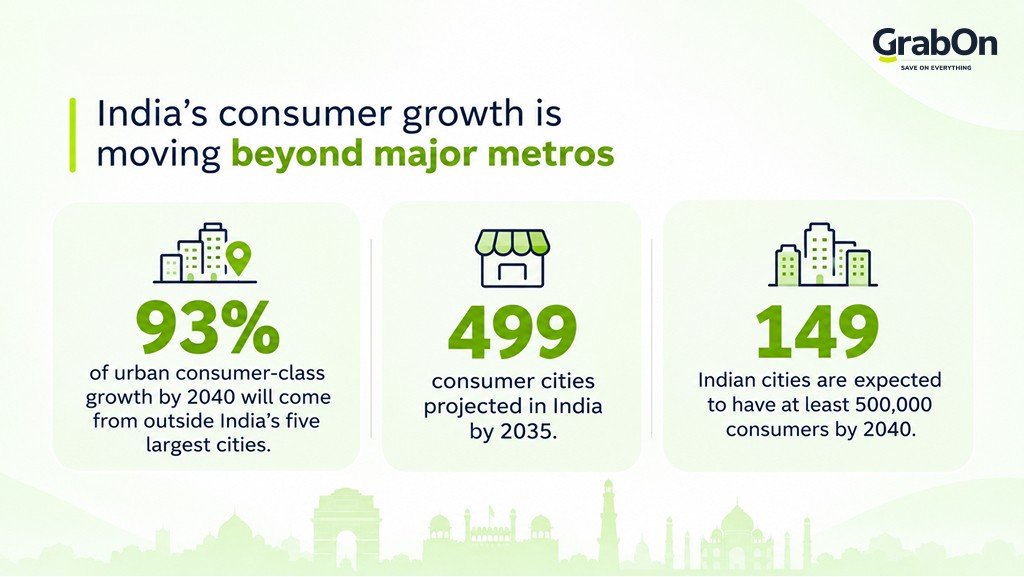
By 2040, 149 Indian cities are projected to have at least 500,000 consumers, compared with 53 in the United States and 112 in Europe.
These projections point to a growing consumer market beyond India’s largest metropolitan areas, creating opportunities for retailers, e-commerce companies and consumer brands to reach customers in smaller urban centers.
Source: World Economic Forum
Is India’s Middle Class Facing an Employment Challenge?
A college degree doesn’t always translate into a stable job for India’s young workforce. According to Azim Premji University’s State of Working India 2026 report, 39.3% of graduates under 25 were unemployed in 2023, compared with 20% among graduates aged 25–29.
The report also found that the growth in India’s graduate population has outpaced graduate employment. Between 2004–05 and 2023, around 5 million graduates were added each year, but only 2.8 million found employment annually. A smaller share entered salaried jobs.
These figures reflect a growing challenge for young Indians pursuing the traditional path to financial stability through higher education and salaried employment.
Source: Azim Premji University, State of Working India 2026
What Is the Future of India’s Middle Class?
India’s middle class is expected to expand significantly over the next decade, supported by urbanisation, rising household incomes, financial inclusion and wider access to consumer services.
According to the Finance Ministry, India is expected to overtake China in terms of middle-class population between 2030 and 2035, based on OECD projections.
The NSE’s September 2026 prospectus also projects that India’s middle-class households will increase from 184 million in FY26 to 217 million by FY31. The upper-middle-class segment is expected to contribute to this expansion, with households earning ₹8 lakh-₹10 lakh annually projected to increase from 74 million to 98 million.
The consumer economy is also expected to become more geographically diverse. According to the World Economic Forum, 93% of India’s urban consumer-class growth through 2040 will take place outside the country’s five largest cities. By 2035, nearly 500 consumer cities are expected to emerge across India.
However, the long-term growth of India’s middle class will depend on more than population expansion. Sustained wage growth, employment opportunities, affordable housing, manageable household debt and access to quality healthcare and education will also influence how much purchasing power households gain.
Sources: PIB, NSE Prospectus, September 2026, World Economic Forum.
FAQs
What percentage of India’s population belongs to the middle class?
Approximately 31% of India’s population belongs to the middle class, according to the Press Information Bureau. The estimate is based on the government’s cited historical growth data.
How many middle-class households are there in India?
India has an estimated 184 million middle-class households in FY26, according to RedSeer research cited in the NSE’s September 2026 prospectus. This includes 110 million lower-middle-class households and 74 million upper-middle-class households.
What percentage of India’s spending comes from the middle class?
Middle-class and affluent consumers accounted for an estimated 80% of India’s spending in 2026. Their contribution is projected to reach 93% by 2036, according to the World Economic Forum.
Which cities will drive India’s middle-class consumption growth?
Tier-2 and Tier-3 cities and other emerging urban centers are expected to contribute significantly to India’s customer growth.